Congested roads, litigation hike up R.I. auto insurance rates
It’s no secret: Rhode Islanders pay a lot for auto insurance. Year after year,
surveys put the state’s premiums among the highest in the nation. Most recently,
the National Association of Insurance Commissioners, using 2001 data for full
coverage (liability, collision and comprehensive), ranked Rhode Island fourth,
with an average annual premium of $1,027.03, almost 26 percent more than the
$817.43 national average.
But if Massachusetts, which is also always near the top of the list, can launch reforms expected to reduce rates by attracting more insurers and encouraging competition, could Rhode Island do it too?
A modernized health plan: Supporting cost management and the employee experience.
The Surest health plan came from a group of innovators wondering: What if health care…
Learn More
Actually, no, insiders say. Because unlike Massachusetts, Rhode Island already has a highly competitive auto insurance market, with more than 100 companies offering coverage, compared with only 19 in Massachusetts.
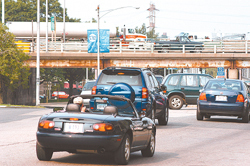
Both states’ rates are high, to a great extent, because they’re very urban and congested, as are New Jersey, New York, the District of Columbia and Connecticut, the other most-expensive states in the nation. More cars on the roads mean more accidents.
State-by-state accident figures aren’t kept in the same way as crime data, but an analysis of 2000 claims by the Insurance Research Council showed Rhode Islanders filed 5.17 property-damage claims per 100 insured cars, and 1.84 bodily injury claims, third and fourth in the nation, respectively. Massachusetts topped both lists, with 6.88 property-damage claims and 2.22 injury claims per 100. The national averages were 4.13 and 1.11.
And Rhode Island has another kind of congestion that pushes its insurance rates even higher: “an exceptional amount of lawyers,” as Bill Warburton, Rhode Island president of USI New England, a large insurance broker, put it.
Paula Pallozzi, chief property and casualty insurance rate analyst at the state Department of Business Regulation, said “Rhode Island is quite a litigious state,” with lawyers quickly jumping in when someone’s hurt. The laws encourage that, she added: Rhode Island is a tort state, where disputes over who’s at fault in an accident are meant to be resolved in court, and it also has a “very unique” law that requires the losing party to pay back interest on any judgment from the day of the loss.
“That’s pretty big,” she said. Legislation to change that is introduced year after year, she added, but it never passes, “so apparently the trial lawyers are hard at work.”
In fact, Pallozzi and Warburton said, for years insurers in Rhode Island paid out more in claims than they collected in premiums, only making a profit because they were making money in the stock market.
“When they were seeing investment returns, they didn’t see a need to seek rate relief,” Pallozzi said. “Once the stock market turned around, they did come and do that.”
Under Rhode Island law, premiums are suggested by the insurers and submitted to the Department of Business Regulation, which makes sure they are “actuarially supported,” Pallozzi said – meaning they reflect actual costs for different kinds of drivers.
There’s no specific cap for how much profit an insurer can make, though rates can’t be “excessive, inadequate or unfairly discriminatory,” and a 5 percent to 6 percent profit is typical, Pallozzi said. As for annual increases, this year the General Assembly approved a new law that said a 5 percent change in a single year could be deemed reasonable; insurers had sought to make it 12 percent but the DBR objected.
In terms of road conditions, the prospects for lower insurance rates aren’t good.
Edmund T. Parker Jr., chief engineer for the state Department of Transportation, said many of the infrastructure problems that cause congestion – and accidents – in Rhode Island can’t really be fixed, and will probably get worse over time.
Route 95, for example, was built around urban landmarks that couldn’t be moved, resulting in unusually sharp curves, and has too many on-ramps and off-ramps, because everyone wanted easy access, Parker said.
And as suburban and rural development has increased, “we’ve seen drastic increases” in traffic on those areas’ roads, Parker said. The Route 4/Route 1 corridor to South County, for example, was built for 6,000 cars a day. It now carries more than 40,000.
Making Rhode Island’s roads safer, wider and straighter is certainly a priority for the DOT, Parker said, but there’s only so much that can be done in a heavily built-up state, and even when it is possible, there’s a balance to be struck between safety and preserving open space and existing buildings.
As Rhode Island’s elderly population grows, Parker said, that will also contribute to higher accident rates. There are strategies that can help, he said, such as using bigger letters on road signs, and to compensate for older people’s reduced night vision, use more reflective letters, better road stripes and more street lighting.
Drivers could do their part, too, Parker said: Don’t drink and drive; buckle up; get off that cell phone; stop eating. In short, pay attention.
“Most accidents are the result of driver inattentiveness,” he said.