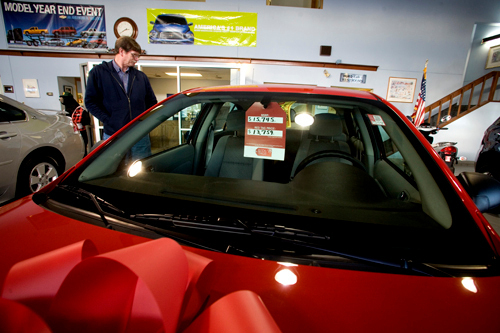
Chris Hurd is breathing a sigh of relief, at least for the moment.
As the owner of Hurd Auto Mall in Johnston, Hurd oversees 15 acres, three showrooms and an inventory of 1,000 General Motors vehicles that hadn’t exactly been zooming off the lot lately.
Sales had been so slow, Hurd resorted to cost-cutting moves such as turning down the thermostats and making sure the lights on the lots are off when they’re not needed.
But in a sudden spurt of buying, the dealership sold about 125 cars between Christmas and the first weekend in January. And things haven’t slowed much since then. “That’s a pace I haven’t seen in a long time,” Hurd says.
Why the increased activity? Because GMAC, the financing affiliate of General Motors, accepted more than $5 billion from the federal government late last month in exchange for preferred shares of the company. With the cash infusion, GMAC in turn eased tougher lending standards it put into place a few months ago.
The stronger flow of credit combined with the prospect of good deals apparently attracted people to GM dealers nationwide. And Hurd was no different.
On weekends earlier this month, Hurd said, his 20 salespeople were swamped with prospective buyers. “I think a lot of people had put their buying aspirations on the shelf last year,” Hurd said recently. “It’s been pent up.”
But the increased interest at GM dealerships is far from a signal that the auto industry’s doldrums have ended. According to figures released earlier this month, U.S. auto sales were down 36 percent in December from the year-ago levels.
Leading the dismal performance was Chrysler, which said its December sales were off by 53 percent from a year ago. Ford and GM said their declines were 32 percent and 31 percent, respectively.
Foreign automakers weren’t immune, with Toyota reporting a 37 percent drop, while Honda and Nissan posted 35 percent and 31 percent declines, respectively.
Even on the vehicles that have sold, profit margins have narrowed significantly as automakers and dealers have grown more desperate to move inventory, particularly SUVs and trucks.
Edmunds.com, which tracks the auto industry, reported that the average manufacturer incentive in the United States was $2,902 per vehicle sold in December, up $221 – or 8.2 percent – from November and $443 – or 18 percent – from December 2007. Zero percent financing is also more common.
Hyundai Motor America is even offering to let buyers return a car within one year free of charge without damaging their credit if they can’t make the payments because of circumstances beyond their control, such as being laid off.
The situation has turned President’s Day weekend in February – traditionally a time that auto dealers and manufacturers offer the best incentives and rebates to clear out their stock – into almost an afterthought.
Several local dealers say they don’t have any special marketing campaigns planned this year, adding that they don’t foresee the deals getting much better.
“Washington’s birthday is now,” said Bob Tasca Jr., president of Tasca Auto Group.
Times, indeed, have been tough for most local dealers for the last year.
Jack Perkins, executive vice president of the Rhode Island Automobile Dealers Association (RIADA), said five new-car lots have closed since December 2007, three of them since fall, and all them associated with domestic carmakers.
While 60 dealerships remain, Perkins foresees more closures and consolidations as older franchise owners drop out of the business and fewer younger people are willing to take over in the face of an industry decline.
Last week, GM said it might shed as many as 500 dealers this year as it attempts to cut 1,700 of its existing 6,400 dealerships nationwide by 2012. The automaker also is considering selling the Hummer and Saab brands and is weighing options for Saturn and Pontiac.
In this environment, many dealers have resorted to layoffs to survive. At Shannon Motors, a used-car lot in Johnston, owner Gary Gosselin has been forced to let go 11 of his 36 employees in recent months as sales have plummeted.
In addition to layoffs, Gosselin has slashed his advertising budget and pulled his cable TV ads.
He blamed the tightening of the credit market for much of Shannon Motors’ problems.
Sales financed by traditional lenders have dropped by 75 percent year over year as banks that once allowed no-documentation loans have raised credit standards beyond the range of many of his customers.
Gosselin’s in-house financing company is picking up some of the slack, but more and more he is seeing people with credit reports marred by things like mortgage foreclosures.
“Because it was easy in the past to get a loan, they still come in,” he said.
Bob Tasca Jr., who oversees an inventory of about 1,000 cars at Ford dealerships in Cranston and Seekonk, said sales figures for new cars are down about 15 percent from this time last year.
As a result, the company has cut its advertising budget by about 20 percent and reduced its personnel, too.
Tasca, whose family has been selling cars for well over 60 years, said the auto industry hasn’t suffered this badly since the oil embargo in the early 1970s and the energy crisis of 1979. But this time, it’s different, he said.
“There are so many things coming together,” he said. “Right now, there’s not a lot of room for mistakes.”
For instance, Tasca said, some dealers would like to trim their inventory to reduce their exposure during the decline in sales. But a lack of selection might convince fickle customers to go somewhere else.
Some new-car dealers report a bright spot in their used-car segment.
Tasca said his “preowned” car sales are up 20 percent over last year. While that doesn’t make up for the drop in new-car sales, “I’d rather be selling something than nothing,” he said.
The story is similar at Fox Toyota. General Manager Kevin Walton said sales of new Toyotas have dropped by about 10 percent, but the number of people buying less-expensive used cars has increased slightly.
“Those people are buying because of a need not because of a want,” he said.
Perkins, the executive vice president for RIADA, said there were some hopeful signs for the industry, particularly the domestic automakers, at the Northeast International Auto Show at the R.I. Convention Center, which ran Jan. 8-11.
Perkins said the show was well attended – although he didn’t have specific figures – before snowy weather arrived, and the 2010 models of domestic cars attracted the most attention.
“[The automakers’ top executives] went to Washington and stated how great the product is now, and people wanted to see what they were talking about.”
Exhibitors also spent much of the weekend reassuring visitors that financing is available at the new-car dealerships, and it isn’t too difficult to qualify for.
That might explain why consumers showed up at Hurd Auto Mall earlier this month on the news that GMAC would offer loans to borrowers with credit scores of 621 – just above what would be considered a subprime loan – instead of the previous minimum score of 700.
The increased activity was enough to raise the optimism of Hurd.
“I’m hopeful for 2009,” he said. “The first quarter is going to be an attractive time to be in the market for a car.” •