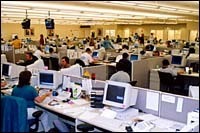
find temporary quarters at
FleetBoston in Lincoln.
In the wake of this month’s terrorist attacks, few economists doubt that the national disaster will dampen consumer spending. The only question seems to be whether the slowdown will nudge the economy into a recession.
If it does, Rhode Island’s economy won’t be spared, economists say.
For Leaders Who Don't Have Time to Get Sick
Top performers guard their calendars, delegate relentlessly and optimize every hour of the day. Health,…
Learn More
Gary Ciminero, an economist and acting executive director of the Rhode Island House Policy Office, said the state’s economic outlook won’t deviate much from the rest of the country. So what’s his forecast for the national economy?
“I think it will be an acute, nasty decline, but I don’t think it will be a chronic decline,” Ciminero said.
Prior to the terrorist attacks on the Pentagon and New York’s World Trade Center, Ciminero had expected economic growth to flatten. Now, he expects the economy to contract slightly in the third quarter, followed by an even deeper drop in the fourth quarter.
The culprit: A severe decline in consumer confidence, which will be exacerbated by pervasive layoffs. In Rhode Island, Ciminero predicts jobs – which he had forecast to grow slightly – will now shrink.
“This will be the worst Christmas season in terms of consumer spending in two decades,” Ciminero said. He said he expects the country to slip into recession – defined as at least two consecutive quarters of decline in the gross domestic product – by the end of the year, lasting at least through the second quarter of 2002.
William B. Sweeney, a professor of economics at Bryant College, also foresees a recession, but he agrees that it will be short-lived.
“The biggest single concern for me is how these attacks will impact consumer optimism,” Sweeney said. “Will confidence drop further? I think it will in the short term, and that’s what will push us over the cliff and into recession.”
Rhode Island’s economy will suffer the same fate, Sweeney said, although the state should show “a little more stability” because of the recent influx of service jobs, which have replaced more-vulnerable manufacturing jobs. Although sectors such as tourism will sag, other service sectors, such as restaurants and financial services, will fare better, he said.
Still, consumers are likely to trim spending because of the cloud of uncertainty unleashed by the attacks and the threat of layoffs, Sweeney said.
“If I think my job might be in jeopardy, I’m not going to buy that new car,” Sweeney said.
That mentality also could plague Rhode Island’s housing market, which has been “the one big bright spot” for the state’s economy. Lofty housing prices coupled with low consumer confidence is a bad combination for the housing market, which both Sweeney and Ciminero say could turn sour.
Several factors, however, might converge to soften the expected economic downturn. Chief among them is massive spending by the federal government, which took swift action to prevent the terrorist attacks from collapsing the economy.
Since September 11, the Federal Reserve Board has injected more than $100 billion into the U.S. banking system. It also cut interest rates by a half percentage point last week.
And several industries are poised for growth as a result of the attacks, including data storage and construction.
“Much of lower Manhattan will have to be rebuilt, and that could stimulate the economy somewhat,” said George Borts, a professor of economics a Brown University.
Defense should see a boost too. Cruise-missile maker Raytheon’s stock shot up 27 percent on Sept. 17, the first day of trading after the attacks.
But overall, investors reacted by sending the Dow Jones Industrial Average down nearly 685 points, its biggest one-day drop ever. The loss in percentage terms was 7 percent – better than many analysts had predicted – but the market continued to drift lower in mid-week.
“I don’t think the average investor is panic selling like people were concerned about,” Chad White, executive vice president at the Providence brokerage firm Barrett & Company, said last week. “Over the next few weeks, I think we’ll see some opportunities to buy.”
White says the Fed’s moves should buffer the market in coming months.
“The liquidity that’s been pumped into the economy will serve as a big stimulant,” White said. “Looking six to 12 months out, we’re bullish.”
The market has history on its side, too, according to Frederick J. Harkins, an investment representative at the Providence office of Edward Jones, a financial services firm that caters to individual investors and small businesses.
The market historically has dipped in the weeks following national tragedies. But invariably, it snaps back, Harkins said.
During the two months after the start of the Cuban missile crisis, the Dow lost 9.4 percent, only to gain 28.7 percent during the subsequent six months, according to Edward Jones. In the weeks after the onset of the Persian Gulf War, the Dow sank 4.3 percent, but rose 18.7 percent over the next six months.
“Investors who are well diversified and have a long-term perspective aren’t going to have any problems,” Harkins said. “Long term, things are going to come right back up.”
(Photo by Brian McDonald)