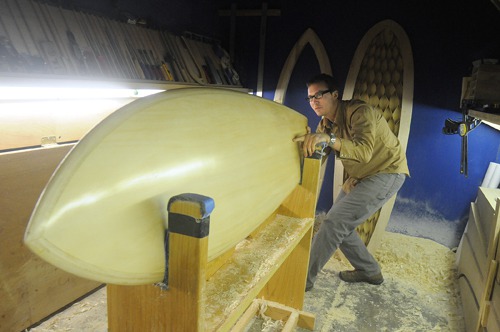
With the help of a $10,000 micro-business loan from the R.I. Economic Development Corporation, Kevin Cunningham hopes to carve out a niche in the $150 million national market for manufacturing surfboards.
In many ways Cunningham, a 2005 Rhode Island School of Design graduate in architecture, is a poster boy for the state’s newfound emphasis on small-business creation – and especially helping young entrepreneurs create businesses and jobs in green, sustainable industries here in Rhode Island.
Yet EDC Deputy Director J. Michael Saul says the state’s Small Business Loan Fund has only about $630,000 available for lending in the $13 million fund, given commitments and reserves needed to operate the fund.
Keith W. Stokes, the new EDC director, recently asked the Rhode Island congressional delegation to create a legislative earmark of $5 million to recapitalize the fund, according to Saul. “It’s a brand new request,” Saul said. The EDC would like to see the money by Oct. 1, 2010 (the beginning of federal fiscal year 2011).
U.S. Rep. James R. Langevin, D-R.I., is weighing the merits of EDC’s request. “Small businesses are the backbone of our state’s economy, and we must work together on solutions to ease their access to capital,” Langevin said.
Similarly, the state’s Micro-Business Emerging Growth Fund, set up in 2005 with $1 million as an allocation within the larger small-business loan fund, now has only about $120,000 left to lend to startups.
Since 2005, the state has closed 30 micro-business loans, totaling $880,000, according to Meaghan Wims of Duffy & Shanley, a public relations consultant working with the EDC.
But in the last two years only two micro-business loans have been made – $30,000 in July 2008 to A Family Tree, a child-care business in Warwick, to help with a down payment to buy a building and expand operations, and $10,000 last month for Cunningham’s environmentally friendly surfboard-manufacturing company.
Since the beginning of 2009, however, according to the EDC, the lack of resources has caused between 20 to 30 potential applicants to be referred to two new micro-business lending options – SEED, the Southeastern Economic Development Corp., which provides micro-loans via the U.S. Small Business Administration, and ACCION USA – because they “have better funding than we do,” said Sean Esten, the financial portfolio manager.
For the last two EDC micro-loan recipients, at least, the funding is doing the one thing on which most state business and political leaders have agreed is crucial to turning the economy around – growing small businesses in Rhode Island.
From his cubbyhole in a woodworking shop in Conley’s Wharf on Allens Avenue in Providence, Cunningham designs and manufactures surfboards for his startup company, Spirare Surfboards, established in 2009. “I make functional art – art that is designed to get wet,” he said.
His “just-me operation” is still a night and weekends business, as he continues to work his day job as a construction manager in Framingham, Mass. His wooden surfboard designs, however, have attracted the attention of the Nike 6.0 surfing team members, Coco Ho and Carissa Moore, a surfer and documentary filmmaker who is planning to feature Spirare’s surfboards in an upcoming film, Cunningham said.
“It’s a pretty big deal,” Cunningham continued, “to get a professional-level surfer on your boards. … A cover shot in a surfer magazine, that’s going to create a huge influx of interest.”
He currently manufactures three environmentally friendly surfboard models: recycled foam, which retails starting at about $600; a wood and recycled foam composite, which runs between $800 and $1,200; and a wood honeycomb, which starts at $1,500.
When he applied for loan support from the EDC, Cunningham said, coming from an art school, he had never done a business plan before. He says the EDC staff was helpful in preparing the financials. His three-year, $10,000 loan is at 6.25 percent.
Ironically, Cunningham also received help from a $5,000 fellowship in 2008 from the Rhode Island State Council on the Arts, from a program that Gov. Donald L. Carcieri now seeks to end in his latest proposed budget.
A Family Tree, which opened its doors in April 2008, now runs three child-care centers in Warwick, serving about 220 students in before- and after-school and preschool programs, according to co-owner Erica Saccoccio. It currently employs 18 people – having added five new full-time positions when the business opened its third center in October 2009.
Within its first two months of operation, her child-care business had reached its capacity for enrollment, and Saccoccio saw that she would need to expand. At a course run by the Center for Women & Enterprise, Saccoccio learned about the micro-business loan program – and applied for $30,000 – about half of the down payment she needed to purchase a new building.
“Without the loan, we would not have been able to expand,” Saccoccio said.
Until there is new money in the Small Business Loan Fund, there will be a crimp in lending to small businesses, according to Esten.
Saul called the recapitalization critical to the state’s efforts to grow small businesses. “The most critical component to start or expand a small business in Rhode Island which will create jobs is capital,” he said.
“Right now,” Saul added, “we are in what I would call a tight capital market.” •