Annie has lived with bipolar disorder for some time. She’s learned about her diagnosis from her psychiatrist, and she’s carefully refined her mix of medications for best effect.
But she’d never really read up on the disorder or the drugs she takes – not on her own, in-depth, like a student learning a new subject that just happens to hit close to home.
Not until now.
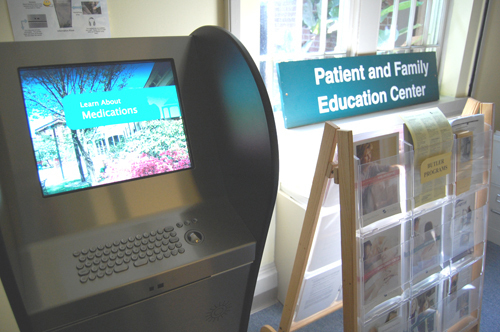
Annie (not her real name), 50, was recently admitted to Butler Hospital, and in her unit she found a novel tool for patient education: a self-service kiosk like you’d find, say, at a tourist attraction, but focused on mental-health issues.
Butler, long a pioneer in mental health, and to its knowledge the first to use patient-education kiosks like these, bought six this summer with a $50,000 grant from the Rhode Island Foundation. A local firm, the Self-Service Network of Portsmouth, set them up, and Butler staff compiled the materials that would be available, drawing on local and national resources.
The kiosks arrived in late September, and despite technical problems that have taken a couple out of commission, by the end of October, they had been accessed for more than 1,300 user sessions, with more than 18,000 total page views, Butler figures show.
Some units use them as part of group therapy, to spur discussion and give patients expert materials to work with. There’s a kiosk in the patient and family education room, and another in the patient admission area, so caregivers can use them, too.
But the main goal, said Diane Ferreira, director of social services, is to engage patients in their own care, get them to ask questions and seek out information, “so they can start thinking about what they can also do for themselves.”
Judy Sheehan, director of nursing education, said that approach “makes them an active participant, which is really critical.” Depending entirely on the hospital staff can be “infantilizing,” she said, whereas “being able to search it out and work with us as a partner makes a huge difference.”
“Our hope is that over time they will continue to use the Internet,” Sheehan said, “because these are resources that they can use outside of here.”
Annie first used the kiosk in her unit to look up her medications. She had asked the unit staff for a list of what she was taking, and they suggested that she follow up at the kiosk.
“It was so easy to use,” she said. “Just hit some buttons and up comes up my first medication. I printed it off, and I ended up printing off four, plus my disorder. I’m going to send them to my mom and dad in Florida so they can understand more, because they’re very detailed.”
But Annie isn’t just doing this for her parents; she’s also printing copies for herself, and reading materials that supplement and expand on her conversations with her psychiatrist.
“I’d never had the opportunity to go in there and plainly pick out a medication [to read about], rather than going through pages and pages, and trying to follow links,” she said. “I like seeing the side effects and knowing what I am to expect and why I’m feeling the way I do.”
Reading about bipolar disorder was also “very helpful to me,” Annie said, “because I’d never actually read about it in detail.”
The materials available through the kiosks are top quality and carefully culled, Sheehan said. There are educational pages from Butler’s own Web site, as well as the rich and comprehensive Rhode Island Network of Care site, a collaborative project now led by Butler that includes expert information and community resources. And there’s MedLine, the federal government’s vast medical-education Web site.
A large, multidisciplinary team developed the kiosks, Sheehan said, and along with patients and caregivers, a wide range of Butler staff are using them – for everything from one-on-one education to discharge planning and group discussions.
“I spend 45 minutes or so giving them information about medications … and then I bring the group to the kiosk and show them how to use it,” Drapeau said. He’ll demonstrate a few times, and he’ll answer their questions by looking them up on the unit.
“It works very, very well, and there’s really been a great response to it,” Drapeau said. “They feel more empowered, and they feel like when you can access information on your own without somebody necessarily helping you, people feel a little more confidence in their treatment and less at the will of others – and I think that’s a good thing.”
Patients also follow up on their own, Drapeau said, looking up information and then coming to him with printouts. “They’re more informed in general, and it stimulates conversation,” he said. “It also improves things like compliance with the treatments, because there’s a third party verifying the information they’re getting from us.”
The kiosks have a built-in survey, though so far, only a few dozen patients have responded. Of those who have, substantial majorities said they liked using the kiosk, found the navigation system easy to use, and found it easy to find the information they wanted.
James W. Alves, associate vice president of patient-care services, said over time more user data will be gathered, analyzed and used to improve the kiosks.
But for Butler, the experiment is looking very good so far.
“Having the kiosks in the units has opened up the conversation,” Alves said. “Nursing staff are finding much more openness on the part of the patients, and patients are talking with each other and with the nurses. … In small part, it’s a stigma-buster, which is great.” •