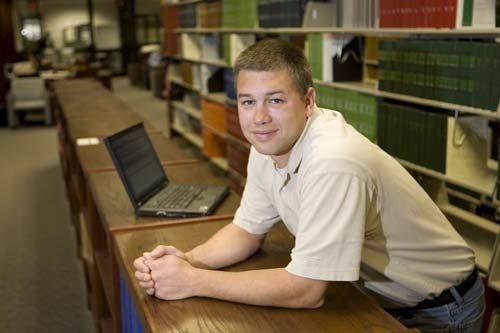
Aaron Greenlee was living in Pawtucket and driving about 100 round-trip miles every weekday to work full time in tech support and data provisioning at a communications company in Marlboro, Mass., while studying for his bachelor’s degree at Roger Williams University in Bristol.
There was but one way he could keep up with such a tight schedule: He took courses online at Roger Williams over the last three years that allowed him to finish his criminal justice degree, paving the way for him to enter Roger Williams University School of Law as a first-year student in September.
The online courses “allowed me to work at my own pace,” he said, because when he had free time, it was usually at night or during lunch, certainly “at times when teachers weren’t standing in classrooms. The flexibility [online classes] gave my schedule was invaluable,” he said.
Greenlee, 30, who now lives in Bristol, does not feel as if he missed anything by working online. In his Vietnam history class, for example, discussion boards, as well as the responses of fellow online students to questions posed by the professor, were posted for all to see, allowing enough give-and-take to replicate the actual classroom experience, he said.
Greenlee is one of a growing number of students, usually adults, who are taking advantage of online education opportunities.
According to an October 2007 report, “Online Nation: Five Years of Growth in Online Learning,” by the Sloan Consortium, a group of institutions and organizations based in Needham, Mass., estimates show 3.48 million online students nationwide in the fall of 2006, an increase of 9.7 percent from the previous year.
“The number of online students has more than doubled in the four years since the first Sloan survey on online learning,” the report said. “The growth from 1.6 million students taking at least one online course in the fall of 2002 to the 3.48 million for fall 2006 represents a compound annual growth rate of 21.5 percent.” The entire higher education student body had an annual growth rate of around 1.5 percent during the same period, the study said.
“We’re finding that this is the fastest-growing area in higher education today,” said Ken Osborne, dean of instructional technology at Roger Williams University School of Continuing Education at the Providence campus.
“It took us a while to buy into the concept that these online courses are comparable to classroom instruction,” said John Stout, dean of continuing education at Roger Williams. Feedback from students has convinced him that “the quality is built in,” he said, and in some cases, online work can offer “even more quality” than the classroom.
Online classes at Roger Williams are offered in seven undergraduate programs and one graduate program (public administration). Courses in math, writing, core curriculum subjects, industrial technology, liberal arts, general education, public administration, business, criminal justice and paralegal studies are online.
The school began offering online courses in the summer of 2004, with eight courses and 76 students, according to Osborne. The summer of 2008 saw the offerings grow to 50 courses, he said, with 556 students working solely online. (Online classes are offered at all other times of the year as well.)
It is not possible to earn a degree at Roger Williams University by only by studying online, according to Osborne, but “we’re working on it,” he said. “We will be hiring staff to assist the faculty in [online] course development.”
Salve Regina University in Newport offers online degree and certificate programs through its School of Continuing Education. Online work at Salve can lead to master’s degrees in business administration, management, international relations and humanities; online professional-certificate programs are offered in management, human-resource management and law-enforcement leadership.
And a new degree program is set to begin. “We’re about ready to roll out a master’s degree program in health care administration and management, completely online, that should be ready by the spring,” said Thomas Sabbagh, dean of graduate studies and continuing education at Salve.
Like his counterparts at Roger Williams, Sabbagh has found that the online courses are “extremely popular,” particularly with the adult-learning population due to the “affordability, accessibility and flexibility” of the classes. Adult learners benefit the most from online offerings because they are the most self-motivated, he noted. “Adults actually look forward to getting their work done at a quick pace.”
Of the “roughly” 1,000 students enrolled in Salve’s graduate and continuing studies program, Sabbagh said, 38 percent – approximately 380 – solely work online. Online learners at Salve have come from all over the country and the world. “There’s probably not a state in the country we haven’t touched yet,” he said, “and we’re probably in 20 different countries.”
Members of the military make up a large number of online learners. Of the 600 adults enrolled in continuing education at Roger Williams, 130 are long-distance online students representing 33 states; and most of the 130, Stout said, are in the military. The university works especially closely with the National Guard and the Navy and recently became part of the Navy Distance Learning Partnership. Osborne spoke of online students in Iraq, Afghanistan and on board Navy ships in the Mediterranean Sea.
“A lot of our online students are in the military,” Sabbagh said. “Most of them are in international relations and management. Members of the military can start their education here and, if they’re deployed, they can finish online. Online has worked out very well for the military members because their time is precious, they are driven men and women who like to be organized and to order their lives.”
Tuition for a three-credit online course at Roger Williams is $1,125, Stout said, noting that’s less than the rate for traditional daytime classes on campus. At Salve, according to information on the university’s Web site, a three-credit online course is $1,140. Both schools said financial aid is available for online learners.
Questioned about potential cheating, Stout said most software programs for online learning are equipped with mechanisms that can detect plagiarism and can tell if the work submitted actually is by the registered online student. If there is a serious question about the veracity of a student’s online work, “we will hire proctors,” Stout said, to monitor exams anywhere in the U.S. or through military education offices for those overseas. •