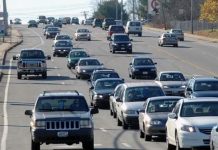
WASHINGTON – The U.S. Environmental Protection Agency last night ruled that California cannot limit automobile carbon emissions because those emissions would be reduced somewhat by a new federal energy law.
The energy measure approved by Congress on Tuesday, (READ MORE) and signed into law by President George W. Bush “brings a much-needed national approach” to greenhouse-gas reduction, EPA Administrator Stephen Johnson said in a news conference last night, according to Bloomberg News. Having a federal standard, he added, is better than “if individual states were to act alone.”
But Environment Rhode Island spokesman Matt Auten today said that, in moving to block the California Clean Cars Standards, the EPA “has ignored the threat of global warming – and its mandate under the Clean Air Act.”
Under the federal Clean Air Act, California is allowed to set pollution standards that are stricter than federal standards once a waiver is granted by the EPA. Other states then have a choice of adopting either California’s rules or the federal government’s.
Yesterday’s action – on a request filed Dec. 21, 2005 – was the first time the agency had denied a waiver request from the state.
“While the federal energy bill is a good step toward reducing dependence on foreign oil, the president’s approval of it does not constitute grounds for denying our waiver,” Arnold Schwarzenegger, the governor of California, said in a statement today. “California sued to compel the agency to act on our waiver, and now we will sue to overturn yesterday’s decision and allow Californians to protect our environment.”
“This is a distressing development, but it is certainly not a surprising one,” R.I. Attorney General Patrick C. Lynch said in a statement this afternoon, adding: “No administration in our country’s history has been consistently cozier with the energy and automobile industries than the Bush administration.”
The EPA’s decision came only after California, joined by Rhode Island, Massachusetts and 12 other states, had filed lawsuits last month seeking a court order to force the agency to respond. (READ MORE) The ruling was a blow not only to California but also to Rhode Island, Massachusetts and the other states that had already adopted the California clean-air standard. Together, those states represent nearly 40 percent of the U.S. auto market.
“The EPA’s ruling is disgraceful,” said Rhode Island’s U.S. Sen. Sheldon Whitehouse, a member of the Senate Environment and Public Works Committee. “The Bush administration’s refusal to carry out the duties imposed on it by the Clean Air Act have polluted our air and water, further endangered the health of millions of Americans and cost us precious time in our fight to address the looming threat of global warming.”
The federal law includes a requirement that auto manufacturers achieve fleet fuel efficiency of 35 miles per gallon by 2020, a requirement the EPA’s Johnson called stricter than the 33.8-mpg average the California standard would have required.
But Mary Nichols, chair of the Calif. Air Resources Board, estimated the state program would require an average of 36 mpg by 2016. “We are not trying to implement a fuel economy standard,” she added. “Ours is a comprehensive program targeting global warming.”
The proposed state standards would cut greenhouse gas pollutants by 392 million metric tons by 2020 – the equivalent of taking 74 million cars off the road, Environment Rhode Island said in a report this spring entitled “The Clean Cars Program: How States are Driving Cuts in Global Warming Pollution.” (PBN subscribers can READ MORE.) By 2016, they also would require a 30 percent reduction in climate-change pollutants from new cars and trucks sold in Rhode Island and other Clean Cars states.
Building a Strong Data Foundation in the Age of AI
Artificial intelligence (AI) has become a key priority in the boardroom and across management —…
Learn More
“In Rhode Island, the transportation sector emits more global warming pollution than any other sector,” Environment Rhode Island’s Auten said today. “The Clean Cars Standards are one of the most effective tools states like Rhode Island have to reduce global warming pollution,” he added.
“We can’t afford to delay strong steps to address global climate change,” Senator Whitehouse said. “We will keep fighting to pressure this administration to do the right thing and allow states like Rhode Island to take action.”
Meanwhile, Nichols told Bloomberg News, California probably will file a new federal lawsuit, seeking a reversal of the waiver decision. That may mean another multi-state suit; Lynch today announced that “Rhode Island is ready to join the efforts of any state to fight this egregious decision.”
“The Clean Cars Program: How States are Driving Cuts in Global Warming Pollution,” a May 2007 report from the Environment Rhode Island Research & Policy Center, is available online at EnvironmentRhodeIsland.org.