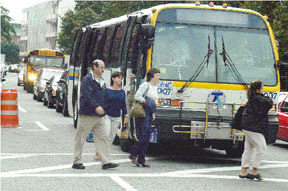
incentives for using public transit.
The U.S. Environmental Protection Agency recently began recruiting Rhode Island employers in a campaign designed to reduce smog and rush-hour traffic throughout New England.
The EPA’s campaign, locally called New England’s Best Workplaces for Commuters, is part of a national effort that encourages employers to offer their workers incentives for using public transportation or car pooling. The campaign is signing businesses on to a free, voluntary program that recognizes employers who offer their employees commuter benefits such as transit passes, van-pool subsidies, car-pool matching, bike lockers and compressed work schedules.
Grow Smart Rhode Island is partnering with the EPA to promote the campaign in Rhode Island. Grow Smart Rhode Island is a nonprofit organization dedicated to improving Rhode Island’s quality of life, economic vitality and environmental health.
A modernized health plan: Supporting cost management and the employee experience.
The Surest health plan came from a group of innovators wondering: What if health care…
Learn More
New England’s Best Workplaces for Commuters Coalition is now challenging area businesses to sign up for the first annual Best Workplaces for Commuters list, which will be announced in early November. The deadline for enrolling online is Sept. 30.
Last week, the EPA and Grow Smart Rhode Island sent letters inviting more than 100 Rhode Island employers to take part in the program, including Brown University, Providence College, Rhode Island College, Fidelity Investments and Hasbro, said Patty Klavon, the EPA’s New England program manager for the campaign.
“We want employers to know that offering the commuter benefit makes good business sense,” said Klavon. “It costs a small amount of money and in return you get employees arriving to work less stressed, and you save on taxes. It’s a great public recognition for something that actually helps their business.”
The push comes as cities across the nation, and Providence in particular, struggle with ever increasing traffic problems, including air pollution, wasted fuel costs and loss of worker productivity. Employers who offer commuter benefits to their employees experience improved employee recruiting and retention, increased employee job satisfaction, and savings on parking and federal taxes, said Klavon.
The average Providence commuter spends 41 hours stuck in gridlock each year, according to the Texas Transportation Institute, a transportation think tank at Texas A&M University. In Providence, 29 million gallons of gasoline was wasted last year while cars sat in traffic jams, at a cost of $335 million in wasted gas. That amounts to $795 per commuter per year, according to the data.
At the same time, nearly 50 percent of workers describe their commutes as unsatisfying or stressful, and 36 percent say they would be willing to take a 10 percent pay cut or more for a shorter commute, according to an October 2001 report by HR Magazine. And employees with commuter benefits are eight times more likely to use public transportation than those who don’t have the benefits, according to a 2001 survey by Xylo Inc., a Bellevue, Wash.-based consultant on work-life issues.
“There’s clearly been a major increase in traffic congestion in Rhode Island in the last decade. According to the U.S. Census, our population will increase even more rapidly in the next decade. So we’ve got to find ways to decrease traffic congestion and maintain a high quality of life,” said Scott Wolf, executive director of Grow Smart Rhode Island.
“Secondly, this is a program that really doesn’t cost the taxpayers anything up front, and could pay big dividends, pardon the expression, down the road, in the form of higher worker productivity, more tax revenue without a higher tax rate, reduced air and water pollution and reduced stress for everyone.”
Thirty-four employers in other New England states are already on New England’s Best Workplaces for Commuters list. The 48,000 commuters covered by current New England’s Best Workplaces for Commuters will help reduce 33,600 metric tons of carbon dioxide per year, a reduction equivalent to planting 416,000 trees each year, according to the EPA.
Employers can enroll at www.bestworkplacesforcommuters.gov, or www.bwc.gov.
The Web site also allows employers considering the Best Workplaces for Commuters
designation to access a Web-based calculator to estimate the financial, environmental,
traffic-related and other benefits of offering commuter benefits.
For the complete current issue, visit our subscription Web site, or call (401) 273-2201, ext. 227 or 234.