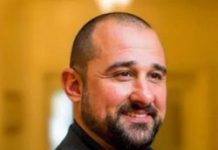
David Vernaglia grew up with computers – those big, clunky things available in the ’80s, then their sleeker, more sophisticated successors. After graduating from Brown University, he was a systems operator for America Online when it was still a novelty, in the early ’90s.
But it was as a Latin and Greek teacher at The Wheeler School that he found a new calling: using IT to make things happen – first in the classroom, then in a wide range of other fields.
His small firm, Everlasting Designs, does everything from network and database design, to Web sites, to multimedia systems – building, revamping, planning and training people to use them. The common element, he says, is treating IT as a tool, not a goal unto itself.
PBN: You’ve been in business for 13 years, much of it while teaching and doing IT at Wheeler. Did your outside work focus on schools as well?
VERNAGLIA: Not really. I did all sorts of work … we did 30 or 40 Web sites, mostly for small and medium-size businesses; we did a lot of design work for print; and then I started doing a lot of work with Gary Shine, of Shine Online Services, who probably taught me more about business than anyone else I know. He defined for me the concept of being a lifestyle entrepreneur – a person who starts a business so they can live the way they want to live. … With him I started doing a lot of medical-database research work, compiling information on clinical trials … and that really took my skills to a higher level.
PBN: Do you have any formal IT training?
VERNAGLIA: No … I’ve done the requisite amount of reading and I’ve interacted with very skilled engineers and technicians, but it’s all self-taught. I have a credo that I won’t hire a subcontractor that’s formally trained, especially in Microsoft, because they’re all about doing things a particular way, rather than the best way or the most cost-effective way. They’re good people, don’t get me wrong … but in the end, I’ve been able to provide a better level of support and service by being an independent computer consultant.
ISO 9001:2026: A Practical Opportunity to Build for What’s Next
For Rhode Island manufacturers, ISO 9001 has been much more than a certificate on the…
Learn More
PBN: How does your teaching background affect your IT work?
VERNAGLIA: I think the fact that I can communicate well, and I can translate things into a not ridiculously dumbed-down, but intelligible explanation of what’s going on and what needs to be done, has always been the backbone of my business. Most tech guys are stuck in a world between too much tech and not enough interpersonal skills, and that can cause a big breakdown where there’s not a sense that you’ve got the client by the hand and you’re leading them in the right direction, but rather they’re just blindly following you.
PBN: A good chunk of your work involves schools. What kinds of projects do you do?
VERNAGLIA: It’s very dependent on what the school is able to afford. What we’re trying to do now is connect schools to grant money; we’ve recently started working with independent grant writers [who can help]. … What we’ve been doing lately is enhancing inter-classroom and inter-school communications with audiovisual technology. Kids need to be able to see things to be able to appreciate them, and be able to interact with them. … When you have videoconferencing capabilities on the smart boards and on every monitor in the school, it allows everything to be more interactive. It allows for classrooms to communicate with other classrooms … [and] for team-teaching classes, and one teacher teaching more than one class. The cool thing is that it’s not limited to just the school: We could interact with schools all over the world.
PBN: Many times in schools, technology becomes the center of attention, and the content becomes secondary. How do you get around that?
VERNAGLIA: What I’ve found that works best is to make it a naturalized means of communication. You can’t look at it as technology – look at it as a way of creating an environment that no longer feels like technology, but rather feels like the way it is. When you walk into this room, you can just look at the screen and communicate this way – it’s natural and available and useful. … It’s an issue of taking the specialness out of it and making it mundane. If you can make that a valuable tool, then you’re golden.
PBN: What do you do with business clients?
VERNAGLIA: For a lot of my clients, I’m the consultant who will come in and discuss evolutionary changes in their systems. They may have a database that goes back to the early ’90s, and they need a change, so I’ll help them develop a transition plan and come up with a three- to five-year plan. We’ll look at who you’re going to be financially tied with: Is it Microsoft, or do you want to be independent and go with Linux, really think it through, deal with things like the education of the users and support of the systems, and in some cases we’ll also install the systems, so there’s a lot of hands-on work. There’s only three of us in the company, but we’re very efficient, so we’re able to take on large installation jobs.
PBN: Your work is very diverse, especially for such a small firm. Is that on purpose?
VERNAGLIA: It’s a very rich mix of many different things. We’ve developed custom software applications, we’ve dealt with migrations of archaic databases to new databases, we’ve done data recovery, we’ve done security checks. … We really run the gamut and continue to do so – You’ve got to stay fresh. … A lot of companies are more specialized … but what I want to do is excel at creativity. •