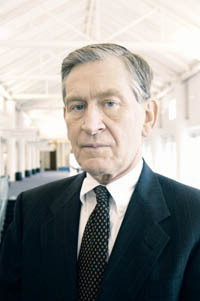
In his first few weeks as the state’s first director of revenue, there haven’t been too many surprises, reports Gary S. Sasse. After all, the Rhode Island Public Expenditure Council, which he led for three decades, played a part in creating the new R.I. Department of Revenue.
Sasse says his department’s job is, in part, to analyze the cost and benefits of the state’s tax and revenue programs and recommend changes. He enters the position at a challenging time: The state has a mammoth structural budget deficit – a projected $550 million shortfall this fiscal year and the next – and it must deal with it immediately.
PBN: Why did you decide to take the job?
SASSE: It’s a challenge. For a long time, we had expressed concern that the state needed an agency that would provide both to the executive and the legislative branches non-partisan, objective information on tax and revenue issues. And I would hope that I can make a contribution to begin that role as the first director of revenue. The biggest issue facing the state today is the fiscal situation, and being part of the team to work with the General Assembly and the governor to help address it was a public service I felt I could make a contribution towards.
Beyond Cash Donations: How New Forms of Giving Are Transforming Not-for-Profit Accounting
Evolving Funding Landscape for Not-for-Profits Not-for-profit organizations are being asked to do more with less,…
Learn More
PBN: Is the General Assembly willing to work with you, as part of the Carcieri administration?
SASSE: The Department of Revenue is an executive department, but I think the department will be dependent upon serving both the executive and the legislative branches, providing objective and non-partisan analysis and information.
PBN: Over 30 years, you have seen your share of fiscal problems in this state. Where does this one rank?
SASSE: As the governor pointed out in his State of the State speech [last week], this is the most serious fiscal challenge the state has faced since the credit-union crisis in 1991.
PBN: What are the best ways to get out of it?
SASSE: Well, the issue in this state is spending. It’s not a situation that we can tax our way out of. We have a structural problem, which means when the economy improves and the economic cycle changes, we won’t necessarily get out of the problem. So the best way is to control spending, to look at ways to deliver government services more efficiently and more effectively. This will require redesign and re-engineering. And when the governor presents his budget for fiscal ’09, you’ll begin to see some suggestions made to improve the delivery of government services and reduce costs.
PBN: The idea of allowing 24-hour gambling at Lincoln Park has been floated as a way to increase the state’s annual revenue by as much as $16.5 million. What’s your stance on the issue?
SASSE: The lottery is now a division that is part of the Department of Revenue, and in consultation with the director of the lottery, we’re analyzing data to determine the financial impact of 24×7. When we finish the analysis, we’ll make recommendations to the governor.
PBN: There’s been discussion about the pros and cons of tax credits, such as those issued for film and TV productions. What does the future hold for these credits?
SASSE: That’s an important issue. Over the years, the State of Rhode Island has enacted numerous tax credits, and they’ve all been for good purposes. They’ve been created to try and generate jobs and investment in the state. One of the missions of the Department of Revenue and office of revenue analysis, which was created as part of the department, is to assess whether or not the tax credits that we are providing are achieving their objectives and whether there’s a return on investment. Hopefully as we get geared up, we’ll be able to provide that information to the governor and the legislature as to what tax credits are working and which ones aren’t.
PBN: Will some of them be eliminated?
SASSE: We’re going to do the study first. I’m not going to guess at what the analysis will show. But we’ve already taken steps as part of the governor’s supplement budget. There’s been a recommendation to cap the amount of the historic tax credits. That recognizes the reality of the fiscal conditions that the state is facing. We have an open-ended program and yet we have a budget in deficit. So that’s one, but we’re going to go through it as systematically and comprehensively as we can. It’s an important priority.
PBN: Many in the business community say the state’s tax structure makes doing business here very difficult. What are your plans to make improvements?
SASSE: Over the last few years the Assembly has been proactive in trying to make our tax structure more competitive, as witnessed by the elimination of the capital gains tax and also the enactment of the alternative flat tax and the property-tax cap. Those have been constructive steps to improving the competitiveness of our tax structure. And yet there are reports from groups like the Tax Foundation [a Washington, D.C.-based research group], which rated the Rhode Island business climate very low. We have to pay attention to those reports. There are areas we’re going to score. We’re going to look at what would represent a strategic tax policy to improve the competitiveness and not have rankings come out in the future where our business climate ranks in the bottom three or four in the country. I don’t think there’s any question that we could do a lot to improve our business-tax climate.
Rhode Island is a high-tax state and one of the reasons for that is we have the fifth-highest property tax burden in the United States. Our property-tax burden is 45 percent above the national average. And to address that question, it’s going to require that the state and the municipalities work together to promote programs where services are delivered in the most efficient fashion. There’s a shared responsibility. •
interview: Gary S. Sasse
POSITION: R.I. Director of Revenue
BACKGROUND: Before taking the newly formed position of revenue director in the Carcieri administration, Sasse had been executive director of the Rhode Island Public Expenditure Council since 1977. He oversaw research- and policy-analysis projects at RIPEC and led commissions to reform government operations and education. Before RIPEC, he was associate chief administrative officer for the city of Memphis, Tenn., and director of the Tennessee Office of Urban and Federal Affairs. Until recently, he was an adjunct lecturer on public policy at the Kennedy School of Government at Harvard University.
EDUCATION: B.A. in government, Florida State University, and M.P.A. (master’s in public administration) from the University of Missouri.
RESIDENCE: East Greenwich
AGE: 65