WASHINGTON – T.F. Green Airport (PVD) will have sufficient capacity to handle its needs through at least 2025, if planned improvements are made, according to the Future Airport Capacity Task 2 (FACT 2) report released yesterday by the Federal Aviation Authority.
If the planned changes were not made, however, the study found T.F. Green would be facing unacceptable delays by 2015 and Boston’s Logan International Airport (BOS) would be in trouble by 2025. Nationwide, FACT 2 found that six major airports – all in the New York, Philadelphia, Los Angeles and San Francisco areas – will be facing capacity problems by 2015 even if all planned improvements are made.
FACT 1, released in 2003, had found T.F. Green would be in trouble by 2020, even after all planned improvements. The FAA has gathered more accurate data on airport operations since the earlier report, the agency noted, while some airports have announced plans to improve airfield operations or expand capacity.
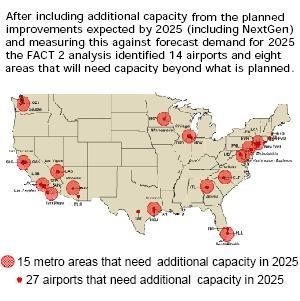
As a result, FACT 1 found 15 airports with insufficient capacity by 2013, even after planned improvements, whereas FACT 2 found all but six would be fine until 2015. FACT 1 found 18 airports, including T.F. Green, lacking sufficient capacity by 2020, whereas FACT 2 found the planned improvements insufficient at only 14.
The FACT studies each reviewed the operations of 291 commercial service airports and 223 metropolitan areas around the country, and each performed an in-depth analysis for the same 56 key facilities.
FACT 2 also attempted to simulate the effects of “NextGen” technologies – including ground- and air-based weather, navigation, traffic control and security systems – and found significant reductions in flight delays. “These findings indicate that the FAA should move forward aggressively to develop the NextGen concepts, assess system benefits and costs and identify appropriate methods of financing the improvements,” the report said, especially at “capacity-constrained” airports, where adding runways isn’t practical.
Other improvements considered, and the report’s comments, include:
• New runways: “Master planning, environmental studies, and land acquisition need to be conducted as far in advance as possible, to reduce the time and expense associated with moving a project through the development process.”
• New commercial service airports: “There is likely to be a need for as many as four more major commercial service airports across the country during the next two to three decades,” in growing markets with capacity-constrained airports.
• Regional solutions: Studies of regional traffic and development alternatives
have been used to analyze specific air travel behavior within defined regions
that experience significant congestion, including San Francisco, the Los
Angeles basin, New York, and Boston. Several of these regions have ongoing
study efforts in place. These initiatives should continue, and may need
additional emphasis.
• Congestion management: “In some cases, runway construction may not be a
viable alternative,” as at New York’s La Guardia and in San Franciso. “In these cases, demand management, regulatory or economic solutions, and other market mechanisms may need to be investigated.”
• High-density corridors and multi-modal planning: “Even with the planned improvements, the FACT 2 analysis identified significant and chronic capacity problems on the East and West Coasts … The demand for travel in these high-density corridors may require consideration of high-speed ground modes as well as short-haul air travel. … In order to adequately plan for airport and multi-modal transportation improvements and infrastructure investment … it will be necessary to better understand the travel behavior and options … in the country’s busiest travel corridors.” Therefore, the report said, the Board of Governors of the Airport Cooperative Research Program “has unanimously approved undertaking an FAA-suggested study to examine multi-modal travel behavior and the impact of travel demand on high-density travel corridors linking mega-regions on the East snd West Coasts. The National Academy of Sciences’ Transportation Research Board” which administers the ACRP, “expects to award a contract for the study in the summer of 2007.”
“The solution at each airport will be different, and can only be identified through consideration of local factors and concerns,” the report concluded. “The FAA is prepared to work with local airport operators to address their capacity and demand issues and to seek innovative approaches to their needs.”