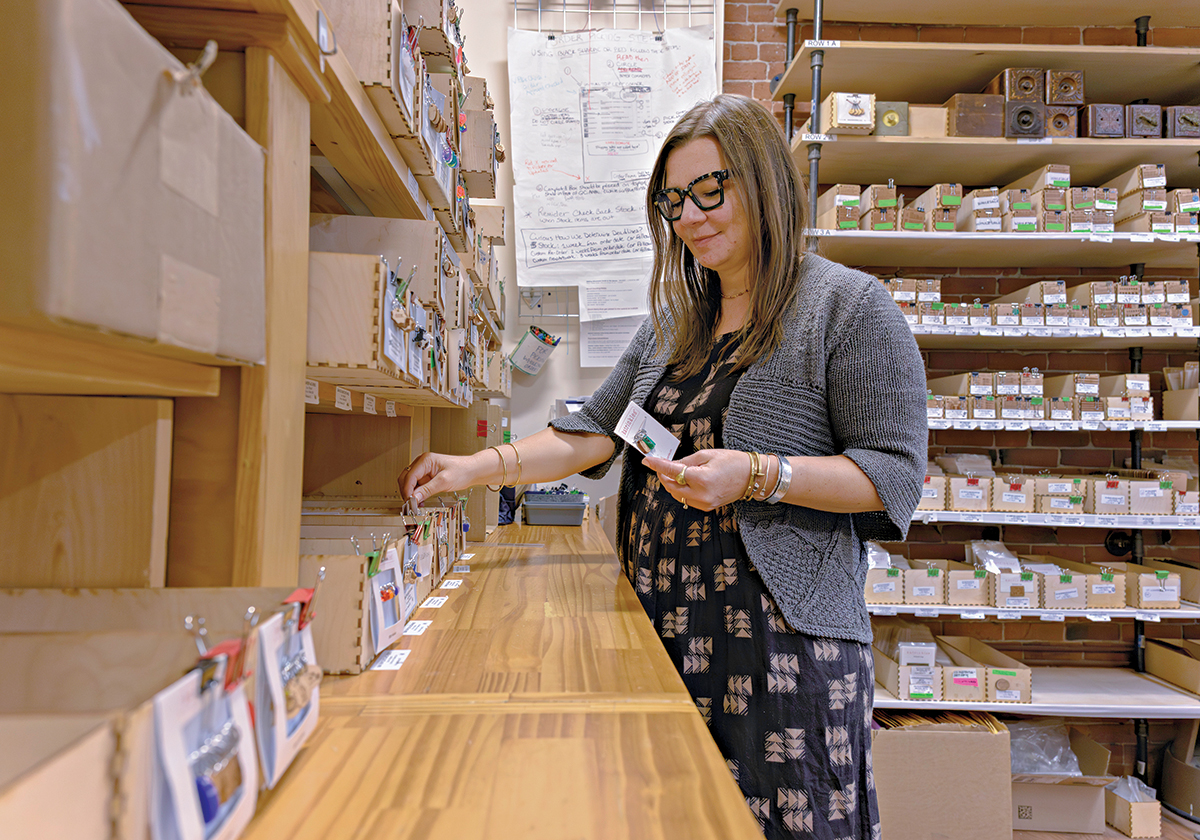
Katy Westcott is a designing woman. She knits socks and crochets sweaters. She spins yarn and even sews her own clothes. So her life as the CEO of Katrinkles Inc., the company she launched in 2012, is a comfortable fit.
A small Providence business, Katrinkles creates playful buttons and tools for crafters. Items range from stout-looking needle threaders to cross-stitching tools; most are made with domestic materials.
The company debuted in 2012, selling buttons and tools; Westcott left her job a couple of years later to focus on growing Katrinkles. What had started as a hobby morphed into a profitable operation right away.
“I didn’t assume it would be my livelihood or that I’d have employees, but it was kind of my life. As a person who loves to knit and crochet, I am my customer,” she said. “I wanted to have a business that I’d like to work at.”
Westcott also loved designing things and enjoyed the challenge of making gadgets that fill a niche and are useful.
Creativity and curiosity are in the Westcott family’s DNA. Her grandmother was a seamstress and she’s descended from a family of jewelers who emigrated from Germany. Her relatives were also interested in textiles. When she was growing up, Westcott learned to spin yarn and make furniture for her dollhouse.
As a kid, Westcott went to Henry Barnard School, where the curriculum was student-centered and based on experiential learning. Then, in high school, her physics teacher took the class to a manufacturing facility in Massachusetts.
“It was very clean and high tech, with a lot of bright colors. I thought how cool it was to do that,” she said. That experience planted a slow-growing entrepreneurial seed. She graduated from Rhode Island School of Design in 2002 with a Bachelor of Fine Arts in jewelry and metal arts and then moved to New York.
She worked for a goldsmith, then took over the wholesale side of the business, where she learned a lot, she says. Eventually, Westcott moved back to Rhode Island and began working in the costume jewelry business for an Ohio-based company. For fun, she took a laser-cutting workshop at AS220 and installed a laser machine in her Pawtucket apartment. It allowed her to make her own buttons and she knew she’d arrived at the intersection of jewelry and fiber arts.
“That ultimately caused me to start Katrinkles,” she said.
Westcott found buyers on Etsy, and with her dad helping at the booth, she also sold at craft fairs. She was able to grow the business without making a huge financial investment.
“People would always assume Katrinkles was his company, or that he was making everything for me,” Westcott said. “It makes me sad that people wouldn’t assume a woman is the business owner, or that women can’t be manufacturing on large, industrial machines.”
Then in 2017, she hired her first two employees. Today, that’s up to seven crafters designing tools and accessories for knitters, crocheters and fiber artists on laser machines in the Providence studio. Their most popular item? The gauge wheel, a tool that makes it easier for knitters and crocheters to keep track of the stitches in their project without having to count them all.
Westcott says it was a steep growth curve in the beginning, and there was a lot to keep up with. By 2023, as she learned to pull back on certain aspects of the business, she felt more comfortable and says she’s happy with where things are now. By this August, the mix of retail and wholesale orders for the year so far had already totaled roughly 3,000.
“At first, I didn’t consider myself a manufacturer. I thought I was a maker of things, an artist, or maybe a craftsperson with helpers,” she said. “But, in early 2020, when we suddenly had a worldwide pandemic, manufacturing was classified as an essential business and the state of Rhode Island kept essential businesses open. As I read that definition, I realized, wow, that’s what we do at Katrinkles. From then on, I embraced what we’re doing is manufacturing.”
Like many U.S. companies, Westcott’s business is confronted by new tariffs, she says, and she’s seeing it in supply chain issues.
“Our current struggle is that we’ve lost the majority of our international business because of the ongoing tariff war and new regulations in the [European Union and the United Kingdom],” she said.
She uses British high-efficiency particulate air filters in her machines, for example, and they can’t be sourced elsewhere. She predicts the prices of those will increase. Other items, such as magnets, which she’s bought from China, are no longer being shipped. Getting them from another source, if it’s even possible, will raise costs. It’s situations such as this that are her biggest challenge, she says.
“When you’re running any business, nothing is constant,” she said. “I have to be ready to act when an obstacle presents itself, and after each hurdle, there’s always another one to tackle.”