The Industrial Age has not been kind to the cityscape of Fall River.
An elevated highway blocks waterfront views, the Queguechan River and its once-dramatic falls have disappeared inside underground conduits, and the mills that bustled a century ago are now mostly underutilized hulks.
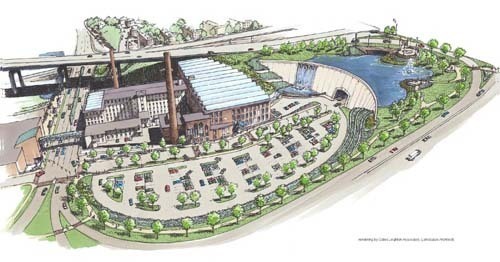
An eyesore, most folks would say. But perhaps not for long. This month city officials and planners from Rhode Island’s Newport Collaborative Architects Inc. unveiled plans for dramatic infrastructure changes that could spark a turnaround for the gritty city. The project would uncover the river, restore the waterfall, replace the old highway structure with a shore-side boulevard, and transform mill buildings into an enterprise zone for renewable energy businesses.
To make the proposal economically viable, they hope to harness the river – and the sun, winds and tides as well – to provide cheap electricity to new businesses and everyone else in the city. They have dubbed the project FREE, for Fall River Energy Enterprise.
“Renewable energy can provide jobs for every skill set, from GEDs to PhDs,” said Alan Amaral, president of the Fall River Office of Development and chairman of the FREE task force, at a recent press event.
“This is exactly in line with the Obama administration’s push for alternative energy,” added John Grosvenor, Newport Collaborative principal. “We’re at that magic moment when the phoenix could emerge from the fire. Fall River could become the region’s leading alternative energy city.”
Newport Collaborative, well known for its mill-preservation projects in Rhode Island, helped develop the preliminary plan, along with Providence landscape architectural firm Gates, Leighton & Associates.
Fall River’s first textile mills appeared alongside the Queguechan in the early 1800s. The river was a natural power source, with water dropping 126 feet as it left Watuppa Pond. By the dawn of the 20th century the city was the largest producer of print cotton in the country, with a mill capacity of more than 1,000,000 spindles. Shortly after World War I, however, Fall River’s industry began to falter, as textile manufacturers began relocating to southern states – and later overseas – to take advantage of cheaper labor.
The FREE plan calls for building a crescent-shaped dam in front of Watuppa Pond, with a waterfall dropping 75 feet. The river would then flow through the landscaped grounds surrounding several historic mills. With a force of more than 25 million gallons a day, the river would power hydro-turbines that would provide energy for the enterprise zone. Building the dam and changing the current course of the river would also eliminate flood problems around Watuppa Pond.
Grosvenor describes the century-old mill structures in the enterprise zone as ideal preservation projects. They were built with locally quarried granite, a material that’s both attractive and durable. The stone also has geothermal properties that help with energy conservation.
“Fall River has 10 million square feet of underutilized mill space,” Grosvenor said. “Returning those mills to full use will be a great recycling effort. Preservation and renovation [are] much more efficient than building something new. Experts estimate it typically takes 65 years for a new green building to save the amount of energy already embodied in an existing structure.”
Grosvenor notes that historic mill buildings can be adapted to many uses, but to help build a brand image for the city, space in the enterprise zone would be reserved for businesses involving alternative energy, which could include anything from research and development to manufacturing.
Tides are also unusually high in Fall River, and that has planners looking at wharves as tidal energy-generating platforms.
The FREE plan also calls for removal of the elevated spaghetti ramps to Interstate 195 near Wattupa Pond, which block views and access to the waterfront and Battleship Cove, a museum of World War II Naval ships.
“The budget to maintain and repair those ramps over the next 10 years will be $115 million,” said Grosvenor. “Let’s spend that money to take down the ugly thing and replace it with a waterfront boulevard. It won’t be a high-speed road, but that ramp isn’t high-speed now. It’s stop-and-go all day long.”
He predicts the project could result in a real estate bonanza. “We’ll end up with 10 or 20 acres of prime development land along the water,” he said. “Water always has aesthetic appeal.”
City officials are now looking for ways to fund more in-depth studies and plans, which could be completed by 2011. The Greater Fall River Development Corporation has already committed $100,000, and Mayor Robert Correia has suggested using $860,000 the city received in federal block grant money for energy-conservation programs.
“FREE creates jobs, allows for cheaper energy costs, and brings together the ideas we’ve all known to be the best for Fall River,” Correia said. “It can transform Fall River as we know it.” •