At one time, free checking accounts were all the rage in the banking industry. And it was no different in the Rhode Island market, particularly when Bank of America’s arrival in 2004 whipped up the competition for customers.
Since then, the competition hasn’t changed much, but the free checking products have.
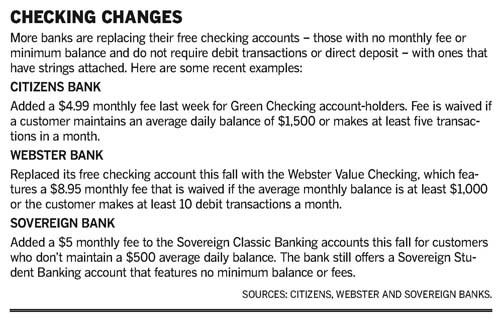
Last week, Citizens Bank became the latest bank to restrict free checking to select customers when it added a $4.99 monthly fee to its Green accounts for those who don’t maintain a $1,500 minimum balance or don’t record at least five transactions a month.
Citizens joins Sovereign Bank and Webster Bank, among others, in attaching strings to their free checking product as bankers nationwide say new regulations have restricted income from overdraft fees and additional measures capping credit and debit card fees threaten to make it more difficult for financial institutions to maintain profits.
Even among those that still offer fee-free checking services without strings, few are making promises that those offerings will remain, citing uncertainty over how much new financial regulations will affect revenue.
The Washington Trust Co. offers an account called Freedom Checking that features no monthly service charge. Officials from Washington Trust, Rhode Island’s largest independent bank, likely will re-examine the program as they head into the new year. “This is the time when everybody takes a look at their product lineup,” said Elizabeth Eckel, Washington Trust’s senior vice president of marketing.
A growing number of banks across the country have already pulled the plug on their strings-free checking accounts, according to Bankrate.com, an online industry tracker.
An August survey of U.S. banks found that 65 percent still offer a free noninterest-earning checking account, down from 76 percent a year earlier.
Those results come just as new federal rules kicked in prohibiting consumers from automatically enrolling customers into their overdraft protection programs, which have been a big source of fees from some banks.
Greg McBride, Bankrate.com’s senior financial analyst, said even more banks will drop free checking products now that regulations will soon go into effect authorizing the Federal Reserve to set limits on debit card fees collected from merchants by banks.
“We’re at the beginning of this wave of ending free checking,” he said. “It’s going to take some time for the dust to settle.”
Citizens, for example, will waive the $4.99 monthly fee if the Green Checking account-holder makes five online bill payments, debt transactions or ATM withdrawals monthly, or if the customer maintains an average daily balance of $1,500.
At the same time, Citizens this month increased the charge for using other banks’ ATMs from $2 to $3. And the bank is starting to charge customers at least $2 a month to receive a paper statement.
Citizens’ spokeswoman Amie Kershaw said the adjustments are in response to the regulatory changes as well as the growing cost of maintaining accounts. Kershaw said the cost of producing a monthly statement alone is $2.50 for each customer.
That explains why Citizens and other banks are pushing customers to receive statements electronically. In fact, Citizens says it will pay customers 10 cents per transaction if they are enrolled in the bank’s Green$ense account, which features electronic statements.
Citizens is also offering a customer review until the end of the month in which the bank guarantees it will find products that will save a customer $25, or the bank will pay $25.
“We’re trying to offer back value to our customers,” Kershaw said.
Bank of America no longer has a free checking account, but started offering a paperless account in August. Customers enrolled in eBanking avoid the $8.95 monthly maintenance fee by opting to receive online statements regardless of transactions or account balance.
While Webster ended its strings-free checking, the bank touts on its website that it’s “easy to free” by maintaining a $1,000 monthly average balance or by completing at least 10 debit card purchases a month.
There are similar “performance-based” fee waivers at Navigant Credit Union. Timothy Draper, Navigant’s marketing director, said only about 700 of the 47,000 checking account-holders actually end up paying the monthly charge.
“We’re going to try to hold the line as long as we can,” Draper said. “We’re not out to make a fortune off the people in the community.”
McBride said banks were willing to absorb the cost of maintaining the accounts because they were lucrative in other ways: overdraft fees, and charges to merchants for debit card transactions, as well as the opportunity to cross-sell other banking products.
“The checking account is the centerpiece of the banking relationship,” McBride said.
Now the Dodd-Frank act is forcing banks to try new pricing models. McBride said the last banks and credit unions to add free checking products have been the first to drop out.
Others have hesitated, in part, because of concern about losing customers to competitors who still offer free checking.
NewportFed has the Totally Free Checking account that features no minimum balance requirements, no per-check charges and unlimited check-writing.
Meanwhile, BankNewport offers the Go account, which also has no strings attached for free checking, although 12 debit transactions a month or direct deposit enrollment gets customers a higher interest rate, according to Susan Replogle, BankNewport senior vice president and director of retail banking.
Some institutions that are sticking with the free offering have used it to their advantage.
The Rockland Trust Co., a subsidiary of Rockland, Mass.-based Independent Bank Corp., is touting its checking account in an advertising campaign.
“When it comes to free checking, we take the word ‘free’ seriously,” says one print ad before noting that the accounts have no fees and no minimum balance requirements.
Jane Lundquist, the bank’s executive vice president of retail banking, said the bank has picked up numerous customers as competitors have dropped free offerings. In some branches, she said, the number of checking accounts has grown by more than 50 percent.
Lundquist said the effect of the Dodd-Frank act on Rockland Trust has been limited. The bank had no overdraft protection program before the new regulations, so it did not rely on those fees.
“We haven’t had the negative impact,” said Jane Lundquist, the bank’s executive vice president of retail banking. “So we have no plans to change [the free checking account].” •