Forget all the talk in Massachusetts about extending commuter rail service to New Bedford and Fall River, Dan Gallagher says.
He sees the fiber-optic network that his nonprofit soon will build from Providence to the far reaches of Cape Cod as a much more crucial economic-development tool for southeastern Massachusetts, a region that like Rhode Island has hit double-digit unemployment rates.
The network will serve as the foundation on which to grow an innovation sector and entrepreneurial culture, said Gallagher, president of OpenCape Corp. and the chief information officer at Cape Cod Community College.
“The future is not in shipping people to Boston,” he said last week. “The future is the development of intellectual capital – ideas. If you are going to play an economic role in that, you must have [an advanced] telecommunications infrastructure.”
The $40 million OpenCape project is attracting much attention after it was awarded $32 million in federal funding in March. It also has commitments of $5 million from Massachusetts, $1 million from Barnstable County and $2 million from New York-based RCN Metro Optical Networks, the private company with operations in Rhode Island that has been selected to build and operate the network.
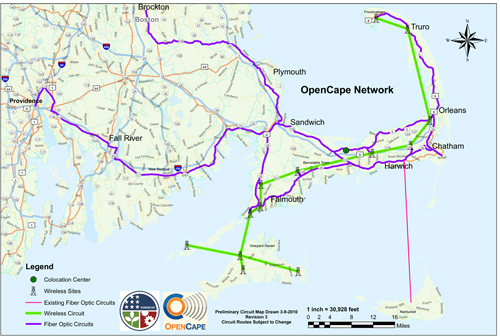
It will be another two to three years before the 350 miles of fiber-optic cables are strung from Provincetown to regional network access points in Providence and Brockton. A wireless microwave network – which will reach to Martha’s Vineyard – and a data center are part of the project, too.
Planners say this will be an open and neutral “middle mile” project, which means lateral connections to the main trunk will have to be made by other telecommunications firms, in most cases.
“You have to think of this in terms of a highway we’re building and the off-ramps and side roads are really going to be constructed by other companies – what are described as last-mile providers,” Gallagher said. “They will come in and offer services. But now they have a way – at a reasonable price point – to carry all of your traffic to the Internet.”
OpenCape, however, will make immediate connections to research facilities, colleges and universities, hospitals and municipalities in a region that many have complained has been underserved by telecommunications companies. “There are pockets that are not served at all,” Gallagher said.
“We found that hospitals wanted to be connected to each other, regardless of ownership” to ease the use of electronic medical records, Gallagher said. “This makes that all possible at a reasonable price and at a high capacity.”
Once the network is complete, scientists at Woods Hole Oceanographic Institution, for instance, would be able to download and upload vast amounts of information for marine research. “They require a very large amount of bandwidth and they have been unable to get it,” Gallagher said.
Even at Gallagher’s Cape Cod Community College in West Barnstable, the school has been hamstrung by the lack of a fiber-optic network.
“We just didn’t have enough bandwidth for all of our students’ needs,” he said. “And that which I could get was so expensive, we couldn’t afford it. So we needed more options and more capacity for serving our students.”
Work on getting the fiber-optic backbone installed on the Cape and the islands of Martha’s Vineyard and Nantucket – areas that have long relied on the tourism industry – started about four years ago. OpenCape, a 501(c)(3), gained immediate support from towns and school districts on the Cape, and it received seed money from several local organizations.
The early effort paid off when OpenCape sought a slice of the federal stimulus money handed out by the National Telecommunications and Information Administration.
Gallagher noted that only 1 percent of the organizations that applied for the money actually received a grant.
The early preparation also won over RCN, the private company that OpenCape awarded the contract to install and operate the system.
Mary Stanhope, RCN’s director of marketing, said the company owns its own fiber-optic network that runs as far north as Burlington, Vt., and Portland, Maine, along the East Coast to Washington D.C. with a loop to Chicago and an extension to Toronto.
This is the first time RCN has agreed to install and operate a fiber-optic network it won’t own. “They had a pre-existing plan,” Stanhope said, explaining the company’s eagerness to form a partnership. “They weren’t reacting to an output of money; they had already identified a need.”
The OpenCape network will eventually connect to RCN’s own system through an existing “colocation” facility on Carpenter Street in Providence, where RCN’s customers can locate network, server and storage gear.
OpenCape estimates the project will create 233 jobs in the equipment, construction and manufacturing sectors, and an additional 194 indirect jobs.
But supporters foresee that the effects on southeastern Massachusetts will go far behind just the immediate construction of the network, spurring “economic diversification,” according to OpenCape.
Gallagher said municipal officials already have said a priority with the new system will be to develop regional umbrella services, allowing the region’s cities and towns to share information such as assessors’ data, library services and geographic-information systems. “There will be savings and efficiencies,” Gallagher said. “Why does every town have to have its own system and not share it?”
Stanhope, of RCN, sees some advantages to having an access point to the OpenCape network in Providence. She said it would open areas of southeastern Massachusetts to voice-over-Internet providers, host data centers and software-services companies.
Gallagher said he sees other benefits.
“More connectivity is a good thing,” he said. “It creates more competition, better prices and more capacity.” •