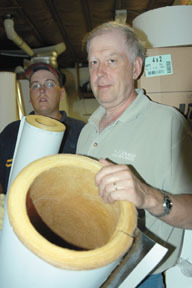
Insulation in East Providence.
R.I., Bay State contractors may have to pass along higher
costs
When a fire ripped through a Johns Manville fiberglass-manufacturing plant in Defiance, Ohio, on May 16, Greg Fiske’s life here in Rhode Island got a bit complicated.
The same goes for insulation contractors throughout the country. The fire at the 300-employee factory wiped out an estimated 40 percent of North America’s supply of fiberglass pipe insulation. (Nobody was hurt in the blaze.)
For Leaders Who Don't Have Time to Get Sick
Top performers guard their calendars, delegate relentlessly and optimize every hour of the day. Health,…
Learn More
Now, prices for the material – used to insulate pipes and ductwork in virtually every commercial and industrial building – have spiked some 30 percent, contractors say. Many are scrambling to use alternative – and more expensive – insulations such as calcium silicate and foam glass.
Fiske is general manager of Anchor Insulation in East Providence. He said the company uses fiberglass-pipe insulation for roughly 60 percent of its insulation work – mostly commercial and industrial jobs, from hotels, office buildings and schools to power stations and biopharmaceutical factories.
He says Anchor Insulation has warned its customers that the kink in supply could drive up costs.
“We’re quoting based on current price and availability,” Fiske said. “But when the time comes to do the job, if we can’t get (the insulation) or have to pay more for it, we’ll need to get a change order to cover those costs.”
Denver, Colo.-based Johns Manville said in a July 8 letter to distributors that it could take as long as two years to bring its production of fiberglass pipe insulation back up to pre-fire levels. It has introduced a new pipe-insulation material and plans to import some product to help bridge the shortfall.
Meanwhile, the company and the country’s other two fiberglass-pipe insulation manufacturers – Owens Corning and Knauf Fiber Glass – essentially are rationing supplies, a Johns Manville spokeswoman said.
Bob Tise, president of Homans Associates, a distributor of mechanical insulation products in Wilmington, Mass., said the company’s supply of fiberglass-pipe insulation has dried up – as has its inventory.
“We allocated it to the customers we felt deserved it, but we’ve gone through all that inventory,” Tise said.
The company relied on Johns Manville for virtually all its fiberglass insulation. It recently cut a deal with Owens Corning for a limited amount of product, representing only about 13 percent of its normal stock, Tise said.
In the meantime, it is selling contractors substitute products such as mineral wool and rubber insulation, he said.
Lead times for orders of fiberglass-pipe insulation are expected to grow – especially for larger diameter sizes – according to Lancaster, Pa.-based Specialty Products & Insulation Co. (SPI), one of the country’s largest distributors of insulation products.
In an “information bulletin” that SPI sent to its customers last month, the company declined to speculate on future prices. But it said the supply disruption would be felt throughout the distribution channel, and could affect construction schedules.
“We are expecting a potential disruption in inventory levels, which may impact our ability to provide you the full range of fiberglass-pipe insulation in the quantities … and time period you may require,” SPI’s bulletin reads.
Fiske said Anchor Insulation has leased additional warehouse space to stock up on any fiberglass insulation it can get its hands on.
“I hate to say we’re hoarding it, but any chance we get to pick up more of
the stuff, we’re buying it,” Fiske said. “A bird in hand is worth two in the
bush.”