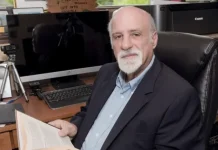
PAWTUCKET – A former U.S. Air Force officer who served as a military construction and infrastructure manager has been named the new executive director of The Pawtucket Foundation, Thomas A. Mann Jr. took a few minutes to tell Providence Business News what he hopes to accomplish in the city.
PBN: How does the self-image of Pawtucket affect economic development and how will you bolster that image?
MANN: As a newcomer to Rhode Island, I was excited to discover a place like Pawtucket. It has so many wonderful assets that could make for a vibrant, thriving urban center in the Providence metropolitan area. I am often disappointed to hear people speak negatively about the city.
Let me provide a beacon of light: Pawtucket is presently experiencing a positive boom. In the downtown alone, two mill-to-condo adaptive-reuse projects are nearing completion, while two others are already occupied. A new bike path is going to provide recreation access to the riverfront. The new Interstate 95 Pawtucket Bridge is going to be a majestic icon that will represent a true visual gateway to Rhode Island – a critical project that will reflect pride and a positive self-image for Pawtucket.
Partnerships with private-sector interests, neighboring municipalities and other advocacy groups are resulting in measurable progress, such as the Broad Street Corridor Initiative, Tri-Communities Initiative and KeepSpace Initiative, among many others.
There are several large-scale mixed-use development projects complete or in planning … and the city is doing the things it needs to do to create economic growth. The establishment of a creative/artist economy has been very successful. It’s an exciting time for Pawtucket.
Your Business Has Gone Global. Has Your Insurance?
A decade ago, “doing business internationally” was mostly a large-company concern. Today, a manufacturer in…
Learn More
PBN: How does commuter rail fit into that image? How is the foundation pushing for a rail station?
MANN: I can’t stress the importance of a good mass transportation system for a metro economy enough. Commuter rail is absolutely essential to our community. The future of this entire region’s and city’s ability to compete in a global and knowledge economy will rely on our ability to efficiently link people to jobs, goods, education and services. Large companies locate in areas that have good mass transportation opportunities. Given the density, labor pool and geography of Pawtucket and Central Falls, a commuter-rail stop will provide important access to both Boston and Providence markets.
Further, as we strive to create awareness of the effects of climate change, more of our population has become enlightened. It is obvious that if we reduce vehicle miles traveled in an automobile, develop urban centers more intensively with a smaller footprint and provide more opportunities for better transit systems, our economy can grow in a sustainable manner.
The Pawtucket Foundation continues to partner with the city and other regional entities to lay the groundwork for a commuter-rail stop. An initial engineering feasibility study has proved a commuter-rail stop can happen. The next phase is to further develop engineering and technical requirements and siting for a stop. The last critical piece will be to plan for transit-oriented development around the site.
PBN: In that effort, how crucial is downtown redevelopment? How about businesses along Main Street?
MANN: The downtown is historically the center of gravity for any city. Pawtucket’s downtown was originally a thriving, commercial business district designed for pedestrians. It’s a completely walkable city. If one starts from the center of Main Street, he or she can essentially walk anywhere within the downtown in five minutes.
If we can concentrate future mixed-use development in the downtown, along connected neighborhood commercial corridors and around transit nodes, we will see successful economic growth. Pawtucket’s downtown already has tourism attractions, historic architecture, arts-related businesses, financial businesses and professional services. It needs more. People are looking for things to do in the evening. We have two successful theaters, but we could use more entertainment and neighborhood retail venues – there is an overwhelming demand for this.
The Pawtucket Foundation wants to encourage business growth. We are looking for ways to attract development, strengthen current businesses and bring in new ventures. Compared with Boston and Providence, real estate is a fantastic deal in Pawtucket. Now is the time to invest.
PBN: How important is mixed-use development in Pawtucket?
MANN: Let me first say that single-use, single-story development in the United States has resulted in sprawling land use patterns that suck up taxpayer dollars to cover massive infrastructure costs. This pattern of development is also unsightly and results in higher transportation and carbon costs. Take a ride down any big-box retail corridor lined with gas stations, convenience stores, and fast food joints. This is not a safe place for a child to cross the street. There is no sense of place.
When we mix uses, build vertically and pay attention to creating pleasant, vibrant streetscapes, we are creating neighborhoods that are attractive to residents, visitors and business owners. This can only be accomplished with mixed-use development.
In Pawtucket’s downtown, the city has made fantastic use of old mills. Now, it’s time to also focus on the vacant lots – parking lots – and empty Victorian-era buildings. There are some exciting opportunities and I would definitely support the city in putting the pressure on land-owners to intensively develop their property or sell it to someone who will.
In doing this, there are financial challenges and risks, so perhaps we need to also work on some innovative financing solutions to free up necessary capital for downtown development. This is why public-private partnerships are so essential. The private sector has to step up to the plate and contribute to these deals to make progress happen.
I guarantee the City of Pawtucket is willing to create incentives and work with a responsible developer or entrepreneur. You won’t find a more welcoming municipality staff.
PBN: What about historic preservation and mill renovations?
MANN: Many local citizens are emotionally invested in our present stock of historic architecture. In some cases, it makes sense to save and reuse these buildings. In some cases, we may find out it makes sense to demolish these structures to create a more efficient lot layout and development footprint.
I think we can have some real debates about which buildings we should keep and how new buildings should look. Should new construction be contextual or convey the spirit of the times? European urban-infill projects tend to be self-expressions. A colleague of mine practicing architecture in Belgium said he would lose his license if he designed a contextual building.
When we had the R.I. Historic Preservation Investment Tax Credit, the positive result was obvious. I’d encourage people to go check out our renovated mills. You won’t believe what we now have in Pawtucket and the exciting live-work opportunities for artists.
The reality is that Pawtucket is primed for development. Outside of Providence, I’d argue that no other city in Rhode Island has this kind of direct access to I-95, a beautiful riverfront, historic significance, a walkable downtown, access to good mass transit, density, parks and available stock of development opportunities.
If you are a developer or business looking for land, you need to look at Pawtucket right now. When the financial merry-go-round starts turning again, Pawtucket will be a hot market.
The Pawtucket Foundation – a partner in the Northern Rhode Island Tri-Communities Coalition – is a policy group established by local business and nonprofit leaders to encourage economic development and reinvestment in Pawtucket and Central Falls and advocate for downtown, river and gateway improvements. For additional information, including background information about Executive Director Thomas A. Mann Jr., visit www.PawtucketFoundation.org.