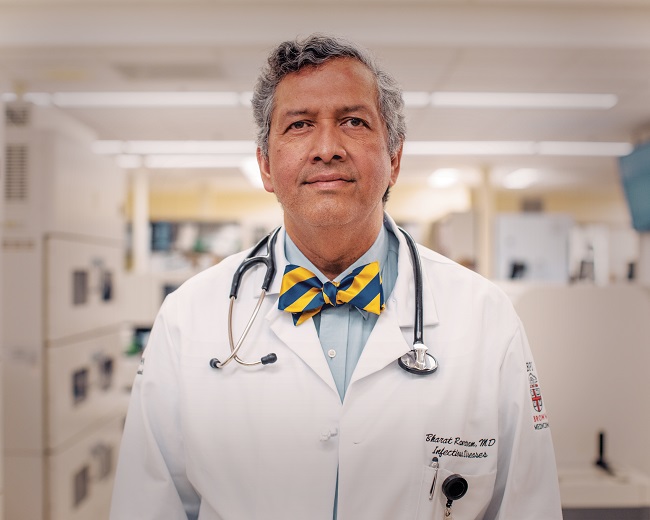
Dr. Bharat Ramratnam serves as Lifespan Corp.’s chief science officer and medical director of the Lifespan Clinical Research Center. Along with these titles, Ramratnam is also the research chair for the department of medicine at the Warren Alpert Medical School of Brown University and leads the retrovirology lab for the Lifespan/Tufts/Brown Center for AIDS Research and Rhode Island Hospital’s COBRE Center for Cancer Research Development that is funded by the National Institutes of Health.
Ramratnam, who also earned several awards for his teaching and research and is a permanent member of the NIH AIDS Immunology and Pathogenesis Study Section, spoke to Providence Business News about his work.
Selling Luxury Real Estate Requires More Than Exposure
By Emilio DiSpirito IV License Partner | Private Office Advisor Engel & Völkers Oceanside www.DiSpiritoteam.com…
Learn More
PBN: Last year Lifespan, Care New England Health System and Brown University signed a research collaboration agreement. What areas has this collaboration been successful in so far?
RAMRATNAM: Nearly a year ago, we announced that Lifespan, Brown University and Care New England had signed an agreement to align research operations. The goal of this agreement and the creation of the Brown Innovation and Research Collaborative for Health, as it is now known, is to establish a unified approach to conducting health and medical research that streamlines operations and strategically aligns the institutions’ research priorities.
Teams from each organization are busy designing BIRCH and collaborating on a strategic plan that will guide current work and future investments in health centric research. We are excited that BIRCH as a singular entity will begin operations in [mid-fiscal year 2024].
PBN: What are some research areas that Rhode Island health systems and educational institutions stand out in?
RAMRATNAM: Our practice is to involve a multidisciplinary team from both hospital systems and Brown University’s School of Public Health and Warren Alpert Medical School to tackle some of the biggest health challenges in Rhode Island. We are partners with our community, and as an example of recent success, consider Rhode Island’s performance in responding to HIV/AIDS.
Comprehensive programs centered in our Division of Infectious Disease that partner academia, research, community-level organizations and state government have led to improvements in the well-being of [individuals infected with HIV-1]. Similar cross-society collaborations by faculty from Department of Pediatrics at the Warren Alpert Medical School of Brown University have led to Rhode Island leading the nation in terms of youth vaccination rates.
We also pride ourselves on presenting Rhode Islanders with state-of-the-art clinical trials, including those sponsored by National Institutes of Health. We were among the leaders in the world in terms of recruiting patients to COVID-19 clinical trials in the early days of the pandemic.
PBN: Where do you see opportunities for improvement in Lifespan’s research?
RAMRATNAM: Efficient research operations require many staff [members] with different expertise ranging from information technology to regulatory affairs. BIRCH will prove critical in organizing talented staff at all three organizations in one location, thereby offering our researchers access to the best and most efficient practices in research.
Many of our greatest health challenges demand a better understanding of basic disease processes in the setting of socioeconomic and psychosocial stressors. BIRCH aims to encourage collaborations among pure biologists, health delivery teams, biostatisticians and experts in public health with the result of closer connections to community and individual patients.
PBN: What are your goals for Lifespan’s research over the next few years?
RAMRATNAM: We need to build on our current NIH-funded Centers of Excellence focused on HIV/AIDS, stem cell biology, drug addiction, injury control, psychosocial stress and sleeping disturbances. All these centers focus on Rhode Island-centric concerns but have national and international importance.
BIRCH allows us multiple opportunities to expand our current programs in cancer and brain health.
A major and ever-present theme is our commitment to our community and increasing diversity, equity, inclusion and well-being both among our highly valued staff and the community we serve.
PBN: What are some challenges related to researching retroviruses and how do you plan to overcome those?
RAMRATNAM: Enormous progress has been made in the early diagnosis and treatment of HIV/AIDS such that infected individuals live as long as uninfected people. The medications are well tolerated and stop the virus from replicating and destroying the immune system.
A singular challenge is eradicating [the] virus and curing the individual of infection. HIV is a genomic parasite and inserts itself into our DNA. The field is exploring new ways of removing the virus from the genome or permanently shutting off its ability to replicate. This remains a considerable scientific challenge.
Katie Castellani is a PBN staff writer. You may contact her at Castellani@PBN.com.