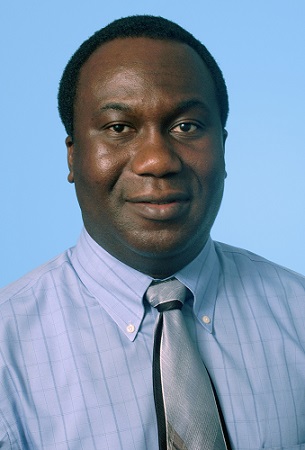
Dr. Kwame Dapaah-Afriyie, an internal medicine specialist known as a hospitalist, has been appointed to serve a four-year term as governor of the Rhode Island Chapter of the American College of Physicians.
Dapaah-Afriyie, who is director of hospital medicine at The Miriam Hospital, was designated governor-elect of the Rhode Island Chapter of ACP in February. He will complete a year of training before starting his term as governor in the spring of 2023.
Your Business Has Gone Global. Has Your Insurance?
A decade ago, “doing business internationally” was mostly a large-company concern. Today, a manufacturer in…
Learn More
Dapaah-Afriyie, who also founded The Miriam’s hospitalist program in 1997, discusses the program and what the next five years will hold for him in his new role at ACP.
PBN: What will some of your main responsibilities be once your term as governor of the Rhode Island Chapter of the American College of Physicians begins in the spring of 2023?
DAPAAH-AFRIYIE: I envisage continuing the great work our current governor, Kelly McGarry, and my other predecessors have done in regards to the college’s core objectives: professional development, patient care, medical education and advocacy.
Psychosocial effects of the COVID-19 pandemic have taken a toll on the medical community. Steps to rekindle and advance professionalism will be my initial major focus.
PBN: You’ve been very active in the care of people hospitalized with COVID-19. Are you beginning to see fewer and less seriously ill patients now that cases of the virus are decreasing?
DAPAAH-AFRIYIE: Yes, the omicron surge, which came at a time when we were significantly understaffed, has thankfully subsided. We are seeing fewer patients admitted to our hospitals requiring management of COVID-19. The acuity of those admitted has also decreased significantly. It is nowhere near what we dealt with in 2020 and the early part of 2021.
There is no doubt that R.I.’s vaccination program, which has yielded one of the best results in our country, has played a major role in this. Also, the availability of new treatment options has provided us with more effective ways to prevent severe disease. Still, I’ve seen how terrible this disease can be and urge everyone to get vaccinated.
PBN: What inspired you to create the hospitalist program at The Miriam Hospital?
DAPAAH-AFRIYIE: That is a very long story. But, in short, the need for it arose due to the increasing acuity of patients in the inpatient setting, and challenges posed by having primary care physicians needing to hold office hours in outpatient settings while also having to visit patients of theirs admitted to the hospital.
In order to enhance and optimize patient care, there was and still is no doubt about the need for timely inpatient care management by hospitalists. Hospitalists are internists employed by hospitals who specialize in the care of admitted patients. At The Miriam, they are supported by residents, who provide additional on-site care of patients.
PBN: What are some of the program’s focus points now as opposed to when you founded it in 1997?
DAPAAH-AFRIYIE: At the onset, the emphasis was on patient care outcomes. We had to prove that we could provide the care PCPs had been providing, while maintaining the required channels of communication with them to ensure patients were content with this new model. Lots of clinical studies have been published to allay these initial concerns.
Over the years, we have enhanced our academic mission through publication of articles and case reports in medical journals while working closely with medical students and residents. We have also improved our collaboration with case managers to more efficiently discharge patients when they are ready to go home.
PBN: You are in the unique position of not caring for patients long term. Rather, you treat people who are hospitalized and in need of internal medicine care. What drew you to this specialty?
DAPAAH-AFRIYIE: My initial medical training before my residency at The Miriam Hospital was based on an acute inpatient care model. Although this is relatively new in the United States, it has been a long-standing model of care in many other countries.
We have varying skill sets and talents, which ought to be harnessed to optimize patient care. We just saw the LA Rams win the LVI Super Bowl. Well, PCPs are like quarterbacks and hospitalists and other specialists perform assigned roles. The best patient care is the result of team effort.
Elizabeth Graham is a PBN contributing writer.