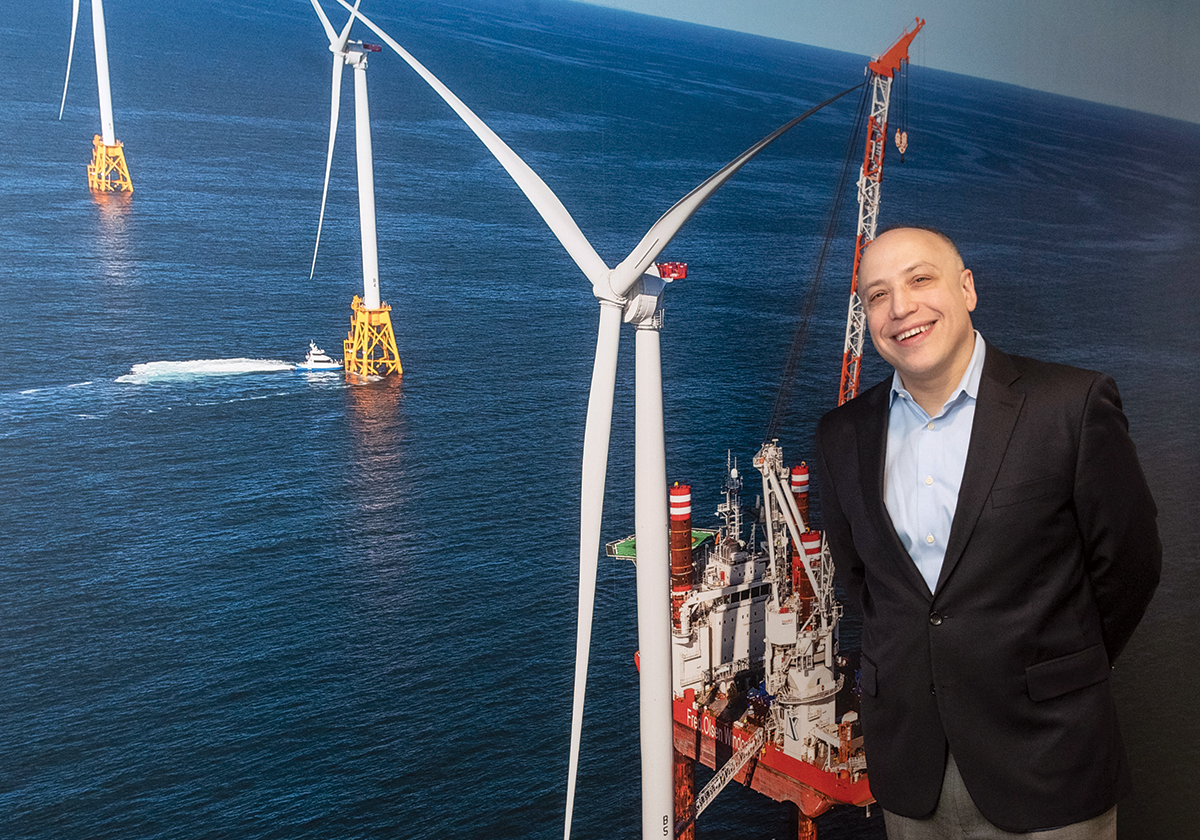
5Q: Jeffrey Grybowski | Co-CEO, Orsted US Offshore Wind
1. When will construction start on the Revolution Wind project? Depending on how long it takes for federal and state environmental and regulatory reviews, local construction activity could begin as early as 2020. We plan for the project to be online in 2023, producing power and delivering it to the New England electric grid through a new offshore power transmission cable linked to the mainland. Preliminary planning and oceanographic investigations of the offshore site are already well underway.
2. What will Orsted’s $250 million in investments in Rhode Island include? Revolution Wind will represent one of the largest private investments into the Rhode Island economy in recent years. We’re already committed to invest $40 million in port infrastructure to ready Rhode Island ports for our project. In total, we plan to spend approximately $250 million locally on goods, services, salaries, local contractors, equipment, environmental studies [and] workforce training.
3. How did Orsted arrive at the projection that Revolution Wind will save Rhode Island electricity ratepayers millions of dollars? Thanks to ... the maturing of the industry … we’ve been able to bring down the cost of offshore wind energy in a major way. Our fixed pricing of 9.8 cents per kilowatt hour makes Revolution Wind an affordable and stable, long-term source of clean energy. National Grid estimates our project will save R.I. ratepayers millions of dollars, meaning a savings of roughly 50 cents a month [for residential users] over our proposed 20-year contract.
4. What comes after the Revolution Wind project? In the U.S., we’re actively developing offshore wind farms to serve Rhode Island, Connecticut, New York, New Jersey, Maryland and Virginia. Eversource recently invested in a 50% ownership stake of Revolution Wind and our South Fork Wind Farm project serving Long Island, adding even more expertise to our team.
5. How far along is Orsted in developing a compensation package for commercial fishing? We’ve set a very high bar for responsible offshore wind development through our work at the Block Island Wind Farm. We’ve developed a long-standing, cooperative working relationship with the maritime sector, including commercial fishermen. … Our ongoing dialogue with commercial fishermen continues and we’re confident we can develop Revolution Wind in a way that works for all ocean users.
Scott Blake is a PBN staff writer. Contact him at Blake@PBN.com.