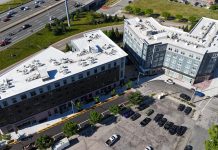
RK Associates vice president of leasing talks about the renovated RK Swansea Place.
The first batch of stores in a redeveloped shopping center along Route 6 opened in late July.
Target, Marshalls, Radio Shack and a group of smaller stores opened their doors at the renovated RK Swansea Place, with more expected to arrive in coming months.
This comes roughly four years after Dedham, Mass.-based RK Associates purchased the financially struggling plaza that once hosted a Kmart and a Building 19. The company started renovation work last November, revamping the façade, repaving the parking lot and installing a traffic signal at the plaza’s entrance.
Kenneth Fries, vice president of leasing for RK Associates, answered five questions about the project.
Rhode Island's Market Has Changed. Developers, Builders, Investors and Sellers Must Change With It.
By Emilio DiSpirito IV License Partner | Engel & Völkers Oceanside Leader | The DiSpirito…
Learn More
PBN: What gave you the confidence to move forward with that project?
FRIES: Our decision to move forward was a combination of the improving economy and Target’s commitment to the project. Target’s [enthusiasm] about the trade area was the catalyst that encouraged us to undertake the revitalization of the shopping center. We worked closely with Target to establish a successful redevelopment that would attract other key retailers despite this sluggish economy.
Our development strategy, however, put us in the position to react quickly to their interest in the market. We typically buy undervalued, underdeveloped properties with the goal of re-tenanting/redeveloping those assets when market conditions permit. This project fit squarely into our business model and is off to a successful start.
PBN: Now is RK Swansea Place unique or indicative – at least when you started work – of a broader recovery for shopping centers?
FRIES: RK Swansea Place is unique in that it was an existing site requiring minimal permitting and site development to accommodate a prototypical Target and, therefore, allowed us to execute a deal that was beneficial to both parties. The broader recovery of shopping centers in terms of occupancy has been fueled primarily by the expansion of discount retailers. Dollar Tree, Big Lots, Savers, Ocean State Job Lot and Aldi account for the majority of retail space absorption. Lower vacancy rates provide landlords with the ability to charge higher rents to new or expanding tenants in the market thus providing the feeling of a recovery. We will not have fully recovered until the market justifies new, ground-up development.
PBN: As a company, RK Associates seems to be growing despite these tough economic times. What’s the attraction to grow now?
FRIES: Our investment strategy, which includes very conservative financing of projects, is ideally suited for a capital constrained market. We have the ability to fund our acquisitions from existing cash flow, thereby eliminating any need for outside financing and the accompanying hurdles. We are able to hit the ground running on new projects without having to wait for a myriad of lender approvals. In fact, during recent years, we have identified, contracted to buy and closed on various shopping centers in in less than 45 days.
PBN: Do you think the downgrade of the U.S. credit rating will impact shopping centers? Will it adjust the thinking of center owners considering building or renovating plazas?
FRIES: Overall, the downgrade is meaningless and merely reflects the current political landscape in Washington. The economy as whole and the health of the retail sector will be far more significant factors for shopping center development and renovations. Our decisions to renovate or build is a direct result of tenant interest and demand. In a twist on the old movie line – if they come, we will build it.
PBN: I’ve noticed that many indoor malls, including Rhode Island Mall, have been converted to shopping plazas. Why is that? Does it have to do with the troubled economy?
FRIES: Rhode Island Mall’s shift from an enclosed regional mall to basically a strip center is quite similar to the de-malling of the Lincoln Mall and our own RK Newport Towne Center (formerly known as the Newport Mall). Each of these centers, for one reason or another, had become functionally obsolete and no longer generated interest from quality tenants nor the cash flow to support the enclosure. In our case, we purchased the Newport Mall in a rundown condition requiring significant capital improvements. Similar to our Swansea project, it was a permitted site, and through some maneuvering with existing retailers, we were able to reposition the center with new quality tenants.