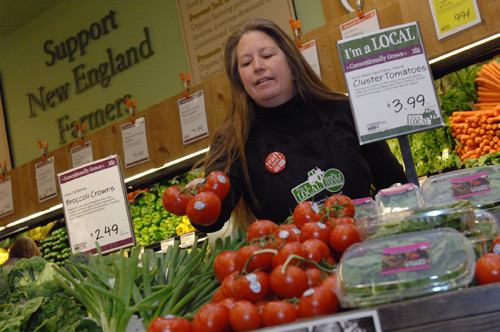
Although he has been a chef and owned and operated two restaurants in South County, Steve Siravo readily admits he knew little about the grocery-store business when Whole Foods markets in Rhode Island started selling his homemade salsa about two years ago.
But he has since learned, through his own efforts and the support and assistance of Whole Foods staff, particularly Holly Dion. Dion carries the unusual title “local forager” because she literally searches for local products that Whole Foods can sell, working closely with local producers and farmers like Siravo.
Dion, a former executive chef with a degree in culinary arts from Johnson & Wales University in Providence, describes her job as “ambassador for the local buying program” because she is the “initial contact” local producers must make if they want Whole Foods to carry their goods.
Whole Foods is far from alone in reaching out to local suppliers, but at Stop & Shop, for example, the emphasis is on produce rather than other kinds of goods.
At Stop & Shop stores in New England, category managers at each store and a procurement team work “in close collaboration” with local producers, such as farmers, according to Suzi Robinson, manager of public and community relations for the chain based in Quincy, Mass. “Through a large network of farmers, we are able to offer for sale a wide selection of items,” Robinson said, with the most popular being tomatoes, corn, cucumbers, peppers, summer squash, hard squash and beans. “We pay the farmers a weekly negotiated price for their product no different than any other grower partner.”
Robinson estimated that as much as 20 percent of each store’s produce is locally grown during the peak of the growing season. Stop & Shop, which has 25 stores in Rhode Island, also offers a lesser percentage of locally produced and manufactured items year-round.
Based in Austin, Texas, Whole Foods with 300 stores bills itself as the “largest retailer of natural and organic foods” in the nation and has three stores in the Ocean State – two in Providence and one in Cranston.
The company maintains “very high standards” for the local goods it carries, Dion said. There must be no artificial preservatives or additives, no genetically modified organisms and no hormones added; everything must be “organic or all-natural,” she said.
The stores each offer more than 100 local products on any given day, Dion said. She declined to put a percentage figure on the number of local versus other products, but said Whole Foods has a goal of making 20 percent of all products local.
The role of a “forager” like Dion has become more important in recent years at many supermarkets because consumers are increasingly intent on supporting the local economy and, for health and safety reasons, knowing the origin of the goods they put on their dinner tables and in their cupboards.
“Customers want to know where their food is coming from and who’s growing it,” Dion explained. “They want to buy locally because it helps the environment, too. Whole Foods has been doing this right along, for 30 years since it started in Texas, so it is great to see this [local emphasis] come to the forefront now.” She dismissed the notion that buying local is a fad. “It’s not going anywhere,” she said.
In addition, with the economy so dismal in the state, people who have lost their jobs for one reason or another generally return to school for more training and/or they open their own businesses, often based on a lifelong passion. This means more and more of our neighbors are becoming entrepreneurs and producing goods they want the public to buy.
She is anxiously awaiting the chance to try Block Island blackberry soda, made with Block Island blackberries. Confreda Greenhouses and Farms covers 250 acres in western Cranston and grows corn, peppers and tomatoes for Whole Foods. “They plant more than a million pepper plants,” she said in awe. In New England, she estimated that Whole Foods acquires produce from about 200 farmers on large and small farms, with many third- or fourth-generation family farmers.
Siravo, owner of Poblano Farm in South Kingstown, operated a Wakefield restaurant specializing in Mexican food for about six years when, a few years ago, customers were raving about his salsa, praise that gained the attention of Kenneth Hughes, who works with Dion at Whole Foods. “We got to talking and he suggested I submit a few samples” to see if Whole Foods would carry his salsa, Sirvao related.
Although he stressed that the recipes for his salsa and newly introduced pasta sauce are his own – the natural flavor of the main ingredient, such as tomato or chili peppers, is what he most focuses on – he did not know anything about labeling, packaging, promoting or seeking federal and state health department approvals. Hughes and Dion took him through the process, step by step.
“They never make a decision for you,” Sirvao said of the foragers, “but they give you a good background on what sells. They help prepare you so you’re set up to succeed and you don’t make a misstep.” He started off selling Poblano Salsa at the Garden City Whole Foods two years ago and now his product is carried in 38 Whole Foods markets from Maine to New Jersey, as well as other stores in Rhode Island such as Dave’s Marketplace.
Dion, who has been Whole Foods’ Rhode Island forager for three years, regularly stops at farm stands and goes to farmers markets to find produce. If she finds a product she likes, she makes sure, first and foremost, that it is locally produced and then tries it with family or friends at work. If the product wins informal approval, the next step is to have tasting teams at Whole Foods try it, such as the grocery team, the bakery team or the produce team, comprising market employees in those departments.
“We would never just deny someone,” Dion said, referring to cases where a product is not seen as meeting Whole Foods’ standards. “We just believe in supporting people in their dreams and we would give them constructive feedback, such as telling them that the sodium level is too high. We often work to make a product better, if the vendor is open to it.”
Dion at some point meets with the local vendor to discuss pricing. “Usually, they have a pay range they would like and we have a pay range we would like,” she explained, “and we come to a compromise” on a price that is fair to the consumer, the market and the supplier.
If a local product fails to sell well, Dion said Whole Foods does not just pull it off the shelves. She works with suppliers to encourage them to promote their product more, by conducting in-store demonstrations, for instance, and in some cases the store will offer better shelf placement to a struggling local product. “But if they’re not interested in the demonstrations, then eventually we have to stop carrying their products,” Dion said. “We only have so much shelf space.” •