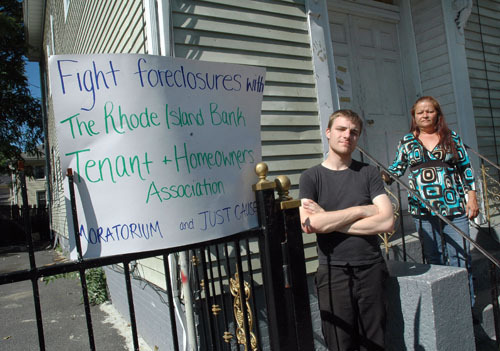
On the day before last Thanksgiving, Ben Kaplan got an unexpected letter in the mail at his Richter Street apartment in Providence’s Smith Hill neighborhood. He had been living there for five years, but he was being evicted, the letter said, by U.S. Bank NA, a subsidiary of U.S. Bancorp. The bank had foreclosed on his landlord.
“We didn’t know it was happening until we got a letter from the bank,” the 30-year-old Kaplan said last week. “And we were hosting Thanksgiving, too.” So Kaplan set about trying to negotiate with the bank. He told them he’d be willing to pay them rent – he was paying $550 a month for a one-bedroom – and that he had records that showed he had been paying on time. “But it eventually proved to be fruitless.”
Then, after Kaplan had given up and was preparing to move, R.I. Realty Ventures LLC bought the three-story home, valued at $273,700 by the city, for $72,000.
So Kaplan got a reprieve and a new landlord.
While Kaplan was able to stave off eviction, there are plenty of Rhode Island residents who have been evicted because of foreclosures – 1,166 tenants in Providence in 2008, according to a study released early this month by Rhode Island Legal Services. And there were another 1,172 in the rest of the state last year.
And many of those bank-owned property evictions were of responsible, rent-paying tenants, Rhode Island Coalition for the Homeless community organizer Rosalina Collazo said recently. That’s why she’s helped organize the Rhode Island Bank Tenant & Homeowner Association, a new group that’s working to raise awareness and push for legislation that would curb foreclosure-related evictions for rent-paying tenants.
“What’s happening is that when a home goes into foreclosure, the tenants automatically get pushed out by the services hired by the bank,” she said. “They send illegal letters, saying, ‘You’ve got 24 hours’ or ‘You’ve got 48 hours.’ And many people don’t know and actually go right on the street or to the shelter or to family and friends.”
During the last few months, Collazo and others have been walking neighborhoods around the state, knocking on doors of houses that are being foreclosed. “And we talk to the people and give them a pamphlet with whatever little rights they have in … Rhode Island.” And she found that a lot of apartment tenants do not know their rights when it comes to foreclosure-related evictions.
And, on May 20, a federal law gave tenants in foreclosed properties more rights, said Steve Fischbach, an attorney with Rhode Island Legal Services. “So all renters will be entitled to stay for 90 days before they can be evicted,” he said. “People who have lease terms that extend beyond 90 days, the banks will have to honor those leases.”
“It’s a good law – it’s not want we want, but it’s pretty good,” Collazo said. She said it doesn’t protect all tenants from being evicted, which is what her association is seeking. Her association is looking to stop foreclosures, which should stop the evictions, she said.
The report put out this month, “Move Out Rhode Island – An Analysis of 2008 Foreclosure Related Evictions,” is a collection of data showing where evictions took place and which lenders filed for the evictions. Fischbach, who authored the report, said the data culled from district court filings.
The three lenders with the most evictions – Deutsche Bank with 460 evictions; U.S. Bank with 382 evictions; and Wells Fargo with 262 evictions – accounted for 47 percent of all evictions, according to the report.
And the report also points to a disproportionate number of Hispanic households being evicted. While Providence boasts a 23.1 percent Hispanic population – the highest in the state – that ethnic group accounted for 46.1 percent of the city’s evictions. While 6.1 percent of Rhode Islanders are Hispanic, they accounted for 32.1 percent of evictions statewide.
The Warren Group, a Boston-based tracker of real estate data, pegged the number of foreclosures in Rhode Island at 3,479 for 2008.
Collazo said her group hasn’t had much luck getting any answers from financial institutions about bank-owned property – usually called Real Estate Owned, or REO – policies and why they evict paying tenants. “We haven’t had much response, but it seems to be that they don’t want to be landlords,” she said. “But after all their predatory lending, they should take responsibility because these loans were bad – selling to people who couldn’t afford it.”
Two spokesmen for Bank of America, which the study said is behind 180 of last year’s evictions – 8 percent of the state’s total – didn’t immediately return calls for comment. The bank is the only one in the Rhode Island Legal Services’ study with offices in the state.
Fischbach said the practice of evicting paying tenants “mystified” him, “because the cost of maintaining [a foreclosed property] should easily be absorbed by paying rents. It should be a moneymaker. … Banks are in the position that they’re in because they’ve made a number of bad decisions. This is just one of them.”
Kaplan, who was nearly evicted, agreed.
“It seems to me that anyone buying [an apartment building] would be buying it, at least in part, for the rental revenue,” he said, adding, “It was particularly disheartening because of the economic situation. In trying to deal with this, we wrote to senators and others and [found] that [U.S. Bancorp] was one of the banks that received a bailout. They got $6 billion, which seems unreal. … They’re using some of the money they get to hire lawyers to kick us out.” •