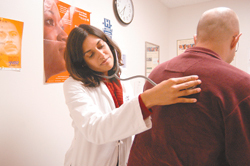
Dr. Sophia Gandhi examines a patient at the R.I. Free Clinic, where more than 1,300 uninsured adults receive care and the staff mainly consists of volunteers.
The tiny basement room is crowded and abuzz with activity. Young women in white
coats rush in with medical charts, write out long notes about their patients,
then grab new charts off a rack on the wall and head back out to the exam rooms.
On a white board on the wall, another volunteer keeps track of all the activity: who’s in the waiting room, who’s in intake, who’s ready for a checkup. An interpreter stands by. A pharmacist is on hand to dispense prescription medications.
This is the world of the Rhode Island Free Clinic: fast-paced and ever busier with the state’s seemingly endless supply of uninsured patients. All the volunteers have day jobs, so the clinic doesn’t open till 6 p.m. – and then they work until every patient has been cared for, often as late as 10:30 p.m.
For Leaders Who Don't Have Time to Get Sick
Top performers guard their calendars, delegate relentlessly and optimize every hour of the day. Health,…
Learn More
“There are a lot of people out there who don’t have health care,” says Linda Bastien, a nurse practitioner, during a break. “I think there’s probably a larger population than we even know about: the working poor. What would be the alternative for them?”
Bastien is one of more than 135 volunteers – health care professionals, students and laypeople – who staff the clinic. But the pool of potential volunteers is limited, executive director Lisa Smolski said, by the clinic’s inability to pay for malpractice insurance for retired doctors and others who don’t have coverage for their volunteer work through their regular jobs.
The clinic gets plenty of in-kind support from Lifespan, Women & Infants’ Hospital, Rhode Island Medical Imaging and other agencies and doctors, but its cash supply is too small to pay tens of thousands of dollars for insurance, Smolski said.
Now, however, a long-delayed provision of the Health Insurance Portability and Accountability Act of 1996 (HIPAA), is giving a break to clinics like Smolski’s all across the United States. The law allows qualifying health care professionals who volunteer their services to get free malpractice coverage through the federal government. Congress hadn’t provided funding before, but in March, it finally allocated money for the program.
The coverage won’t come automatically – clinics have to apply to the U.S. Department of Health and Human Services, submitting detailed information about the providers to be covered. Smolski, who said several retired doctors have told her they’d like to volunteer, is putting the word out so she can apply as soon as possible.
“This comes at a really good time for us,” Smolski said, noting how eager the clinic is to expand.
About 1,300 adults rely on this Broad Street clinic, which opened in June 1999 and has grown dramatically since then, from a one-night-a-week primary care service to a multifaceted clinic with several specialty services, from podiatry to mental health. They are all uninsured, ineligible for Medicaid and unable to pay for health care on their own.
So far this year, patient visits have increased by nearly 45 percent, and the demand for more hours, more checkups and more follow-up care keeps growing, Smolski said. But the clinic has limited funds, and it would need more doctors to serve any extra patients and supervise medical residents who help out.
On the fund-raising front, the clinic got a big break last month when it was chosen by Citizens Bank and NBC-10 as a “Community Champion,” eligible for a $25,000 grant, loads of free publicity, and volunteer support. But the clinic’s recruitment efforts have been hampered by the lack of malpractice coverage.
Volunteers in Health Care, a national program based at Memorial Hospital of Rhode Island, with Brown University support, had documented similar problems at clinics in many states, and had been lobbying for years to get the HIPAA provision funded to help them recruit and retain providers.
“Free clinics across the country have been hit hard by the rising costs of malpractice insurance,” Dr. H. Denman Scott, program director at Volunteers in Health Care, said in announcing the new program recently. “We’ve even heard about physicians being told that their insurance carrier will no longer cover their volunteer activities.”
Dr. Anne S. De Groot, the physician on duty Tuesday night, said the federal coverage would make volunteering an option for many doctors – from her father, Leslie J. De Groot, a renowned endocrinologist who’s retiring, to researchers like herself.
Treating patients is only a small part of De Groot’s work. She’s an assistant professor of community health at Brown Medical School, runs a tuberculosis and HIV research lab there, and has her own company, Epivax, which develops vaccines. But she also wants to keep a hand in clinical practice, and she does so by treating tuberculosis patients and prison inmates, and by volunteering at the free clinic.
The cost of malpractice insurance to cover her very limited clinical practice is “huge,” De Groot said, and she can understand why many other doctors working in research and administration just won’t do it.
“It’s a lot of money,” she said. With malpractice coverage, however, “there are probably a lot of people like me who are physicians but don’t have an active practice – who do research or run a company – who’d be happy to work at a place like this.”
Expanding the clinic’s physician roster would not only allow it to take more patients, said fund-raiser Laura Nelson, but it would allow for more flexible hours.
“The beauty of the retirees is that they can come in during the day,” she said. “The practitioners can often only come at night. We have daytime hours only twice a month now.”
The Rhode Island Free Clinic’s younger volunteers would also benefit, Smolski noted: dozens of nursing, pharmacy and medical students who help out and learn from the professionals, as well as medical residents who work under doctors’ supervision.
On Tuesday, in-between patients, University of Rhode Island pharmacy professor Margaret Charpentier gave informal tutorials on how to educate diabetics about nutrition.
A new wave of veteran practitioners would enrich the environment even more, said Bastien, who’s been in her field for 10 years but said she still learns a great deal here.
“It’s a give-and-take,” she said. “Everyone’s always learning from everyone else.”