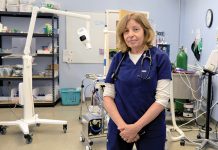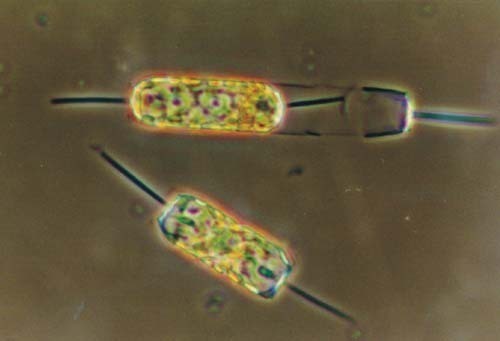
Tatiana Rynearson spends a large portion of her waking hours with plankton – specifically a one-celled variety called diatoms.
She collects samples of the tiny organisms; she examines them under microscopes; she grows them; she tests their DNA.
But before you start thinking that maybe Rynearson, a University of Rhode Island oceanographer, should broaden her horizons a bit, consider this: Her work eventually could have an effect on the quality of the air we breathe.
Scientists such as Rynearson believe microscopic diatoms, which exist in seawater throughout the world, are responsible for producing as much as 20 percent of the oxygen in the earth’s atmosphere through photosynthesis. It’s also believed they absorb a similar amount of carbon dioxide.
Now experts are worried about the effect global warming will have on these organisms that have such a vital impact on the world’s climate.
That’s why Rynearson was recently awarded an $852,000 grant from the National Science Foundation to study the “biogeography” of diatoms – how they are distributed throughout the globe and how they are genetically related to one another.
The warming of the world’s oceans “could have a reverberating effect,” said Rynearson, an assistant research professor at URI’s Graduate School of Oceanography. “We want to know what kind of adaptability the diatoms have.”
As part of the five-year study, Rynearson will collect diatoms in water samples from around the world, including South Africa, Italy, Japan Norway, Mexico and the U.S. coastline. Then she’ll use DNA fingerprinting – she pioneered the technique on diatoms – to track how the organisms move with currents and tides through the oceans. “It’s like a living bar code,” she said, referring to DNA fingerprinting.
In her lab at URI’s Narragansett Bay campus, Rynearson also will grow diatoms under varying conditions to understand genetic adaptations and to predict how diatom populations will respond to environmental changes.
Rynearson developed an interest in plankton while an undergraduate at Brown University, studying the fossilized remains of diatoms as she worked toward a degree in aquatic studies. “The more I thought about it, the more I realized that I should know about how living diatoms work,” she said.
After graduating in 1994, she worked for two years at the marine-research organization Alfred Wegener Institute in Germany. She continued her oceanography studies at the University of Washington and eventually earned her doctorate there. She joined the faculty at URI’s Graduate School of Oceanography in 2005.
There will be no shortage of diatoms for Rynearson to sample, considering there are up to 200,000 species of diatoms around the world and a single glass of seawater could contain as many as a half-million diatoms.
Despite their size, they also play an important role in the oceans’ “food web,” providing sustenance for larger organisms, such as a kind of crustacean called a copepod, which then becomes food for even large aquatic animals. “There are many connections to diatoms, and we’re not sure we understand what all those connections are,” Rynearson said.
The effects of global warming on the plankton aren’t understood, either.
Because diatoms survive in a variety of environments, from tropical water to the polar regions, experts have assumed for years they could endure a climate change. But nobody knows for sure, Rynearson said.
Her project will “look at the highways and byways in the ocean to see where the diatoms are going, where they’re coming from, and how well they do once they get there,” she said. “No one’s been able to answer that before.” •