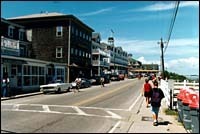
business on Block Island this
summer. (Tom Croke)
Despite predictions of record-high gas prices this summer, many tourism officials in Rhode Island say they doubt the cost of gas will crimp the number of tourist visits to the Ocean State. And some say high prices may even have the reverse effect.
“I don’t think higher gas prices will affect our bookings because we’re in such close proximity to the New York area, where we get most of our business,” said Cindy Roberts, owner of Bed & Breakfast Newport Ltd., which handles reservations for 350 hotels and B&Bs in the Newport area. “Maybe it will benefit us, because people won’t want to drive farther.”
A modernized health plan: Supporting cost management and the employee experience.
The Surest health plan came from a group of innovators wondering: What if health care…
Learn More
Theory has it that as gas prices rise, people are less inclined to travel. And that, in turn, puts a damper on tourism.
But there is thin evidence to support the notion that steeper prices at the pump will keep people from loading up the family SUV this summer.
Gas prices in Rhode Island last summer jumped considerably from the year before, hitting a record high of $1.69 a gallon for regular unleaded. Although official tourism figures from 2000 won’t be released until later this month, there were few signs of a slowdown in tourism.
“All indications are that Rhode Island had an excellent summer travel season last year,” said Robert Murray, senior vice president of corporate affairs for American Automobile Association of Southern New England. Murray noted that gas prices topped $2 in California and other states last summer, but the summer-drive season was busier in many of those areas.
Gas prices already are on the rise this year in advance of the summer travel season: The price of regular unleaded gas in Rhode Island hit $1.62 a gallon in late April — just seven cents shy of the $1.69 record-high set last July 3, according to AAA Southern New England.
Some energy observers say prices could set record highs again this summer, although forecasts vary. Murray said he expects prices in Rhode Island to near $1.75 for regular unleaded. The U.S. Department of Energy predicts gas prices nationally will come within a few cents of last summer but will not eclipse those prices.
Although signs for $1.75 a gallon would be an unwelcome sight for motorists, that price still is within the realm of “what the market will bear,” Murray said. Unless gas prices spike off the charts, he says, even record highs this summer likely won’t be enough to alter vacation plans.
Murray puts it this way: A 1,000 mile road trip last July — when prices were at the peak $1.69 a gallon — would have cost $84.50, assuming gas mileage of 20 miles per gallon. If prices top out at, say, $1.80 this summer, the same trip would cost an additional $5.50.
“Nobody’s going to cancel a summer vacation for five bucks,” Murray said.
And then there is Roberts’ theory: Steeper gasoline prices might cause travelers to modify their plans, which could bring more tourists to Rhode Island. Others agree that is a possibility.
“Rhode Island is one of those pass-through states,” said Tim Tyrrell, a professor in the Department of Environmental and Natural Resource Economics at the University of Rhode Island. Tyrrell tracks tourism statistics for the state. “If a family is driving up from New York and gas prices are a concern, maybe it won’t go all the way to Cape Cod,” Maybe they’ll stop in Connecticut or Rhode Island instead.”
Tyrrell said there has been little examination of the correlation between gas prices and local tourism. A study of the effect of high gas prices on Cape Cod’s tourism in the 1970s did show that people change travel plans when gas prices are exceptionally high.
“A lot of times, price shocks will make people explore different things that they haven’t done before, and that could be good for Rhode Island,” Tyrrell said. “But it’s hard to speculate about the direct effect of those changes.”
Another finding by AAA also bodes well for the state’s tourism industry. Over the past five years, vacationers have been less apt to take long, cross-country road trips that span two or three weeks. Instead, Murray said, people are taking a larger number of shorter vacations.
“That travel pattern is advantageous to New England,” he said. “There are so many tremendous places that are relatively close.”