INTERVIEW
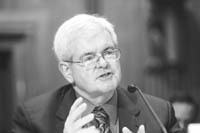
Newt Gingrich
POSITION: Founder, Center for Health Transformation; founder, the Gingrich Group (communications and consulting firm); co-chairman, National Commission for Quality Long-term Care; senior fellow at the American Enterprise Institute; distinguished visiting fellow at Hoover Institution, Stanford University.
BACKGROUND: A Pennsylvania native, Gingrich taught history at West Georgia College in Carrollton, Ga., from 1970 to 1978, when he was first elected to Congress. He became a national figure after leading the creation of the Republican Contract with America, which helped the GOP win its first majority in Congress in 40 years and secured Gingrich the post of Speaker of the House. He resigned in November 1998. Since then, Gingrich has emerged as a technocrat, conservative policy advocate and public speaker.
Education: B.A. in history from Emory University, Atlanta, 1965; M.A. in 1968 and Ph.D. in 1971 in modern European history from Tulane University.
RESIDENCE: Virginia
AGE: 62
Seven years after stepping down as U.S. Speaker of the House, Newt Gingrich is again at the forefront of policy discussions, this time in health care.
As the founder of the Center for Health Transformation in Washington, D.C., he’s become an advocate of health care information technology, especially electronic health records, which he calls the centerpiece of a “21st century intelligent health system.”
And while in some areas Gingrich remains a conservative, he supports consumer-driven health care and tax credits to help the poor pay for insurance, and speaks of personal responsibility as the key to good health.
He also works with Democrats U.S. Sen. Hillary Rodham Clinton, D-N.Y., and U.S. Rep. Patrick J. Kennedy on IT; and in long-term care with former U.S. Sen. Bob Kerrey, the commission co-chair.
On Dec. 16, at the invitation of Kennedy and Gov. Donald L. Carcieri, Gingrich came to Providence to promote health care IT to business leaders. PBN spoke with him afterward.
A modernized health plan: Supporting cost management and the employee experience.
The Surest health plan came from a group of innovators wondering: What if health care…
Learn More
PBN: What is the role of business in transforming health care?
GINGRICH: Businesses have three interests, I think, in health. First, they have an interest in the health of their employees, because it’s a direct cost function. Second, businesses often have new ideas, new technologies, new insights which, if they can transfer them to government and the health system, both lowers their taxes and increases the ability of the system to take care of their employees and customers. Third, everybody in the community is a potential customer, so if they have to spend more and more money on health, they have less money to spend on whatever the business is producing. I think if we’re going to compete in the world market, and compete with China and India, we have to have a health system which is effective both in terms of the quality of health and is affordable.
PBN: How important are electronic health records in particular?
GINGRICH: I’d ask you, how important is an ATM to get cash when you’re traveling? How important is your credit card when you pump your gas at the station and charge it? How important are e-tickets at the airport? We are very used to the idea, in many parts of our society, that using information technology is more accurate, more flexible, more convenient, more efficient. We have to bring that into health. Also, if we get hit with a pandemic like the avian flu, or with an engineered biological attack, it’s just terribly important that we have accurate records, so we can take care of people in a timely way.
PBN: Is this a state function, or a private sector function?
GINGRICH: I think the state has an interest in making sure it happens, but ideally it would get the private sector to manage it and run it. It’s much like the state has a real interest in making sure the airline industry is safe, but we have private airline companies and private airplane manufacturers. The government should set standards and monitor, but shouldn’t try to implement itself.
PBN: Some health plans across the country are starting to offer a form of EHRs; I think they call them PHRs, personal health records.
GINGRICH: We like the iHealth Record, which the AMA has endorsed. It’s a step in the right direction; it’s not a complete health record. I think personal health records are a good starting point because they get you in the habit of looking at your health data online. … Even things as basic as weighing yourself and monitoring your blood pressure – these are all good starting points for better health.
PBN: To what extent is the Quality Long-term Care Commission focusing on how to keep people cared for at home and out of nursing homes?
GINGRICH: In my mind, it’s a very big priority, because I think most people want active, healthy aging with maximum independence. Now there are circumstances where, if you end up with Alzheimer’s or something else, you might need a long-term care facility, or if you end up with a serious long-term illness, or become very old. So we try to maximize the use of expert systems and new technologies to help people live on their own as long as possible, and at the same time we believe if you end up needing a long-term care facility, it should be as modern, effective and compassionate as possible.
PBN: Do you see federal policy being important in this?
GINGRICH: Extraordinarily important. Starting with, I think, a tax credit for long-term care insurance, because you’ve got to get young people to buy long-term care insurance when it’s cheap, because people are just going to live so much longer than any humans in history.