“Family responsibilities discrimination law,” a new category of employment litigation, has become a hot topic in the world of business law over the past decade.
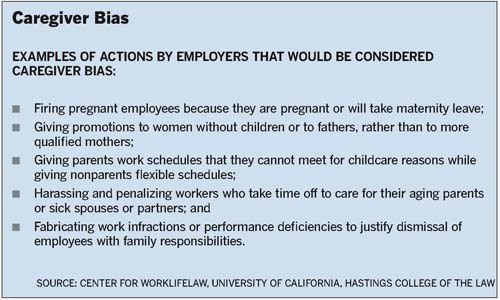
Judges, juries and regulators have become more sensitive to plaintiffs, most of them women, who sue their employers for caregiver discrimination – failing to accommodate their domestic responsibilities. The number of lawsuits alleging caregiver bias increased by 400 percent over the past decade, in spite of an overall decline in employment-discrimination litigation, according to a recent study.
Experts say the problem is most acute for mothers. “You don’t hear ‘This is no job for a woman,’ but you often hear ‘This is no job for a mother,’” said Joan C. Williams, a professor at the University of California’s Hastings College of the Law in San Francisco and a well-known legal scholar on caregiver bias. She spoke at the University of Rhode Island earlier this month.
Indeed, Williams argues that motherhood bias is “much, much stronger” than the glass ceiling bias that women face. “Discrimination against mothers is very open and very, very strong,” she said. “The glass ceiling exists, but motherhood is a huge factor.”
Two federal actions in recent years have raised the issue’s visibility. In 2006, the Supreme Court ruled that an employer had illegally retaliated against an employee by taking away the woman’s flex schedule, which she needed in order to take care of her young son. The following year, the Equal Employment Opportunity Commission issued a landmark set of rules outlining how employers should accommodate employees who are also caregivers, and recognizing the validity of caregiver discrimination.
In the months since the commission released its findings, corporate lawyers have reached out to the Center for WorkLifeLaw, which Williams founded at Hastings, and begun to brief their clients on how to avoid legal jeopardy over caregiver discrimination.
They have reason to take it seriously. A study of over 1,300 caregiver-bas cases by the center found that plaintiffs won more than half the suits, an “extraordinarily high” success rate, according to Williams. In some cases, plaintiffs were awarded more than $1 million.
Williams attributes the high rate of success to the cases’ “family values” appeal. As one lawyer told her: “The story we told was that my client was told to choose between being a good mom and doing her job well.”
Williams discussed her research into caregiver bias at a URI seminar sponsored by the college’s Advance Program, which has worked to attract and retain more women faculty members, particularly in the fields of science, technology, engineering and mathematics. Only 9.5 percent of physics professors are women nationwide, according to a 2004 study by the university. The numbers were barely higher in the other fields. Women make up only 11 percent of the nation’s faculty in engineering and less than 14 percent in chemistry.
Williams blames “the motherhood penalty” for holding back the careers of the 82 percent of women who eventually have children. At the age of 30, for example, women without children make 90 percent of what their male colleagues do — but women who have children make only 67 percent of what men make.
“The penalty shows no signs at all of decreasing,” Williams said, and it helps explain why women earn only 38 percent of men’s lifetime pay.
During her visit to URI, Williams met with university administrators and department chairs to discuss ways they could foster a supportive workplace environment for mothers.
The Advance Program, which was funded by the National Science Foundation, has already made some headway over the five years it has been up and running, leading to a major increase in the number of women faculty recruited and hired in the four departments. Williams, who has visited a number of Advance sites around the country, said she was “profoundly impressed” by the URI program.
In Williams’ view, the most effective way for society to tackle the issue of caregiver discrimination is to change the idea of the model employee from the “ideal worker” to the “balanced worker.”
Workplaces are designed to fit a world of ideal workers, who start working 40 hours a week in early adulthood and continue full-time for four decades without a break. “And who does that describe?” Williams said. “It does not describe mothers.”
Moreover, she said, the difficulty of balancing home and work responsibilities is only growing more intense as an increasing number of professions demand that employees put in 50 to 60 hours a week.
The problem is not limited to mothers, however; fathers also suffer from caregiver discrimination, although less severely, Williams said. “Men are penalized also for taking family leave, especially by other men,” she said.
Williams, who is also speaking at Brown University this month, encourages employers to tackle caregiver issues head-on by developing policies that allow employees to handle their family responsibilities without being penalized. The Center for WorkLifeLaw has set up a Web site, www.worklifelaw.org, which includes a model policy for employers, as well as resources for employees. •