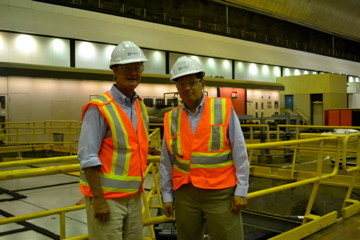
When Gov. Lincoln D. Chafee arrived in Labrador, Canada, earlier this month, he was not there to see the sights. Instead, the governor spent much of his visit touring a hydroelectric plant.
On the visit, Chafee brought along an executive from Toray Plastics (America) Inc., the state’s largest electric user. And he made little secret that he traveled north to show companies in the Ocean State that he recognizes the role of energy prices in business.
“Every business that uses any significant amount of electricity is affected by our high energy costs in New England,” Chafee said.
For some business executives, the attention to the topic is welcomed and the trip an indicator of more than just talk.
“It sends the message that he does care,” said Arnold Kaija, an engineer at Micofibres in Pawtucket involved with energy purchases. “Whether he can do anything about it, I don’t know. But the fact that it’s a concern of his and he’s willing to take action in whatever way he can, that’s a good thing.”
The average electric price in Rhode Island stood at 14.23 cents per kilowatt-hour in 2009, according to an April report by the U.S. Energy Information Administration. Seven states – including Connecticut and Massachusetts – had higher energy prices. As a nation, the average price was 9.82 cents per kilowatt-hour.
The price of power in New England has been a frequent complaint from businesses, especially those that operate manufacturing lines. Toray alone says it spends $20 million annually on electricity.
Executives have made their concerns known through meetings with politicians, testifying at legislative hearings and forming the Energy Council of Rhode Island, a consortium of some of the state’s largest energy users.
Executive Director William Ferguson said it is too soon to rate Chafee’s energy policies. But he said that the trip to Labrador showed the governor is willing to go outside the confines of Rhode Island – and oft-discussed offshore wind energy projects – to find a way to help businesses.
“To me that’s an indication he’s open to other alternatives,” Ferguson said. “The offshore wind, it’s got a high price tag, and if there are options with more reasonable costs available to use, we need to look at them.”
Jerry Elmer, the staff attorney at the Conservation Law Foundation’s Rhode Island office, said Chafee has showered small renewable energy projects with far more attention than his predecessor Donald L. Carcieri did.
“I think Gov. Chafee is properly committed to seeing the large offshore projects continue but in addition to, rather than instead of, looking to facilitate multiple smaller distributed generators,” Elmer said.
Chafee described his trip to Canada as a way to lay the groundwork for a deal to bring hydropower to the state when the project comes online as early as 2016.
“It’s just a matter of getting in line and making deals and making contacts,” he said.
And while the open market exerts major influence on large energy users’ purchases, the government still maintains some control. In Rhode Island, the R.I. Public Utilities Commission must approve the portion of electric bills that cover distribution and related costs.
The governor appoints the three-member commission and in March, the term of Commissioner Mary Bray expired. Chafee said she “has done a good job.” But no decision has been made on the seat, and one is unlikely to come until early next year, he said.
The governor also holds appointment powers for other state boards that set formal or informal energy policy, including the R.I. Energy Efficiency and Resource Management Council.
That council recently suggested that the PUC raise the surcharge on electric bills that funds a pool of money available for energy efficiency projects.
The increase would be relatively small, increasing to a penny per kilowatt-hour from a half a penny now. But that could add up to big money for some electric users, Ferguson said. Choosing whom to appoint to such councils is just one example, Ferguson said, of how governors can impact energy policy even without a trip to Canada. •