face threat from renewal.
(Tom Croke)
Representatives of Rhode Island’s fuel companies are concerned that the city of Providence’s redevelopment plans could threaten already scarce fuel-storage capacity.
Mayor Vinent A. Cianci, Jr.’s ambitious “New Cities” redevelopment plan, unveiled last year, calls for new offices, hotels and a new marina along a 200-acre stretch of industrial land between the Providence River and Allens Avenue.
Your Business Has Gone Global. Has Your Insurance?
A decade ago, “doing business internationally” was mostly a large-company concern. Today, a manufacturer in…
Learn More
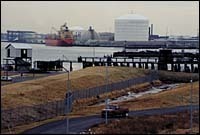
Plans for “Narragansett Landing” are long range, part of the mayor’s 20-year vision to revitalize three neglected sections of the city. But fuel companies say the mere specter of the project has scared away companies that might otherwise invest in empty fuel-storage terminals in that area.
Peter Lom-bardi, executive director of the trade group Oil Heat Institute of Rhode Island, says a 20-million gallon storage terminal on the waterfront, formerly operated by Citgo, sits empty. Because of fears that the city eventually will condemn the property to pave the way for redevelopment, he says, it’s been difficult to find a company that would assume control of the terminal.
“I’ve had calls from three different fuel companies interested in coming to Providence, but the concern is those tanks may be condemned by eminent domain,” Lombardi said. “Why would anyone spend a half million dollars to upgrade the terminal and get it operational when someone could come in and say ‘You’ve got to go?'”
Lombardi said there are also concerns that active fuel tanks owned by Sprague Energy Corp. in the same area eventually could be lost to the city’s redevelopment plans.
Those fears were heard at the state house earlier this year, when legislation was introduced that would require the city to pay for alternate fuel tanks if it condemns existing terminals.
Although the bill – introduced by Rep. Paul E. Moura (D-Providence) – doesn’t specifically mention the city of Providence, it reads: “If an agency seeks to acquire a petroleum marine terminal for public use, it shall first providean alternative marine terminal site.”
The legislation was held up in the House Finance Committee at the end of the legislative session last month.
The threat to the tank farms is especially critical because fuel-storage capacity at the state’s tank farms has dropped from about 350 million gallons in the 1980s to roughly 120 million gallons, according to the Oil Heat Institute.
The problem of less storage is magnified by the trouble fuel companies have getting oil reserves into the Port of Providence. When bad weather prevents barges from entering the port, fuel companies must rely on whatever reserves are stored at the terminals.
Although plans reportedly are in the works to dredge the Providence River, which would allow large ships to enter the port to deliver fuel supplies, Lombardi said that solution is likely years away.
If the city does condemn the tank farms, Lombardi said fuel companies would need the state’s help in finding new sites for the storage terminals because the “not-in-my-backyard” factor would make those efforts difficult.
Last month, lawmakers from several Aquidneck Island communities introduced legislation opposing the use of defunct fuel storage tanks at Naval Station Newport. The resolution was in response to a House commission assembled earlier this year to explore that possibility.
While those tanks have not been proposed as the alternate solution for the tanks in Providence, the resistance to use of the tank farms highlights the difficulty in finding a new site.
Lombardi said Moura’s legislation is necessary to remove the cloud of doubt over terminals in the proposed redevelopment area.
“We’re not trying to stop the New Cities project,” said Lombardi. “All we’re saying is we need all the storage we’ve got – don’t take any away from us.”