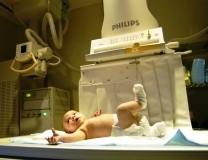
JAKE MAIELLO, just eight weeks old, lies on the platform of a fluoroscopy machine in the new Hasbro Children's Hospital Center for Pediatric Imaging.
To X-ray a baby is no small task.
For starters, babies tend not to lie still – they wiggle and squirm, and left in a strange room without their mother, even for a moment, they’ll be terrified.
ISO 9001:2026: A Practical Opportunity to Build for What’s Next
For Rhode Island manufacturers, ISO 9001 has been much more than a certificate on the…
Learn More
Plus adult-sized machines are much too powerful for tiny bodies, exposing them to many times the radiation needed to make images.
The challenges decrease as children grow older, but modern medical imaging technology doesn’t end with X-rays. There are CT scanners, with even more powerful radiation doses, and magnetic resonance imaging (MRI) machines, like inescapable tunnels, that can be scary even for adults.
Given all this, it’s no surprise that most radiologists choose not to work with children, except in emergencies.
“It’s very labor-intensive,” said Dr. Michael T. Wallach, director of pediatric imaging at Hasbro Children’s Hospital in Providence. “You have to be very patient and very careful – and take pictures on the fly, because they won’t hold still for very long.”
Wallach and his team handle the majority of pediatric medical imaging in Rhode Island, nearly 70,000 procedures each year – primarily X-rays and fluoroscopies (“video” X-rays), but also ultrasounds, CAT scans and MRIs
Now, with a $9 million renovation of the space formerly occupied by Rhode Island Hospital’s emergency room, the children’s hospital has dramatically expanded its imaging capabilities.
Previously, Hasbro Children’s Hospital had only a 2,200-square-foot space devoted to imaging. For CAT scans and MRIs, patients had to be transported upstairs, to Rhode Island Hospital’s imaging center.
Non-urgent procedures required long waits – two to three weeks for an MRI or a CAT scan, and up to four weeks for fluoroscopies or ultrasounds. And young patients who needed to be sedated for a CAT scan or an MRI – not uncommon, given the difficulties in getting a child to lie still in a confined space for as long as two hours – waited an average of seven or eight weeks.
“That’s a very long wait,” said Wallach. Not only were diagnoses delayed, he noted, but the wait was stressful for parents.
The new, 9,500-square-foot Center for Pediatric Imaging will change all that.
First of all, the center, which opened last month, has its own CAT scanner and MRI machine, so there’s no more need to wheel patients up and down the building.
“Our goal here is to look at things in the most efficient, least invasive way possible,” Wallach said. By having all the gear in one place, he said, it’s easier to be conservative –avoiding an MRI, for example, when an ultrasound will provides all the information that’s needed.
The center’s MRI machine has a shorter, wider bore than traditional scanners, so it’s less frightening for children, and the room is set up so a family member can stay with a child throughout the procedure.
And the CAT scanner, Wallach said, lets technicians adjust the radiation dose to the child’s size, so it’s just the minimum needed – a quarter or a fifth of what an adult CAT scan would involve.
“That’s a very big thrust in pediatrics in general,” Wallach said. Researchers estimate that as many as 750 children in the United States each year may develop a malignancy associated with radiation exposure, he said, and while the risk to any one child is statistically very small, it’s best not to take unnecessary chances.
“Nobody knows what the lowest safe dose of radiation is,” he said, “so we assume that the lowest dose is zero, and we always try to minimize it.”
With that kind of gear, Hasbro is now on par with facilities such as Boston Children’s Hospital or Massachusetts General Hospital, Wallach said, where many Rhode Island parents have taken their children over the years, seeking superior technology and shorter waits.
But Hasbro is taking it one step further: This month, it will open a new sedation area within the imaging center, run by Dr. Linda K. Snelling, Hasbro’s chief of critical care, so children who need to be sedated to get through a CAT scan, an MRI, or a CAT- or MRI-guided biopsy can be sedated and watched by experts right on-site.
“This is a very unusual setup,” Wallach said. Snelling reports that, at national meetings, the hospital’s sedation program “is causing quite a buzz.” And for patients, the new program not only will enhance safety, but will virtually erase the waiting times.
Overall, the new center, which employs five pediatric radiologists – the only such specialists in the state – plus one more to arrive next July, and scores of technicians and support staff, will have the capability to meet the state’s demand for pediatric imaging services, Wallach said.
Hasbro’s certificate-of-need application to the R.I. Department of Health estimates that the hospital serves a pediatric population of about 366,000, including about 248,000 Rhode Island children and another 118,000 in southeastern Massachusetts.
With the increased capacity, its CON application says, the hospital will be able to perform more than 72,000 pediatric imaging procedures in the year that began Oct. 1 (including about 48,700 X-rays and fluoroscopies and 11,450 ultrasounds, which are more common in children than in adults), a 4.9-percent increase from fiscal 2003. By fiscal 2012, the CON application estimates, that number will rise to 84,400 per year.
In addition, because most of the pediatric procedures will be done during the day, the facility is expected to be able to handle overflow CAT and MRI patients from the adult imaging center, serving an estimated 3,661 adults this year and 4,590 annually by fiscal 2012.
The CON estimates that the new facility will cost Hasbro Children’s Hospital an extra $4.5 million per year, once it’s fully operational, and will increase net patient revenue by about $4.7 million.
For those concerned about rising health care costs – yes, there will be an impact. An analysis by Blue Cross & Blue Shield of Rhode Island submitted as part of the CON review estimates the insurer will spend an extra $1.6 million on pediatric imaging in 2008 as a result of this facility, and that will boost premiums by about 0.08 percent, or 28 cents per member per month.
Still, the state Health Services Council and then-Health Director Dr. Patricia Nolan both found it a worthwhile investment, and approved the plan two years ago.
No other facility in the region, the review committee determined, could provide these services “as efficiently or appropriately” – or as cost-effectively.