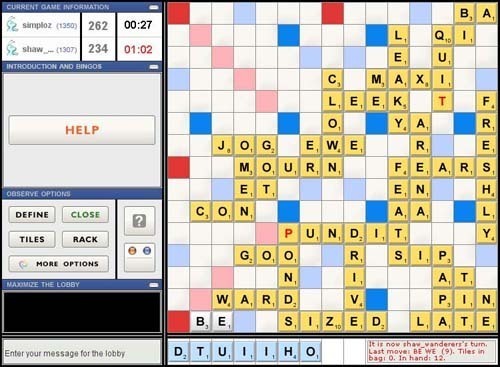
A collective groan went up in cubicles across the country late last month when Web surfers discovered that Scrabulous, a popular online knockoff of the venerable board game Scrabble, had been shut down on Facebook.
By the time it was disabled, Scrabulous had become one of the most popular features on the social-networking site, with more than 3 million registered users and more than 500,000 people playing a day. Wags joked that with Scrabulous gone, office productivity would soar.
But no one was smiling at Hasbro Inc., the Pawtucket-based toy maker that owns the Scrabble trademark in North America. Hasbro executives are betting that digital versions of its well-known board games will play a key role in its growth over the next decade – but on Facebook, Scrabulous was quickly becoming the market leader.
On July 22, Hasbro filed a federal lawsuit against Rajat and Jayant Agarwalla, the two Calcutta brothers who developed Scrabulous, charging them with “clear and blatant infringement of our Scrabble intellectual property,” in the words of Barry Nagler, Hasbro’s general counsel. Six days later, the Scrabulous application on Facebook was disabled.
But instead of breathing a sigh of relief, Hasbro officials found themselves confronting a blizzard of bad press. Scrabulous players were outraged – one protest group was called “Please God, I Have So Little: Don’t Take Scrabulous Too” – and some called for boycotts of Hasbro and its rival Mattel Inc., which markets Scrabble outside North America.
To make matters worse, Hasbro’s official Scrabble game – which debuted on Facebook in mid-July and is still in a beta version – slowed to a crawl as tens of thousands of distressed Scrabulous fans tried to download it. The reaction was harsh. “You could pack up a board and a dictionary and head to a friend’s house in the time it takes to load that stupid thing,” wrote Annie Wagner, a blogger for Seattle’s The Stranger.
Electronic Arts Inc., which developed the official game as part of its year-old digital partnership with Hasbro, said the application had suffered “a malicious attack.”
Things began to look up for Hasbro the following week. Electronic Arts stabilized the official Scrabble application, which has gained more than 300,000 active users. And there was some positive reaction to the licensed game: CNET, a top tech Web site, said players “will find [the official] Scrabble easier to get into, easier to use, and just as competitive and fun” as Scrabulous.
Hasbro hopes consumers will agree. Officials at the country’s second-largest toy manufacturer said they have high hopes for the authorized Scrabble game, and are not overly concerned about its shaky start.
“It would have been great if there were no speed bumps in this process, but when a game receives this much fan usage so quickly, one can’t necessarily anticipate that,” Mark Blecher, Hasbro’s general manager of digital media and gaming, said in an interview. The Scrabble application’s initial failure was caused by hackers, he said, not poor software development. (Electronic Arts did not return phone calls before press time.)
Blecher also dismissed those who said Hasbro should have come to an agreement with the Agarwalla brothers to authorize their game. Electronic Arts did approach the pair about acquiring Scrabulous, but reportedly balked at their financial demands. In an e-mail, Jayant Agarwalla said he could not discuss Scrabulous due to the pending litigation.
Analysts don’t see the Scrabulous blowup harming Hasbro in the long term. “It’s not all that significant,” said Margaret Whitfield, a toy analyst at Sterne, Agee & Leach and a longtime Hasbro watcher (neither she nor her company owns Hasbro stock). “I don’t see this as having any material impact on the company.”
Indeed, the company’ second-quarter results, which were announced the day before the Scrabulous suit was filed, saw revenue rise by more than 13 percent to $784.3 million, as net income grew nearly 800 percent (and exceeded analysts’ predictions by three cents a share in the process) on the strength of demand for brands such as Transformers and Indiana Jones.
“They’re really cooking at Hasbro. They’re on the move,” said Whitfield, who switched her rating on Hasbro last year to “buy” after years of keeping it at “hold.” The company is now in the best shape it’s been in since she began following it in 1992, Whitfield said.
On Scrabulous, Blecher said the company “did what we needed to do,” waiting until Hasbro’s official Scrabble game was up and running on Facebook before filing suit against the rival game.
Questions remain about parts of Hasbro’s case against Scrabulous and its founders. Under federal copyright law, it’s not illegal to create a game that uses the same rules as another game in the way that Scrabulous did, according to Wendy Seltzer, a fellow with the Berkman Center for Internet and Society at Harvard Law School.
Hasbro does have a case to make when it argues that the name Scrabulous is an infringement on its trademark of Scrabble, she said, because the similarity of the names could create the impression that Scrabulous is an authorized version of Scrabble, which it is not.
But, Seltzer said, “Apart from the trademark, I don’t think there is intellectual property at stake here.”
Other observers said Hasbro made the right move.
“Hasbro’s done exactly what they should have done,” said Chris Byrne, an independent toy analyst who does not own Hasbro stock. “The reason that something like a Scrabulous can take off is that it’s building off 50-plus years of brand equity – and sorry, but in our legal system you don’t get to do that.”
As for Scrabble’s version, Byrne said, “if it’s a kind of mode of play that people want, they’ll find it. … In our amazingly short-term-memory society, people will forget and go on to say [about the official Scrabble game], ‘I like this – hey, try this out!’ ”
The official Scrabble game doesn’t have Facebook all to itself, despite the demise of Scrabulous. The Agarwalla brothers have another Scrabble-like game, Wordscraper, which has attracted more than 215,000 users. Legally, Seltzer said, “I think that one’s in the clear.”
Meanwhile, Hasbro and Electronic Arts are preparing for the rollout of a variety of new digital games this fall based on Hasbro brands, including Monopoly, Littlest Pet Shop and a “Family Game Night” collection featuring Connect Four, Battleship and other classics. The games will be available on a range of platforms, including video-game consoles, iPods and iPhones – and, of course, Facebook, through which Blecher said Hasbro will use the games to bring in advertising revenue and build brand loyalty.
The new emphasis on digital games follows a major and fairly rapid shift in Hasbro’s thinking over the course of this decade. Just eight years ago, the company sold off its interactive games division, which was losing money at the time, to Infogrames Entertainment for $100 million – only to turn around in 2005 and start buying the digital rights back. At the time, Blecher explained the shift by saying Hasbro “wanted to be in control of our own destiny.” The megadeal with Electronic Arts followed in August 2007.
“This is absolutely one of the core foundations of Hasbro’s strategy going forward, which is to take our well-loved brands and leverage them in a variety of intellectual property entertainment opportunities,” Blecher said.
Whitfield, the toy analyst, said she expects to see the Electronic Arts collaboration begin to pay off for Hasbro between 2009 and 2011.
Blecher said Hasbro even sees a bright side in the sometimes harsh comments that have flowed into the official Scrabble game’s Facebook page. “We’re constantly looking to leverage the suggestions of loyal fans,” he said. “That’s probably the most important thing we learned – the importance of giving fans a chance to comment.” •