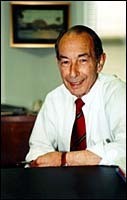
president of HELP.
(Al Alexio)
Name: Louis Fazzano
Age: 80
Position: President of Health & Education Leadership for Providence
Education: Yale University, Bachelor of Business Administration; Harvard
University Graduate School of Business Administration (Military Officers’ Course)
Background: Fazzano has served as president of Rhode Island Hospital and
president of the Rhode Island School of Design. He has served on boards of directors
for dozens of non-profit groups and companies in Rhode Island. He was the former
treasurer and director of Imperial Knife Associated Companies, Inc., and executive
director of the Rhode Island Port Authority and Howard Development Corporation.
Family: Married for more than 50 years, with three children and one grandchild
Residence: Providence
PBN: Provide a little background on HELP and its mission.
FAZZANO: It was formed in response to the mayor’s request that the large not-for-profits do more for the city than they were already doing. At the time, the presidents of the 10 institutions that now make up HELP got together – stimulated mostly by Vartan Gregorian, then president of Brown, and Bill Kreykes, who was president of Rhode Island Hospital at the time. They got together and mobilized a group to discuss what we could do with particular respect to health and education. The goal was to do things where it wasn’t just money but it was getting the professionals in our institutions to bring their skills to bear on problems. And since we’re colleges and hospitals, the goal was to zero in on the children and their needs in health and education.
Selling Luxury Real Estate Requires More Than Exposure
By Emilio DiSpirito IV License Partner | Private Office Advisor Engel & Völkers Oceanside www.DiSpiritoteam.com…
Learn More
How is HELP effecting positive change for Providence children?
There’s no question that getting the HELP Lead Safe Center going is clearly
one of the things we had in mind for a long time and studied diligently for at
least a year and a half. We visited other cities to study what they were doing,
and there’s a problem in Rhode Island with lead paint. I think the indications
are that our little group is having a positive impact on that problem. Also, we’ve
put all the health records of all the elementary students in Providence on a computerized
health card. A number of children in the Providence School District move from
one school to another during the year, because they move from one house to another.
So, when they move from school to school, if they have handwritten records, it’s
hard to get those records to go from one place to another. Now that they’re on
computer, when they go to the new school, their record stays with them. That creates
the ability to analyze health records and identify deficiencies.
A report released by Kids Count recently shows that almost one in five kids
lives in poverty. Do you think that economic disadvantage is ultimately the biggest
challenge facing Providence’s kids?
Clearly, poverty and the lack of low-cost housing in the city of Providence are serious problems. It’s probably one of the things that contributes most to the lead-paint problem and probably contributes to other problems in the city. My sense is the state is trying to find more money for improved low-cost housing. And obviously economic-development activities that create more and better jobs, not only in the city but also in the outlying parts of the state, so more people can be gainfully employed. But these things aren’t going to happen overnight.
It’s been said that HELP is the only organization of its kind in the country.
How is that?
The fact is we’re the only city in the country where colleges and hospitals have joined together to do things for the benefit of children. I think we’re developing some synergies that show that there’s a lot of merit in this kind of thing. Now, on the other hand, we’re a relatively small city. We’ve got six hospitals and four colleges, and one of the benefits of being small is you get to know everybody. And so it was probably easier for us to all get together. The other thing is our colleges in Providence really don’t compete with one another. Each one has a different sphere of interest, so it’s easy for them to work together. On the other hand, the hospitals are all fighting for the same patients, except with respect to one or two.
That’s an interesting point. Do you think there’s a chance that Rhode
Island has too many hospitals?
There was a time when I was of the school of thought that we had too many beds, although I don’t know of a hospital now that doesn’t get overcrowded. So I don’t believe that what we feared a few years ago is necessarily true. The other thing is that people are living longer, so there is a much bigger need for hospital beds as we go forward, I think.
There are a lot of problems in health care right now: rising costs, labor shortages,
uninsured people. Do you see any solutions to any of these problems?
Let me just go off the cuff a little bit. Here in Rhode Island, the quality of
medical care we deliver among our hospitals is dramatically enhanced by the presence
of the Brown Medical School. And it’s not only the faculty and the chairs of the
clinical departments, but it is a large number of highly skilled physicians who
are attracted here because of the teaching and research hospitals. Those things
cost the hospitals money. The Balanced Budget Act of 1997 dramatically reduced
the amount of money that hospitals are reimbursed for their graduate medical education,
so that all the hospitals connected with the university are absorbing large costs.
But we’ve got great hospitals, and not just in Providence, but in Newport, Kent
County, South County. We have a great reservoir of fine physicians. And they’re
close. When I was young, if anyone had a serious illness they went to Boston for
treatment. Now, we’re doing most of it here, other than heart transplants. But
if you want my personal opinion, I do not believe that health care costs are going
to diminish too much in Rhode Island. At one time I was director of economic development
in Rhode Island, and one of my selling points to companies always was, if you
come to Rhode Island, the health care cost for your employees will be 25 percent
less than if you go to Massachusetts. And that’s still the case. So I don’t think
our costs are going to go down. We’ve all come to expect that we can have whatever
health care we want. We’ve all got a Platinum card, and the bill goes to somebody
else.
What do you think of the idea of developing “centers of excellence,” at hospitals,
so they become more specialized in certain areas?
I think that the problem is that many people, when they’re ill, have several different
ailments. I don’t say that the center-of-excellence idea is without merit. Because
clearly, if a hospital devoted most of its effort to cancer treatment, and did
all the research involved in becoming a specialist in cancer, it could probably
make its patients more comfortable than if a patient had to go to multiple places
for treatments. And the costs involved in some of the more complex surgeries would
be such that every hospital can’t do it. Transplants, for instance. It’s hard
to believe that there would be enough transplants in Rhode Island to where several
hospitals would do that. My guess is it will probably be just one that develops
that. The more complex the surgery, the more expensive it is. The cost limitations
I think sort of point in the direction of centers of excellence, to some extent.
You’ve been involved with the business community here for a long time. What
are the biggest changes to the economy in Providence and Rhode Island?
The most dramatic thing to me has been, I won’t say the disappearance of, but the outward migration of manufacturing. And my sense is that it’s not just going out of Rhode Island, but that more manufacturing is being done in other parts of the world where labor is much cheaper and transportation is so much easier. But that’s the biggest change. And the swing toward service-type industries in Rhode Island.
What do you think of the revitalization of Providence’s downtown over the past
several years, and where does the city go from here?
Clearly we’re a much more attractive city than we ever were before. And we’re
a more desirable place to live than ever before. But there is a need, and I believe
it’s being well addressed by the Providence School District superintendent (Diana
Lam), to improve the quality of education that’s delivered in the Providence schools.
I’ve read somewhere that the biggest determinant of the grades that schoolchildren
receive on tests is the household from which they come. And with the large number
of people who live in poverty and depressed areas of Providence, that’s going
to be a challenge. But I do feel that improving our Providence school system is
step one, and I think we’re getting there. I truly believe the new superintendent
is making big steps toward that. It’s also important that the state and the city
find ways to make this area attractive for more service-related businesses to
locate here, because we do need jobs. And I think we’re doing great things along
those lines, but we can’t stop.