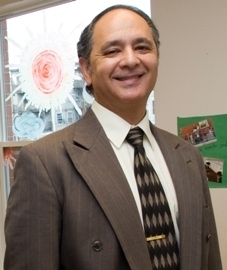
RAMON MARTINEZ is working to grow Progreso Latino and its educational programs.
Ramon Martinez
Position: President and CEO, Progreso Latino
Background: After studying philosophy and geography in California, Martinez joined the U.S. Air Force, in which he served for 20 years. Upon retiring, he entered the private sector as vice president at Genetics & IVF Institute in Virginia for five years. He then spent about a year and a half in Miami, as director of strategic planning at the South Florida Workforce Board. Most recently, he was a consultant for Homeland Security University, in Washington, D.C., where he designed a strategy management process.
Selling Luxury Real Estate Requires More Than Exposure
By Emilio DiSpirito IV License Partner | Private Office Advisor Engel & Völkers Oceanside www.DiSpiritoteam.com…
Learn More
Education: B.A. in philosophy and geography, California State University at Long Beach, 1975; M.P.A., University of Northern Colorado, 1979; M.A. in philosophy from the University of California at Santa Barbara, 1983
Residence: Providence
Age: 53
Though Ramon Martinez has held a number of positions that seem unrelated, the one thing linking his military to private to nonprofit pasts has been his ability to develop and implement strategic thinking and planning. It is part of the reason he applied for the president/CEO position at Progreso Latino. He felt he had the skills necessary to move the nonprofit forward. The son of Dominican and Puerto Rican parents, Martinez said he wanted to give back to the United States and the Latino community because of the opportunities they’ve allowed him to realize. Martinez started his new job on July 5.
PBN: You were living in Virginia when Progreso Latino posted this job. How did you find out about it?
MARTINEZ: My son [who lives in Rhode Island] came across the advertisement and he said, “Dad, you have to take a look at this. It’s exactly you.” I looked at it and I agreed with him. The things that it was asking for, the types of job responsibilities and characteristics, I felt, fit who I am.
PBN: What makes you qualified for this position?
MARTINEZ: The organization has suffered some major challenges, economic challenges and organizational challenges. And it seems that they’ve stabilized that a bit and now they felt they are ready to move to the next level, which is to grow the organization and sustain that growth. So they were looking for someone who is an out-of-the-box thinker. … I’m constantly thinking about new ways of doing things, new business models all the time, because part of my background is as a strategist.
PBN: What is an example of strategies you want to implement?
MARTINEZ: I’ve met with the staff and instituted a weekly activities report … for all of my staff and board members and certain stakeholders as well. In there I discuss three points. I ask my staff and myself: What major organizational activities did we accomplish that contribute to the mission this week? What major organizational activities are we going to do next week? Then I ask them to identify organizational issues and give me recommendations as to how to fix them, how to repair them.
PBN: What is Progreso Latino’s mission or goals?
MARTINEZ: We have three policy goals. We’ll develop a continuum of services based on those policy goals. One is to eliminate poverty in the Latino community. Two is to enhance health. And three is to build community engagement.
PBN: What issues do you think are the most pressing for the Latino community in Rhode Island?
MARTINEZ: It’s a burgeoning population. Now the Latino population is almost 11 percent of Rhode Island’s population. The Latino population has grown by 27 percent at least. Even Providence’s [Latino community] alone has grown by 16 percent. However, the poverty rate is very high. The wages they make are very low. I believe almost half of the Latino children live in poverty. In education, the dropout rate is very high.
PBN: Does that concern you?
MARTINEZ: I have a great concern in terms of, if the dropout rate is very high, then what future can there be? So I’m concerned if half are dropping out [then] they don’t have the capability or the skills to fully realize themselves. So we need to get them at the pre-school age, develop them to think critically. And in middle school, to further hone their critical thinking skills … The issue is: What do we need to do to educate our children to demonstrate that they can become successful? And it starts at a very early age.
PBN: How will you try to solve those issues? Will it involve the government and business leaders?
MARTINEZ: It’s a comprehensive position. It will involve the government. It will involve businesses. It will involve volunteers. You can’t do it on a piecemeal basis. We’d like to do something innovative. Even for our youth program I’ve developed in my mind the kind of courses I’d want to teach. I want this organization to differentiate itself. We’re not a community center. It’s an education place. I don’t want our youth to come here just to play basketball or be a place to take care of the kids while mom and dad are working. I want to offer some very unique courses that develop the youth and adults. That’s what we plan to do.
PBN: What else are you planning to do while in this position?
MARTINEZ: I’m trying to create an integrated business model. Essentially what I want to do is to move the Latino community within the four quadrants in “Rich Dad Poor Dad” (a book written by Robert Kiyosaki), where you have a worker in the work force that moves to becoming self employed. But also what I want to do is to have the Latino communities [produce] business leaders, because small businesses provide 50 percent of employment. … And ultimately I’d like them to become not just business owners but investors. Get into the stock market. Invest in companies.
PBN: What do you hope will come out of your partnership with the R.I. Small Business Development Center at Johnson & Wales University?
MARTINEZ: That we’ll collaborate, refer to one another. And I’m going to deliver some manuals. One is about what is strategic thinking. The second is what is strategic planning. The third is a glossary of terms. That means I’ve developed a strategic management process. The small business development center will facilitate the strategic planning process. I told them: Take us as your model. We are a small business, we want to grow. … They’ll use us as a case study.