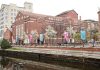
Coventry encourages new uses for old mills
The Pawtuxet Valley Dyeing Co. mill complex is listed on the National Historic Register for its textile uses in the 19th and 20th centuries. But now, with the aid of a town ordinance allowing a zoning change on the property, the buildings will get a new use.
A modernized health plan: Supporting cost management and the employee experience.
The Surest health plan came from a group of innovators wondering: What if health care…
Learn More
They’re becoming condominiums and helping the town meet its affordable housing needs.
The plan for the site, submitted by Nine Howard Development LLC and approved by the Coventry Planning Commission last month, includes 49 condominiums on the 9.5-acre property; 12 of the one- and two-bedroom units will be “affordable,” as defined by state law.
The Low and Moderate Income Housing Act requires all municipalities in the state to ensure that at least 10 percent of their housing stock is affordable and makes it easier for developers who commit to creating affordable units to get the necessary permits.
The state defines affordable housing as residences whose total costs (including utilities) do not exceed 30 percent of the income of workers earning less than 120 percent of the state’s median income.
In the case of the Pawtuxet Valley Dyeing Co., the Coventry Town Council empowered the Planning Commission to re-zone the industrial property as residential. For projects in which the developer is proposing to build affordable housing, the state law condones for “fast-track” permitting, allowing developers to get all their approvals from the municipal zoning board.
Coventry Town Planner Paul K. Sprague said mill redevelopment projects are key to meeting the state requirements. In the town’s affordable housing plan, submitted to the state in 2004, several mills along the Pawtuxet River were targeted for residential use.
Now the Town Council is considering an ordinance that would create a “Mill Conversion District” where such projects would be encouraged and zoning restrictions for which developers would normally need to seek variances would not apply.
“Many of these mills have become deteriorated and have fallen into disrepair,” Sprague said. Thus the town could deal with two problems with a single measure.
Christopher Barnett, spokesman for the Rhode Island Housing, said other communities across the state are doing the same as Coventry – looking into the rehabilitation of historic structures to help meet their affordable housing needs.
Rhode Island Housing often helps finance or secures financing for projects involving affordable housing. Barnett cited several examples of such redevelopment projects in suburban and rural areas, including the Lonsdale Mill buildings in Cumberland, an old school at the corner of West Shore Road and Sandy Lane in Warwick, and the Pilling Chain factory in Barrington.
“We have a preference to create housing in areas where not much exists,” Barnett said. “As we sort through the requests for financing, we take into consideration whether there are enough homes in the community for everyone that wants to be there. As towns begin to implement their affordable housing plans, our financing will be an important tool in reaching these goals.”
Barnett said structures such as mills and vacated commercial spaces make a good fit for residential uses because they are often located centrally within the community and may already be equipped with sewers and power connections.
At the same time, the restorations of the mills can also be a benefit to the towns that house the dilapidated structures that have outlived their economic usefulness.
“It only makes sense to convert these buildings,” Barnett said. “We’ve got a housing shortage – particularly in towns where very few new homes are being created. To convert these structures to housing accomplishes more than one public policy goal.”
In Coventry, along with the Nine Howard Development project, another mill rehab is in the works: Riverside Landing, an eight-unit condo complex planned for two small buildings that are also part of the Pawtuxet Valley Dyeing complex, but across the river.