The release of nearly $2 million in federal aid to support a feasibility study and partial preliminary design for an MBTA commuter rail stop has raised the hopes of Pawtucket officials, though they acknowledge it will be many years before the first commuter steps off a train in the city.
Thomas A. Mann Jr., executive director of The Pawtucket Foundation, noted that this year marks the 10th anniversary of his business-backed, economic-development agency. And from the beginning, it has championed the need to bring commuter rail to the city of more than 72,000 along the Blackstone River.
Ground was broken last month on a Mass. Bay Transportation Authority commuter rail station under construction in the Wickford section of North Kingstown and “those discussions started in the late 1990s,” Mann said, suggesting that work on a Pawtucket rail stop could take even longer. “We hope it could happen faster,” he said.
Mann held out the hope that the Obama administration’s emphasis on infrastructure improvements nationwide might be the spur that could put the Pawtucket project on a faster track because “we need it to happen faster,” he said. “We need to create jobs, we need to increase opportunities for housing, we need to reinvest in a very distressed community.”
Mann said the rail project could take as long as 20 years to complete and the cost could be anywhere between $25 million and $53 million.
According to a study The Pawtucket Foundation did last month, the rail stop would be the basis for “a multimillion dollar economic-development plan that could generate as much as an additional $7.7 million in new annual tax revenue by 2020 and create hundreds of jobs and housing opportunities.”
At the Wickford groundbreaking Aug. 18, Peter M. Rogoff, chief administrator for the U.S. Department of Transportation Federal Transit Administration, announced that the administration has authorized nearly $2 million for the Rhode Island Department of Transportation to do a preliminary engineering and feasibility study for a rail stop along Barton Street in Pawtucket, near the Central Falls border.
Although Mayor James E. Doyle is not seeking re-election this year, Heath and Mann both said the rail project will continue uninterrupted regardless of who becomes mayor because support for it in Pawtucket is so widespread. “There is fundamental agreement” among all the parties involved, Heath said.
For decades, the proposed site of a commuter rail stop had been the former Pawtucket-Central Falls railroad station off Broad Street at the border of the two cities. But that site was rejected a few years ago for a variety of reasons, Mann said, including a lack of space for the railroad sidings that would be needed to accommodate Amtrak trains and a limited right of way that the MBTA and Amtrak would have to share.
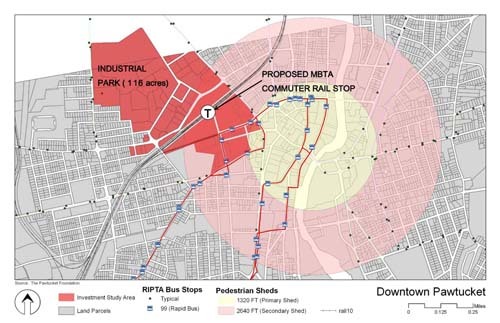
The current proposed site is along Barton Street between the Conant Street bridge and the intersection of Dexter Street, near the former Conant Thread Factory complex. The rail lines are in place and now used for freight trains.
The blighted area is one of Pawtucket’s least appealing right now, a congested place with rundown residential buildings, empty factories and small businesses struggling to survive.
But Mann and Heath said plans are in the works to redevelop as much as 116 adjacent acres of commercial and industrial properties, including the Conant factories. “The area is targeted for significant redevelopment,” Mann told Providence Business News.
He and Mann both spoke of residential units that have been completed, are now under development or are in the early planning stages in the immediate Barton Street area or in downtown Pawtucket nearby. When all are completed, a total of 750 new residential units will result, Mann said. “A lot of the people will be moving into these condos and some of them are going to be commuting to Boston,” he added.
As Mann sees it, the commuter rail station will make Pawtucket the “regional hub” for commuters traveling to and from southern parts of the state, such as Providence, Wickford and Warwick, as well as those heading north to Boston, Worcester and Woonsocket. He said the city is anxious to obtain support for the rail stop from other northern Rhode Island communities because of the “huge impact” it would have on the entire region.
Plans for a rail stop and redevelopment of the Conant Street area coincide with other economic-development initiatives in Pawtucket, including replacement of the Interstate 95 Pawtucket River Bridge, a $100,000 urban design plan to reconfigure downtown streets, the addition of the R.I. Public Transit Authority rapid bus service and the state’s establishment of the Blackstone Valley bicycle path.
“We’ve got multimillion dollar projects in progress that integrate bus, rail, bicycle, cars and people in downtown Pawtucket,” Mann said. •