Center
Two Providence teaching hospitals last week were awarded a combined $22 million in separate federal research grants.
Roger Williams Medical Center will receive a five-year, $13 million grant from the National Institutes of Health to further its studies involving adult stem cells.
Researchers at Women & Infants’ Hospital will receive nearly $9 million in NIH funding – one of the largest grants in the hospital’s 120-year history – to study perinatal heart and lung development.
Your Business Has Gone Global. Has Your Insurance?
A decade ago, “doing business internationally” was mostly a large-company concern. Today, a manufacturer in…
Learn More
Both grants are from the NIH’s Center of Biomedical Research Excellence (COBRE) program, aimed at helping research centers nurture junior scientists, build new labs and buy new equipment. Directors at both hospitals say the grants should sow the seeds for more NIH funding in coming years.
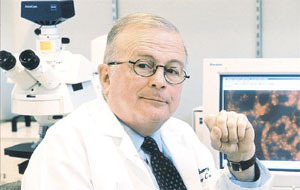
“It provides not only physical infrastructure, but organizational and educational infrastructure that will enhance the development of good young scientists in Rhode Island,” Dr. Peter J. Quesenberry, chairman of Roger Williams’ Department of Research and head of the Center for Stem Cell Biology, said in an interview.
Richard Horan, executive director of the state-funded Slater Center for Biomedical Technology, said the COBRE grants are important because they add to the state’s overall research infrastructure, rather than being targeted at individual research projects, as is the case with most NIH grants.
For example, Women & Infants’ grant of $9 million is more than double the $3.9 million it received in NIH funding during 2002, which was spread over 13 awards.
“These COBRE grants represent an important threshold,” Horan said. “It’s an indication of the biomedical research community in Rhode Island being able to go to the next level.”
The two recent awards are the third and fourth COBRE grants given to Rhode Island biomedical research teams. Brown Medical School was awarded an $11 million grant in 2000 to study genetics and genomics, and Lifespan received an $8.4 million COBRE grant last year for cancer research.
At Roger Williams, the money will be used to advance three projects within the hospital’s Center for Stem Cell Biology, which opened in 2001.
One project is studying the use of stem cells to treat chronic, non-healing wounds, which one day could lead to treatments for severe burns, pressure ulcers or post-operative wounds that don’t heal through skin grafts or other conventional therapies.
A second area focuses on the ability of adult stem cells, taken from bone marrow, to morph into skeletal-muscle cells, which eventually could be used as a treatment for muscular dystrophy. A third program analyzes the underlying biology that enables adult stem cells to transform themselves into other types of cells, such as muscle or bone.
Women & Infants’ five-year grant will pay for new equipment and support four scientists. The hospital plans to purchase in-vivo imaging technology, which will allow researchers to study the growth of heart and lung cells in lab rats using time-lapsed video.
“Our research is trying to understand what makes lungs grow and develop,” said Dr. Juan Sanchez-Esteban, a neonatologist at Women & Infants’ and an assistant professor of pediatrics at Brown.
Sanchez-Esteban said fetal lungs contract and expand while in the womb, a movement that scientists now believe is critical to lung development. By studying how that lung movement prompts genes or proteins to grow lung tissue, researchers hope to someday find ways to coax growth in unborn babies with underdeveloped lungs. Similar research is being done on fetal heart development.
The NIH encourages COBRE grant recipients to collaborate with other research centers. Dr. James F. Padbury, Women & Infants’ pediatrician-in-chief and vice chairman of the Department of Pediatrics at Brown Medical School, said research teams involved in the state’s other COBRE grants have been generous in sharing cutting-edge equipment with other institutions – something Women & Infants’ plans to reciprocate, he said.
“This (grant) will benefit the entire research community, not just Women & Infants’,” Padbury said.
It is that sharing of resources and best practices that will be key if the state wants to foster its growth as a hub of biomedical research, Horan said.
“We’re getting to a level of critical mass,” he told a group of Women & Infants’ researchers gathered to celebrate the grant last week at its research facility in the Jewelry District. “The key is to stitch that together in a collaborative effort.”
While Rhode Island’s NIH funding of $115 million in fiscal 2002 was a record for the state, it still pales in comparison to biomedical research stalwarts, ranking 31st out of the 50 states. Johns Hopkins University School of Medicine in Baltimore, for example, topped the list of U.S. universities with $510 million in NIH funding.
For the complete current issue, visit our subscription Web site, or call (401) 273-2201, ext. 227 or 234.