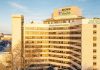
Rhode Island Hospital President Dr. Joseph Amaral has a favorite saying for
how his institution should respond to disaster: “The best disaster plan is the
one you use every day.”
The night of The Station fire, Feb. 20, 2003, the disaster plan at Rhode Island Hospital was tested like never before – anywhere.
Sixty-five burn victims streamed through the emergency department over just a few hours. Forty-three were admitted, 35 of them in critical condition. The number and acuity of fire victims is said to be unprecedented.
Selling Luxury Real Estate Requires More Than Exposure
By Emilio DiSpirito IV License Partner | Private Office Advisor Engel & Völkers Oceanside www.DiSpiritoteam.com…
Learn More
Like many hospitals, Rhode Island Hospital uses what’s called a “Hospital Emergency Incident Command System,” or HEICS. It’s a flexible organizational chart, used for determining who does what when responding to a disaster.
But Amaral says the scope of the incident should not dictate how the staff responds. “Every traumatic situation requires certain decisions,” he says. “These decisions need to be routine, whether it’s 100 fire victims or a three-car accident.”
The problem, of course, is that each emergency comes with unique scenarios. Like any football game plan, the hospital must adapt to what the opponent – the disaster – throws its way.
By daybreak, things were back to normal in the emergency department. But some challenges were just beginning, and it wasn’t entirely clear where on that organizational chart some of those tasks should fall.
In particular, there were family members – hundreds of them – who needed answers, a reassuring voice, a place to go.
“I don’t think we had an appreciation right away for how to handle the group dynamic of all these families who were connected by this unifying event,” Amaral said.
As the hospital’s incident command center was winding down, the social work department was setting up its own ad hoc command center in its first-floor office. Decisions were made on the fly as the morning unfolded.
“To a certain extent, our role played out in an unpredictable way,” said Bill Kirkpatrick, director of clinical social work at Rhode Island Hospital. “The patients all had been admitted to beds, but there were still family members searching for loved ones.”
Social workers had jotted down names of victims streaming into the emergency department during those early morning hours to create a master list of names. A telephone hotline was set up for families to get information about their loved one’s whereabouts.
A makeshift family center was designated in a large cafeteria conference room. Some 20 volunteers manned the center while clinical social workers worked with patients, doctors and nurses on the trauma ICU. Later, the social work staff coordinated the cartloads of food, coffee and other donations from the public.
Kirkpatrick says it’s important that the department use the experience to identify specific tasks that must be done right away during a disaster.
For example, he says the head of the volunteer department now has an on-call schedule so she can mobilize the volunteer staff during an off-hours disaster. The designation of a family center as a place of refuge for families would be made much sooner if another disaster struck, Kirkpatrick said.
And roles must be re-evaluated, he said. Should the social work department be in charge of compiling a list of victims during those hectic early hours, or is that the job of the registration staff?
“The idea is to enhance the existing HEICS with specific tasks, so that in the future they’re automatic, rather than a reaction to what is happening,” he said.
Kirkpatrick is scheduled to present his experiences in April at the national conference of the Society for Social Work Leadership in Health Care in Las Vegas. His presentation’s title: “Station Nightclub Fire: Traditional and Non-traditional Responses to a Community Tragedy.”
Overall, Amaral says the hospital’s disaster-planning efforts proved successful in the face of an unthinkable tragedy. He says it gave all players – hospital workers, EMS crews, ambulance services, police and fire officials – an intimate glimpse of each other’s response preparedness. But there is room to become “more efficient and more effective.”
There have been smaller changes that could smooth the process should another mass-casualty event occur. For example, the hospital has designated alternative traffic routes for employees to use when responding to a disaster, leaving main routes for emergency personnel, media and family members rushing to the scene.
At Kent Hospital in Warwick, where 64 Station fire victims were treated in the first hour following the fire, an effort has been made to improve communications between it and other hospitals, according to spokesman Brian Wallin.
“We were prepared to deal with an influx of 10 or 20 patients into our emergency department at once,” Wallin said. “But when you have a mass-casualty situation with more than 60 patients, you need to have a process to very quickly exchange basic information and confirm the presence of individuals.”
Despite the lessons learned, Amaral says it is still too early to discern how The Station fire has changed things at Rhode Island Hospital. He draws a parallel to a car accident five years ago that left him with a broken neck.
“I had people ask me how (the accident) changed my life,” Amaral says. “But looking back five years things are clearer to me in terms of values and importance than they were even a year afterward.
“An incident like (The Station fire) transforms an institution in ways you don’t really realize until much later,” he said.
Mike Colias is a contributing writer to PBN.