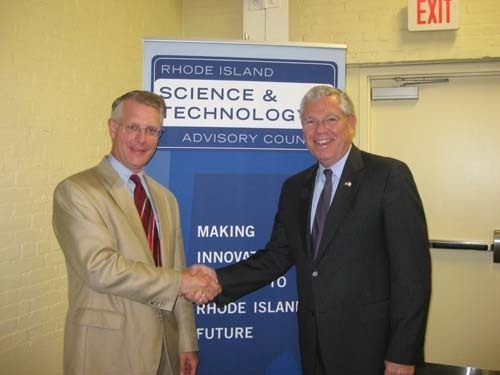
In the flow chart that Nicholas Bowen, vice president of technology at IBM, pitched last week as a possible structure of a public-private research and computing consortium in Rhode Island, there seemed to be a glaring omission: the end result was hazy, listed only as solutions to “grand challenges.”
“To me that means we’ll need to focus and say: ‘What are the real problems that you’re going to take the resources in Rhode Island … and really declare publicly that you’re going to solve something that couldn’t otherwise be solved,’ ” Bowen told the crowd at the June 22 R.I. Science & Technology Advisory Council meeting. STAC is leading the push to bring universities and businesses on board with the program. Bowen added that the best collaborations start with “big ideas.”
“You have people in industry, you have universities, you have governments,” Bowen said. “And they [all] have a set of strengths and a set of needs. For us, we want to really accelerate our knowledge, our ability to do research.”
One of the state’s research institutions has already signed on as an IBM partner. In May, Brown University signed a memorandum of understanding with IBM to go ahead with a two-year pilot program that would create a central research and computing hub run by IBM. The price of that program and who would pay for it are still undetermined, as are the research issues Brown would like to focus on. A similar program in Albany, N.Y., called for about $600 million in investment and has since created 6,200 jobs and drawn another $10 billion in private investment.
Brown University Vice President for Research Clyde Briant, who is co-chair of STAC, said last week that the MOU came out of discussions between he, Bowen and others at STAC. He added that Brown’s plan to work with IBM was not intended to be an exclusive deal.
“One of the things that Nick [Bowen] made very clear is that one of the goals that IBM had was to work with geographical entities, like the state of Rhode Island,” Briant said, “where they could work with a number of groups and not just one single group.”
Briant thought Rhode Island – “a small state where we really collaborate” – would be perfect for that type of joint research. Bringing Bowen in to talk with STAC, which has representatives from research institutions, government and business, was a way to pitch the center.
With projects like IBM’s Blue Gene research computer, designed in conjunction with the U.S. Department of Energy, a partnership was key to funding. “If you actually tried to do that as a standalone business, you would probably conclude that it is not a good investment,” Bowen said.
He added, “I think right now that we’re entering into a new era. … We clearly recognized within the last decade that we need to go beyond the products to work with industries, doing research.”
The approach that IBM, Brown and potentially other partners will be taking has worked in the past, Bowen said. The company is in the process of working with a few nanotechnology companies and the State University of New York in Albany, N.Y., and has created a research hub for the state of Montana. “What would be surprising to a lot of people is what was done in a partnership with IBM, Sony, Microsoft and Nintendo,” Bowen said. IBM brought the leaders of the three video game developers into one room and said, “Building a microprocessor is a multibillion-dollar process and if the three of you pool your money together, we can actually build all three of you a better microprocessor.”
Structured research in that collaborative way, Bowen said, is a step away from the highly private research facilities that sprung up around the U.S. decades ago. In the 1960s and 1970s, every CEO in the country was starting to realize that they needed an in-house research facility, someplace to house their scientists and designers and foster development.
In pitching the research center for Rhode Island – tentatively named the Ocean State Center for Advanced Research – Bowen last week said it would help to open up a dialogue among the local companies. “Now,” he added, “a lot of data centers are horribly inefficient.” •