Since 1973, when the Providence Civic Center opened its doors, Bernard V. Buonanno Jr. has held season tickets to Providence College basketball games.
When he returns to Section 107 this season, his seats will be different in two ways: they will be gray and they will be comfortable, Buonanno said last week. They will not be those “awful, beaten-up,” 35-year-old blue seats.
As part of an $80 million renovation that’s wrapping up this month of what since 2001 has been the Dunkin’ Donuts Center-Providence, Gilbane Building Co. workers last week were finishing the installation of nearly 14,000 new seats. But the renovation is not just the about seats, said Buonanno, a partner with Riparian Partners Ltd. and the co-chair of the DDC Committee, a public panel that oversees the R.I. Convention Center Authority (RICCA), which owns the facility. “It also used to be a very convoluted place.”
The concourse was slim and lines for the bathroom usually mingled with concession stand lines. That’s the Dunk that many Rhode Islanders remember, said RICCA Projects Manager Kerrie L. Bennett during a tour last week.
Now, the downtown Providence center’s bathroom space has been increased 40 percent and the concourse and lobby have been widened as part of the 35,615-square-foot expansion of the building, she said. Another 2,200 cubic yards of concrete have been added to the 14,000 cubic yards used in the original construction.
Also added were the 20 private suites – all leased for $50,000 a year – that have flat-panel TVs, mini-fridges and marble-topped, bar-style seating. A new $1.2 million video scoreboard has been installed and the main entrance, on Sabin Street, has been given a curved, glassy façade.
The three-year renovation began after RICCA purchased the Dunkin’ Donuts Center from the City of Providence in December 2005 for $28.5 million, said RICCA Executive Director James P. McCarvill. Originally projected to cost $62 million, the renovation cost crept up during construction.
McCarvill pinned the escalation on three factors: a building boom that contributed to rising construction- material cost, the heavy investment in building commodities from foreign investors and “more things in need of complete overhaul than we had originally anticipated.”
“It was sort of this perfect storm that landed on our shores just when we were about to go out for pricing,” he said last week.
Almost immediately, event counts at the Dunk started to pick up when RICCA took over, Bennett said. She pointed to figures that show an increase from 121 events during the 2005 season to 123 events during the 2006 season. “And we were only open for eight months that year, when 2005 was a full year,” she said.
Now, the Dunk is preparing for another full season with a grand reopening ceremony and public walkthrough scheduled for Sept. 5 and 6.
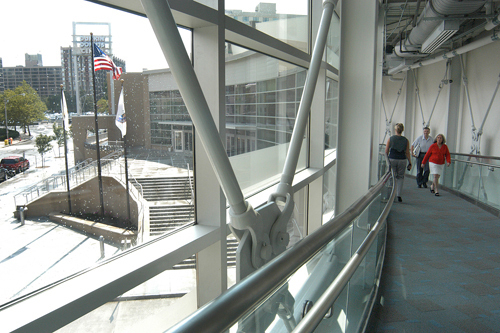
Part of the draw to the renovated Dunk is expected to be the bridge that was created between it and the R.I. Convention Center, said project architect Stephen Duethman, managing principal in the Kansas City, Mo., office of Ellerbe Becket. His firm also designed the original civic center.
“The bridge was to make it clear that the two were connected, to reflect the glass and stone that’s in the Convention Center and to show they serve one purpose,” he said in a phone interview last week.
The civic center originally was proposed in the Providence Redevelopment Agency’s 1960 Downtown Master Plan as a centerpiece in what was then known as the “Weybosset Hill renewal area,” according to a promotional booklet created for the opening ceremony during 1973.
At that time, the center had been proposed as a joint investment between the state and city, Providence City Archivist John Myers said last week.
It was championed by then-Mayor Joseph A. Doorley Jr., who wrote that “because of its existence, untold positive dividends will be realized. Some obscure youngster who through a personal experience of seeing a player perform may dream and someday realize his goal of becoming a professional athlete. The benefits to Providence are immeasurable.”
But it was, as the Providence Evening Bulletin reported in October 1968, also an effort to attract events away from competing cities that included New Haven, Hartford and Worcester.
It was funded through two city bonds – $6 million in 1969 and another $7 million in 1971 – and the project was awarded to Dimeo Construction Co., according to the 1972 Journal-Bulletin Rhode Island Almanac. Dimeo beat four other bidders with its $12.09 million offer.
Although it very well may have inspired athletes, the center historically hasn’t been as financially successful as Doorley had hoped. For many years, the center ran an annual deficit, according to financial data compiled by Murphy & Company. Between 1980 and 1984, it had net losses of between $489,402 and $827,038 each year despite operating revenue each year of more than $1.3 million.
“At that time, the concert business shifted” to larger and outdoor venues, McCarvill said. “It went from maybe doing 20 or 30 concerts to maybe 10 or 15 a year. … That concert income was important to the building, but that business has been gone for 20 years, basically.”
In 2001 Providence Business News polled business leaders, asking about their reasons to come to downtown Providence – only 12 percent answered that they came for events at the Dunk.
By 2003, it was clear that the city didn’t have enough capital to keep up with needed repairs, McCarvill said. “The building started to get tired and the longer you deferred maintenance the more it was going to cost.”
Some city officials, including Councilman Terrence M. Hassett, started talking about selling it. In July 2004, Hassett sponsored a council resolution calling for Mayor David N. Cicilline’s administration to sell it. At that time, he said he could no longer justify using Providence taxpayer money to support facility maintenance, which that year cost $400,000.
“Spending another $400,000 on the civic center at a time when citizens have to wait two weeks to have a refrigerator picked up in front of their house is a blurred view of what city government is supposed to be doing,” Hassett said then, adding, “Each budget year we suggest that it will be the last year we will fund the civic center; yet each year becomes the next year and the center continues receiving a city subsidy.”
But now, four years later there’s no more city funding and the Dunk has again become a way to draw business to Providence, said Providence Warwick Convention & Visitors Bureau President and CEO Martha Sheridan.
“It’s been part of our sales message for about 18 months,” she said. “I can point to one group in particular – an athletic cheer and dance group coming to town in 2009 – that are utilizing both the Dunkin’ Donuts Center and the Convention Center. That was definitely an appealing package for them.”
After RICCA announced its purchase in 2005, Providence College announced that it would host the first rounds of the 2010 NCAA Division I men’s basketball tournament.
“And we have the Boston Celtics coming [for an exhibition game] in October. We gather that our dressing rooms are going to be better than what they have at TD Banknorth” Garden, Buonanno said. “When the renovations started, some people had suggested that we just knock it down, get rid of it. You can’t be a city of this size [without] an arena for games or concerts – someplace where people can come together.” •