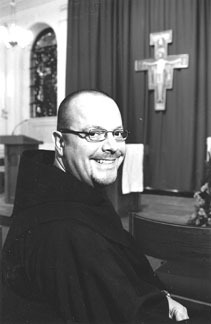
Rev. Sevola says local parishes remain
solidly planted.
Name: Rev. Frank Sevola
Position: Executive Director, St. Francis Chapel and City Ministry
Center
Age: 43
Selling Luxury Real Estate Requires More Than Exposure
By Emilio DiSpirito IV License Partner | Private Office Advisor Engel & Völkers Oceanside www.DiSpiritoteam.com…
Learn More
Background: Joined St. Francis in August 2002, after serving for four
years at St. Patrick-St. Anthony Church in Hartford, Conn. Prior to that Sevola
served at St. Martin de Porres Catholic Church in Phoenix, Ariz., and the Franciscan
Vocation Office in New York City.
Education: Master of Arts in Organizational Management, University
of Phoenix; Master of Arts in Theology, the Washington Theological Union; Bachelor
of Arts in History, St. Bonaventure University.
Residence: Providence
St. Francis Chapel & City Ministry Center is a Catholic and Franciscan
community of men and women who gather in the name of Jesus Christ for worship,
prayer, reconciliation. Established in 1954, it is located in downtown Providence,
in the nine-story former bank building at 58 Weybosset St. St. Francis Chapel
is “a place of people who seek an oasis from the world’s relentless pace and
stress,” the church says. It also runs the St. Francis Food for the Poor Program,
a wellness center and a counseling center.
PBN: In part, your church’s mission is the same as that of St. Francis:
“to heal wounds, unite what has fallen apart and bring home those who have lost
their way.” A lot of those things have been happening lately, in Rhode Island,
the business community, the Catholic Church and the country at large. Have you
been busy?
SEVOLA: We’ve been very busy. The nice thing about St. Francis Chapel
is that people can come for everything, for just some quiet solace, a refuge
from the day, and they can also find a spiritual home here, and a place to volunteer,
to be more involved in the community. I think that gets right to that mission.
You can go through your day pulled in a million different directions, and to
have a nice place to come right in the middle of your workday and your workplace,
in downtown Providence, to sort of pull it all together, can heal some wounds.
Faith often is viewed in the context of family and marriage, but what about
people’s careers? How much do you think people link their spiritual and professional
lives?
I think it happens more than ever. Spirituality in the workplace was a big
deal a couple of years ago. But I think people look to their inner core when
they make decisions and when they think about business. The bottom line is the
bottom line, but I really do think that more and more – certainly people I talk
to – people are concerned about making their decisions to a great degree based
on what they value or what’s important to them, and oftentimes that’s their
religion or their spirituality.
Do you think there’s a larger place for religion in the business world,
especially in light of the ethical and moral issues that have cropped up recently?
I think there’s certainly a place for spirituality more than religion, I would say. Again, people paying attention to their inner core, paying attention to what motivates them on a spiritual level. I think that gets to paying attention to ethics and treating people the right way. Religion is different than spirituality. You don’t necessarily need to have prayer services at work. But to pay attention to spirituality when making a decision, I think that can only help.
Talk a little bit about the diversity of your congregation here.
We’re diverse in a number of different ways. There are people here from every economic background. We have people who come here who are pretty comfortable, and maybe even wealthy, and people who come here who are very poor. And everyone sits in that chapel all together, and there’s a great sense of community and belonging. There’s no separation by class, no question about that. We have people who are older and younger who worship well together; that doesn’t always happen in regular parishes. We have gay people who are as comfortable and welcome as families and straight people. And we have a good amount of ethnic diversity as well.
St. Francis has a progressive reputation, specifically on the issue of
gays. Is that a difficult tack to take in the Catholic Church?
Well, it can be. It can be. But I think the most important thing about having gay and lesbian people coming to church is that gay and lesbian people who are Catholic just want to be Catholic. They just want to have a place where they can worship and feel comfortable. You know, we don’t get into lifestyle and all that sort of stuff. But nor do we do that with anybody who comes here. There’s no litmus test for walking in the front door. You know, it’s a hot-button issue and it can be a flash point, and I’ve experienced that already the short time that I’ve been here. But for the most part, people are welcoming, people are glad to have everybody here, and the gay and lesbian community feels welcomed here.
You have an M.B.A.?
I have a master’s degree in organizational management, which is a little different than an M.B.A.
What was the impetus behind that?
I’ve always been interested in administration of non-profits. I was living out in Phoenix for a couple of years working in a small Spanish-speaking parish out there. I knew that I needed to have more than a degree in theology to run a nonprofit agency. I thought ‘maybe I’ll get a (master’s in social work) or maybe I’ll get an M.B.A., and then I stumbled across this program. And it was great for me because, while I think I have a decent business sense, I’m not a numbers guy. But I do like sort of the soft side of management and business.
How does that help in your position at St. Francis?
Well, this is a nonprofit agency with a $2.5 million operating budget. Forty people work here. We have a number of large programs – our food center, our wellness center, our counseling center – and then all the other stuff. I mean, it’s a business. It’s a nonprofit business, and I’m the executive director. So there are days when I think more about business than I do about religion, that’s for sure (laughs).
You came from Hartford, Conn. How would you compare the two cities, Hartford
and Providence?
Well, Hartford I think is a lovely city. I get the sense that Hartford has a more regional identity than Providence does. There’s certainly a lot more going on in the city of Providence than in Hartford, although I find that the people here are good and the people in Hartford are good, really committed to their area. Hartford struggles for an identity, I think, whereas Providence seems to be pretty comfortable in its identity. In some ways they’re similar, small New England cities with a lot of the same ideas. But Providence just seems to be a livelier, more happenin’, fun place to live. And especially living downtown. It’s busier, there’s always a lot more going on, a lot more places I can just walk out the front door and be at.
How far would you say Providence has to go in stamping out poverty, hunger
and crime?
Well, it seems to me from my short time here that Providence has a ways to go. Downtown is wonderful, but obviously the neighborhoods still need a lot of attention. I had a meeting (recently) with Mayor Cicilline and Pich Chhoeun (Cicilline’s director of neighborhood services) and we’re very interested in being a part of that, especially around the areas of homelessness, hunger, poverty, housing.
Any specific ideas?
Yes, one idea that I’m really interested in getting going is sort of a hospitality van to go around the city every night of the year and minister to people who are out and about on the streets, either homeless people or people who just are hanging around and have no place to go. Maybe on a cold night like last night or tonight, they’ll have a place to warm up, get a sandwich and have someone to talk to. Or on another night it might be a place just to drop in, have a chat with somebody and get some rudimentary medical attention if they need it. But a van that goes around the city to meet people where they’re at, rather than having a central location that people have to come to.
You’ve been somewhat outspoken about the Catholic Church’s sex-abuse scandals.
What do you think the role of individual churches can be in effecting change,
given some pretty large institutional barriers?
You know, to me, the most important aspect of the church is the local community. That’s where the rubber meets the road for most people. You go to church on Sunday, you identify with your local parish. That’s the most important thing. And I think that local parishes, including a place like St. Francis, have the responsibility to make people feel welcomed and feel good about what’s going on there first. And then from that address the larger issues. The abuse scandal, I think the first thing you’ve got to do is pray for the institutional church. Pray for the perpetrators, the priests who did it and the bishops that allowed it to happen. I think the local community can be a great witness to how strong the faith community can continue to be. Because this isn’t about our faith, this isn’t about our worship. This is about some bad people doing some bad things. I think the local church has a responsibility to keep the faith and worshipping community together as it challenges those unfortunate incidents that happen on a larger scale.
You led a prayer service for victims of the West Warwick fire. What was
that like?
It was fantastic. We made the decision that we wanted to do this right off the bat, and we didn’t want to have sort of this traditional prayer service. We called it a jam session, where people could just come and play musical instruments as a tribute, or just get up and talk about their feelings or maybe a friend that they lost, all of which happened. There was some prayerful structure around it, but it was mostly about people just expressing their feelings. We really thought that was most important. People died having a great time, unfortunately. You know, they were there to have a great time and listen to music, doing what they loved. So it made sense to us to try to mirror that a little bit in remembering them.
For the complete current issue, visit our subscription Web site, or call (401) 273-2201, ext. 227 or 234.