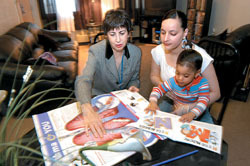
Katie King, left, an asthma nurse with Neighborhood Health Plan of R.I., offers advice to Odette Rivera, of Providence, for treatment of her 3-year-old. Such hands-on outreach is an integral component of the insurer's approach to health care.
Can former CEO affect state’s health policies?
Bernie and Bill Hicks have a big family: six girls ages 3 to 15, all adopted, plus a baby boy in foster care. Their Warren home is in a perpetual state of controlled chaos, noisy and abuzz with activity. Bernie loves it like that; she loves being a mother.
Building a Strong Data Foundation in the Age of AI
Artificial intelligence (AI) has become a key priority in the boardroom and across management —…
Learn More
But unlike the couple’s grown children, this brood is frail and vulnerable. The state placed them here because their own homes were unlivable; all have health difficulties; some have emotional problems. Bernie is a veteran foster mom, but it’s still a challenge.
One of her greatest assets, she says, is Neighborhood Health Plan of Rhode Island, which covers the children under the state RIte Care program.
“They stand by the kids, and they’re willing to go above and beyond to help them in whatever way they can,” she says. “They’re a very people-oriented company.”
Founded in 1993 by the state’s 13 community health centers, Neighborhood Health now covers about 75,000 people, including 18 percent of all children in Rhode Island. Widely praised at the national level – it was recently named one of the “Top 10” Medicare and Medicaid plans by the National Committee for Quality Assurance – it was still relatively unknown to most Rhode Islanders until its CEO, Christopher F. Koller, was tapped to become the state’s first health insurance commissioner and Gov. Donald L. Carcieri’s top health care adviser.
Koller, who starts his new job this week, says Neighborhood taught him that by working with the state, providers and the people it serves, a health plan “can be a catalyst for change.”
How much Koller’s experience will influence him now remains to be seen. But interviews with Neighborhood members, health center leaders and providers reveal just how differently this company does business – and what an impact it makes as a result.
Bernie Hicks first noticed the difference after her two youngest girls, then just 5 months old, were diagnosed with asthma.
“Neighborhood called us one day and told us about a class they were giving at Hasbro (Children’s Hospital) one afternoon,” she recalled. “They invited us to come and said, ‘If need be, we will provide you with care for the children. Bring them and we’ll have somebody here to watch them. We’ll give them dinner. And if you don’t have a ride to get here, we’ll provide you with a taxi.’”
Neighborhood’s intervention didn’t end there. The plan also sent a nurse to visit Hicks, and they developed an “asthma plan” to manage the girls’ illness. She also got free mattress covers to reduce potential exposure to dust mites.
“Every so often, they call to check on things, and make sure things are going OK, and ask if I have any kind of questions,” Hicks said. A Neighborhood nurse also helped her understand her baby boy’s sickle-cell trait diagnosis. “We must’ve talked for 20, 25 minutes, and she told me more than I was even calling for. It’s kind of nice that you can call your children’s health care place and be able to discuss different problems with them.”
Neighborhood is the largest, but not the only RIte Care plan; United enrolls about 38,000 people, and Blue CHiP about 13,000. Koller said Neighborhood’s members tend to be lower-income, more urban and more likely to not speak English – the company reaches out to those populations. And while Neighborhood’s network includes several hundred primary-care doctors and about 1,400 specialists, almost half its members go to health centers.
For the centers, Neighborhood is the single biggest source of revenue, though even for the Providence Health Centers, it still covers less than half the patients. (For Bayside Family Healthcare, it’s just about one-quarter.) But just as the centers, by owning and leading Neighborhood, shape the company, the plan is a major influence on them.
Unlike most health insurers here, Neighborhood is a true HMO, meaning it views itself not as a payer – just covering the bills for whatever services its members get – but as a purchaser, telling providers what it wants and working with them to deliver the care.
Every quarter, Neighborhood staff meet with the 25 biggest providers (the health centers plus several large primary-care practices) and review the care they’ve delivered, the drugs they’ve prescribed, their most common diagnoses, and their patients’ use of outside services: Did they show up at the emergency room? Are they involved in a Neighborhood asthma program?
It’s a truly two-way conversation, Koller said – the plan wants to hear from the doctors, and understand their perspectives, but it also offers feedback and recommends changes.
“They do a great job of encouraging quality improvement,” said Dr. John Machata, medical director at Bayside. “They’re very proactive.”
When Neighborhood’s usage data showed, for example, that Bayside was only screening 70 percent of women for cervical cancer, the plan provided money and support for Machata to set an improvement goal and raise awareness of the issue among his staff and patients.
“We ended up trying to do a Pap on everyone in that demographic, so it helped non-Neighborhood patients as well,” he said. “And we caught cervical cancer. Lives were saved.”
For Providence Health Centers, Neighborhood provided a list of repeat ER users, so the centers could reach out to those patients.
“It definitely pays off in reduced ER visits,” said Merrill Thomas, the centers’ executive director and treasurer of Neighborhood. “It’s the concept of the right care at the right place at the right time.”
Neighborhood has also pioneered health care innovations in Rhode Island, such as co-locating primary and behavioral care – a practice cited as a model in last month’s SHAPE study on behavioral health. Many pediatricians feel challenged treating children with behavioral disorders, Koller noted; when there’s an expert in the same building, they can get advice and feel more confident about the decisions they make.
Another Neighborhood initiative, “Su Salud,” supported by a grant from the Robert Wood Johnson Foundation, is enhancing the state’s medical interpreter services and increasing the availability of Spanish materials, signs and technology in medical practices. Now, as the state prepares to improve dental care, Neighborhood and the health centers are once again key partners in the process.
Focusing so heavily on quality care and member support does limit Neighborhood in other ways. Although after initial losses, the nonprofit has now built up a solid $13-million reserve from its RIte Care operations, it’s given up, at least for now, on serving non-RIte Care clients. The company’s small commercial portfolio, which included Neighborhood itself, just kept losing money, Koller said. The last few accounts, about 300 people, were ended in January.
“One of the saddest days of my life was when I had to turn in my Neighborhood Health card,” Koller said. But with limited resources, the company would rather keep nurses on staff than actuaries, and without actuaries, commercial accounts aren’t viable. “We maintain a commercial license; we have the option. But it’s not our strategic focus.”
Recently, under board chairman Ernest A. Balasco’s leadership, the plan adopted a new mission: to be “a catalyst for improved access and better health in Rhode Island, especially for vulnerable populations.” The goal is to create a world where everyone has access to quality care, and where community health centers are the models for delivery.
With Koller gone, Balasco has been named interim CEO pending a national search.
“The plan is well-positioned for his successor,” Balasco said. “Chris is going to be missed. He made a major impact on this organization. But just as other CEOs leave their companies, the beat goes on.”