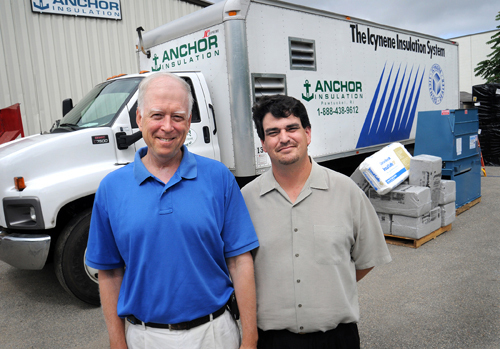
If it weren’t for federal stimulus money, Anchor Insulation Inc., a Pawtucket-based installation and retrofit company, likely wouldn’t have invested in a few $4,000 blower-door, air-leak testers. Nor would it be investing in training about 10 employees to become Building Performance Institute Inc.-certified air-flow analysts.
“A year ago, we had no BPI analysts on staff. Certainly within a few months we’ll have a half a dozen or more,” Anchor President Greg Fiske said last week about the certifications, which cost about $1,000 each. He added that if it weren’t for the stimulus, “we would have stuck with two or three.”
But the stimulus isn’t directly funding the company’s investments, nor is Anchor even guaranteed to be a recipient. The company is revamping its offerings in the hopes that some of the stimulus funding will be funneled through the R.I. Office of Energy Resources to the Rhode Island Community Action programs and, eventually, to Anchor.
“The weatherization aspect of [the stimulus] is huge and in order to do any of it, you have to be BPI-certified,” Fiske said. “To qualify for any stimulus [weatherization] program, whether it’s the CAP program or the housing authorities, however it will get channeled or funneled through, we’re going to need people who meet these standards.”
Of the more than $58 million that will go to energy initiatives in Rhode Island, about $20 million will go toward weatherizing homes. And that money is now starting to arrive in the state. Early this month, Rhode Island’s congressional delegation announced that $8.03 million had been allocated. That’s the funding that Anchor is hoping for a piece of. “We put a lot of people in the right places to make sure that we’re ready to examine these homes” if the funding comes through, Anchor Retrofit Manager Geoff Reilly said last week.
While Anchor and other companies are gearing up to benefit from the stimulus funds, state departments are busy posting opportunities. Gov. Donald L. Carcieri’s administration earlier this year started a Web site, www.recovery.ri.gov, to post bids and track projects. This month, Carcieri’s office announced that it would also post competitive federal grants on that site.
“We’ve seen more bids on our projects than we ever have,” R.I. Department of Transportation spokesman Charles St. Martin said last week. “We’re seeing companies that have not done business with us before.”
Of the 25 ARRA projects – totaling $33.7 million – that the R.I. Department of Transportation has so far awarded, only three companies have won more than one contract. Arden Engineering tops the list with three contracts totaling $4.28 million and D’Ambra Construction and Traffic Markings both have two contracts.
And at least a few of the companies that have not contracted before with DOT have re-evaluated the types of construction that they are able to pursue in order to capture DOT stimulus projects, St. Martin said.
While Rhode Island businesses are getting ready for stimulus-funded projects, there are several watchdog groups busy discussing the merits of the proposed projects. The Ocean State Policy Research Institute, a public policy analysis group, has started Rhode Island Stimulus Watch. The group’s Web site, www.ristimulus.org, is intended to spur conversation about which projects the public wants and which are a waste of money, William Felkner, OSPRI’s president, said last week.
Felkner’s site calls on users to vote and comment on each proposed state and municipal project. “So many people are evaluating these, giving professional opinions or quotes on them,” Felkner said. “We just wanted a way for people to actually say, ‘Do we want this skate park? Do we want this bike track?’ ”
Back at Anchor Insulation, Fiske and Reilly are looking forward to benefiting from weatherization projects that could start soon. But last week, when R.I. Energy Resources Commissioner Andrew Dzykewicz resigned from his post, Fiske said his resignation will undoubtedly slow the funding process down.
Yet Anchor is still confident that its investment in BPI certification and new equipment will pay off. That’s because the company took its training cues from the suggestions from Dzykewicz’s office.
And when the stimulus work starts, the company hopes another firm it will be contracting with, Aspen Aerogels, an insulation manufacturer with a plant in East Providence, can benefit.
The Associated General Contractors of America pegged the 12-month construction job loss in Rhode Island at 13.2 percent of all construction jobs. The stimulus has started to “mitigate total job losses,” ACG Chief Economist Ken Simonson said recently.
Still, while Anchor is waiting for that funding to start trickling down, the company’s workload hasn’t stalled.
“We’ve bought equipment and we’ve trained people, but it’s not like those investments haven’t started to pay off yet,” Fiske said. •