(Corrected, Feb. 22)
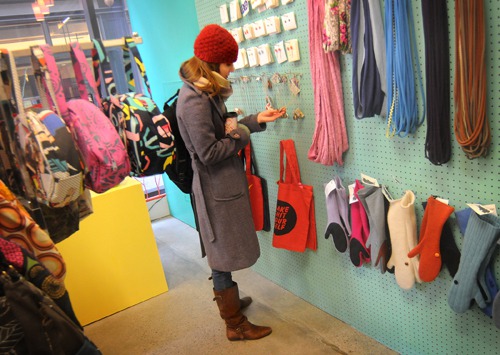
The movement to “buy local” in Rhode Island seems to be gaining traction, despite a bad economic climate, said Deb Dormody, the self-described “boss lady” at Craftland on Westminster Street in Providence’s Downcity Arts District.
“Our sales have grown exponentially each year,” Dormody said, citing in part the effort of Lt. Gov. Elizabeth H. Roberts and other state and city leaders to encourage Rhode Islanders to shop locally.
“People always tell me, when I’m behind the cash register, how much they enjoy shopping here instead of at a big-box store,” Dormody said. “They really like to be able to buy the work of local artists.” With each purchase, she said, a customer receives an “I Buy Art” pin, part of Providence’s “Creative Capital” campaign.
For Roberts, who recently kicked off another month-long tour to promote the Buy Local RI campaign she began in November 2008, such anecdotal evidence of success will have to do for now. Her office has been trying since last March to find a way to quantify the success of the campaign, with little luck.
Matthew Auten, a senior policy analyst working with Roberts, blamed the delay on “a lack of resources.”
An initial survey to track consumer perceptions, conducted in collaboration with students at Johnson & Wales University in order to create a baseline to measure the effectiveness of the Buy Local RI campaign, fell short of achieving the statistical significance desired, Auten said.
“We have limited time and resources,” Auten said. “Our major focus has been to recruit businesses to join the Web site, www.buylocalri.org,” he said. To date, more than 500 businesses have joined.
“We haven’t priced out what it would cost to do a full economic-impact study,” he told Providence Business News.
Roberts is still looking for a sponsoring partner to help prepare additional economic data to quantify the results. In addition to Craftland, she pointed to the success of The Toy Shop, owned by Wayne Kneeland, in Bristol, which has seen its sales climb, as well as the success of Farm Fresh Rhode Island, which promotes the sale of local produce from farmers through seven summer farmers’ markets and one winter farmers’ market.
According to Sheri Griffin, market manager at Farm Fresh Rhode Island, more than 1,000 consumers come every Saturday, from 11 a.m. to 2 p.m., to shop at the winter farmers’ market located at the Hope Artiste Village at 1005 Main St. in Pawtucket, buying local produce worth an estimated $40,000 in revenue each week.
Craftland offers more anecdotal evidence that the “buy local” mantra may be having a positive impact for some businesses.
Founded in 2002 as a seasonal store for holiday shopping, Craftland features only handmade products by independent, predominately local, artists. The store recently began operating year-round – in response to the growing demand of its customer base, says Dormody. In addition, the store has expanded to include a gallery space and a school for crafts.
Dormody, a bookbinder by profession with her own wholesale business, attributes Craftland’s success to its ability to showcase the work of local artisans – from woven scarves and hats to pins and posters, from journals and T-shirts to children’s clothes, from earrings and scented soaps to eclectic accessories.
One sign of the store’s success was the size of the check presented Feb. 15 to a local charity, Girls Rock! Rhode Island, for $6,956.76 – representing 5 percent of its total revenue from its seasonal sale. To mark the occasion, two young women performed on electric guitar, singing original songs, with the store’s founders and backers holding up a wooden, hand-made check as a backdrop.
Roberts, who attended the check-presentation ceremony at Craftland, says that buying local is a good investment in small businesses in Rhode Island. “There are 2,000 small businesses in the arts that employ 12,000 people,” she said. She characterized the money spent by the government to support such arts entrepreneurs as “local stimulus money.”
“When you buy local,” Roberts continued, “50 percent of each dollar spent stays in the local economy. You are reinvesting in the Rhode Island economy.” •
An earlier version of this article gave an incorrect URL for the Buy Local RI campaign’s Web site; the correct address is buylocalri.org, not buylocalri.com.