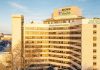
It’s noontime on a 94-degree day, but the waiting room in Our Lady of Fatima Hospital’s emergency department in North Providence is deserted. It’s not for lack of patients – many of the beds in the treatment areas are filled, mostly with older men and women.
But there are no lines, no angry, anxious people wondering if their splitting headache or sharp stomach pain is going to kill them before they get seen.
Building a Strong Data Foundation in the Age of AI
Artificial intelligence (AI) has become a key priority in the boardroom and across management —…
Learn More
You could call it a fluke, but since Fatima revamped its ED in April, the waiting room, which was downsized to only about 15 chairs, has never been full, nurse Belinda Britcliffe said. Nor is the old patient holding area, which was eliminated, missed at all.
This is not how things used to be at Fatima, whose ED treats about 100 patients each day, many of them seniors in North Providence, Johnston, Smithfield and nearby communities. During busy periods, the waiting room would be packed, and the treatment areas inside would be overcrowded, with patients on stretchers in the corridors.
In March, the average wait to see a doctor or nurse practitioner was 81 minutes, said Dr. Emilio Belaval, Fatima’s chief of emergency medicine. Only 37 percent of patients waited less than 30 minutes – even fewer, 32 percent, during the 10 a.m. to 10 p.m. peak time.
Of course people suffering a heart attack or otherwise in urgent need did get cared for more quickly, and the ED’s “fast-track” team also disposed of the minor cases, such as cuts that needed to be bandaged, or ailments that didn’t require any treatment.
But the other 60 percent of patients – the ones who could have appendicitis or just indigestion, a brain tumor or just a migraine – they were the most likely to wait.
For the ones with serious problems, however, the wait could aggravate their condition, Belaval said. Or they could walk out in frustration, without being treated, and not be diagnosed at all.
Belaval, who came to Fatima last year after working at Landmark Medical Center in Woonsocket, set out to change all of this. Emergency-room efficiency is a well-researched topic, and hospitals across the nation – including Landmark, he said – have adopted measures to get patients treated more quickly. Each hospital’s strategies have been different, so Belaval couldn’t just copy a template, but Fatima officials looked at where the unnecessary delays were and worked one by one to eliminate them.
Take registration: Before, walk-in patients would sit with a clerk for as long as 20 minutes, providing detailed information about their insurance coverage, family contacts, etc. Now, with “Quick-Reg,” a greeter with a wireless computer takes just enough information to create an account for the patient. Only at discharge time does the rest of the paperwork get done.
To ensure people don’t just walk out, the ED clerks keep a driver’s license or other document, and they’re the ones who give out prescriptions and discharge papers. They also collect co-payments – something many EDs aren’t equipped to do at all, Belaval said.
The revamped ED also handles radiology and lab work more efficiently, he said. Before, a patient could wait an hour to be taken for an X-ray or blood test, then wait again for the results – all the while taking up a bed that couldn’t be used to treat the next patient in line.
Now, especially during peak times, imaging and lab work are done within minutes and returned right away, Belaval said. There’s also less waste, he said, because while before, a triage nurse might worry that a patient would sit unattended for a couple of hours, so she’d order a test just to make sure nothing was seriously wrong, now doctors are doing a thorough examination and diagnosis soon enough to avoid such concerns.
But the heart of the new system is the six-bed “Patients First” unit, open from 10 a.m. to 10 p.m., which treats all the walk-in patients who are not deemed to be in grave danger as well as ambulance patients who are determined to need only minor treatment.
Unlike the old “fast-track” unit, “Patients First” can handle a range of conditions, so a much larger share of patients can get treated without stepping into the core ED. That keeps more of the ED’s 18 beds open, so a backlog doesn’t build up.
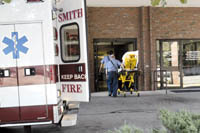
The extra open beds, in turn, allow all patients brought in by ambulance to get a bed right away, Belaval said, rather than waiting on stretchers in the corridors.
Patients First opened on April 18, and by May, the average wait to be seen by a doctor or nurse practitioner had dropped from 81 minutes to 37. Belaval said he hopes to get down to about 22 minutes, but “we’re still in transition.”
The change is already substantial, however. Not only is the waiting room clear, but the ED, even during peak times, is never overcrowded and chaotic, Belaval said. “Now it looks orderly, and that impression is important for patients.”
Because there’s no backlog, and ED traffic tends to come in waves, doctors and nurses work on a different rhythm now, Belaval said, with fast-paced periods followed by time to rest, tidy up and regroup. By his estimate, the ED is saving 78 patient care hours each day.
“You can take some of that time that’s been freed up to practice better medicine,” said Russ Dufresne, a nurse practitioner who works both in Patients First and in the core ED. “You can take an opportunity to build an alliance with the patient.” It’s also more pleasant, he said.
“We see patients who are happier, who haven’t been waiting for hours and are already angry when you see them,” Dufresne said. And rather than treating earaches or indigestion in the core ED, “you’re seeing real emergencies.”
From a business perspective, Fatima sees the improvements as a way to gain market share, Belaval said. Already, the hospital turns away fewer ambulances than its peers, benefiting from others’ overflow during peak times, he said. Soon, he said, he hopes to do no diversions at all, “barring a major disaster” that packs the ED.
Between that and spreading the word about the short wait times, Belaval said, Fatima could boost patient volume from 34,000 to 40,000 per year within the next 18 months.