The opportunity to design large-scale building projects depends on what architect J. Michael Abbott, vice president and principal at Newport Collaborative Architects Inc., calls the “predictability factor,” which in the current recession is as low in Rhode Island as he can remember.
“Anybody that’s getting ready to undertake a four- or five-year project, a big development project, needs a real sense of predictability to the whole thing,” he said last week. “Predictable markets and, on the other end, a predictable financing source” help encourage building and design work.
“Really, nothing is predictable right now,” he said.
When the economy sours, the number of commissions available for architects dwindles and firms tend to flock to stable industries that will keep building regardless of the financial climate. In the past, the old fail-safe in Rhode Island has been higher education institutions, but even universities in Rhode Island have slowed their construction work, Abbott said. “The universities that we were working with put both of our jobs on hold, because their big endowments weren’t so big anymore,” he added. So NCA has skipped university work and is doing a large portion of its work in the current recession on affordable housing.
And as the number of commissions shrinks, designs seem to change, increasingly focusing on simplicity, said Jim Estes, one of the principals of the six-person Estes/Twombly Architects Inc. One of those designs that took a leap toward simplicity was the Watkins House, a two-story Newport home Estes’ firm finished last year. The firm specializes in smaller homes designed around their location and the approximately 2,500-square-foot Watkins House this year won a American Institute of Architects Rhode Island Chapter Merit Award.
The Watkins House’s charm is in its rear, which is largely covered with windows and is a grid of rooms, some fully and others partially enclosed. One semiprivate room is created by a series of clean horizontal flats. And Estes said the small-scale creativity that’s visible in the house is the direction that architecture in Rhode Island is heading, meaning the day of the ornate minimansion likely has ended.
“It’s been a great run for architects these past 10 years or so,” Estes said. “Now, obviously like a lot of other businesses, we’re entering into another phase. It’s going to affect the sort of architecture that you’re going to see. In residential [design] the last 10 years, what you’ve been seeing are these very large, ornate, high-upkeep houses. I think that’s obviously going to change. I think they will become more contemporary, simpler and smaller.”
Abbott added that those lean, creative projects are good news for the industry.
On the other hand, Durkee, Brown, Viveiros & Werenfels Architects Inc. principal Steve Durkee said he doesn’t agree that all designs are simplified by a recession. He puts the decision to go simple in the personal finances and aesthetics of his clients, not in a larger recession-affected trend.
“Whether it’s recession-driven is hard to say. Some owners just want more, period, that’s what they like. And some owners like things to be simple,” he said. “I think what probably drives these decisions more than anything is budget. That’s always the biggest driver.”
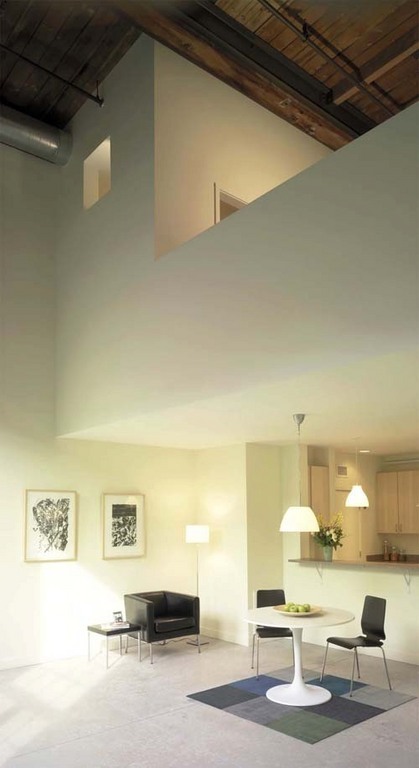
When DBVW designed the Westminster Lofts buildings in Providence, for example, developer Cornish Associates wanted ornate, design-heavy interiors. “And I don’t think that would have been driven by a recession or not,” Durkee said. “It’s all driven by the individual client and what their interests are.”
Of course, saying architects tend to design opulent, inefficient buildings in economic boom times is also a stretch, said Christine Malecki West, an architect with Providence’s William Kite Architects Inc. and the 2009 AIA-RI vice president. Her firm last year was awarded a Merit Award for its work on the School of Architecture, Art & Historic Preservation at Roger Williams University.
Wasting money is never an option, she added. “The real impact of the recession is that projects get put on hold or simply canceled.”
For projects that are moving forward, recently reduced construction costs have actually added some “wiggle room” in the budget and “thus our design options,” Malecki West said. “Contractors are simply putting in very low bids just to stay in business because there’s so little work to go around.”
Durkee added that those lowered construction costs allow for “in some ways, a little bit more than you could get a few months ago or a year ago.” So if an owner were looking for a more elaborate building, it could now be done for less than when the economy was better, he said. Durkee said that some projects, like AS220’s Mercantile Block project in Providence, are going forward. That renovation has gone out to bid for construction contractors, he said.
Dietrich Neumann, a Brown University history of modern architecture and urban studies professor who is a visiting professor at Yale University this semester, isn’t sure there’s a definitive answer on recession-induced simplicity.
“Since simplicity has been the mantra of the modern movement since the 1920s, anyway, one might not always recognize the difference,” he said in an e-mail message.
Durkee said the difference in design preference from firm to firm also makes it difficult to discern whether there have been significant changes in Rhode Island building design in the last year. “This is our firm’s 15th year, and I haven’t really noticed a dramatic change from year to year in architecture design across the state,” he said. “But as new firms come online, you start to see new building designs come on stage.”
One thing Rhode Island architects do seem to agree on, however, is that their job options are shrinking.
“This big limbo-land that we’ve been living in has been a real drag for the industry,” Newport Collaborative’s Abbott said. “I just don’t know where we’re headed. And until we get that clear direction, everybody is just holding back. But the demand is still there, becoming a pent-up demand, and it will burst through eventually.”
DBVW principal Michael Viveiros added that he’s expecting the unemployment rate for architects to skyrocket. It could hit 30 percent in Rhode Island, he said.
“It’s quiet out there,” he said. “About a year ago, every architect, everyone you spoke to, was rushing to the institutions, knowing they had money to spend, projects to move forward with. And I think everybody has heard the news now. And it’s not just Brown University, it’s every major institution. Everybody’s stopped.” •