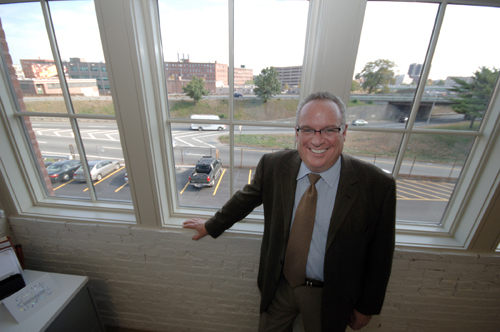
The view from the Rolo Building, Johnson & Wales University’s recently opened student-services building, isn’t so charming right now. From the building’s new glass atrium, there are views of a parking lot and a section of Interstate 195 that will be knocked down by 2012.
But JWU Vice President for Facilities Management Christopher O. Placco has a different vision. Standing in the atrium earlier this month, he detailed the future home of a new quadrangle surrounded by new buildings.
“And then what we’ll want to do is take that large urban space, which is open, and connect it via a series of pedestrian walkways, both internal and external walkways,” to the current quad on Weybosset Street, Placco said. In that way, the school is seeking to create an inclusive, barbell-shaped campus, anchored on either end by quads – one already there and the other planned.
But there’s a large potential snag for the plan: the university doesn’t yet own most of the land where it wants to build the quad.
About four acres eyed by JWU – east of Interstate 95 and south of Pine Street – is part of 19.2 acres that will be freed up when the downtown portion of I-195 is demolished. While the university would like to buy the four acres, a partnership between the city, state and R.I. Department of Transportation has initiated a study to look at best possible uses for the land expected to be freed up.
For both the city and JWU, some future plans for economic development could hinge on the outcome of that study, expected to be completed by the end of the year. Placco said that he has not yet spoken with representatives from Chan Krieger Sieniewicz, the firm chosen to study the possible use, but he hopes to soon. “We’re speculating about property that really doesn’t exist – what parts are public, what parts are private, how many streets are there,” he added.
But Placco said JWU has made a few strategic moves in its quest for the property. One of those was hiring Sasaki Associates Inc., a Watertown, Mass.-based consulting firm, to create its new Campus Master Plan. That firm has worked closely with the Providence Department of Planning and Development, Placco said.
When the highway is removed, downtown and the Jewelry District will be reconnected for the first time in more than 40 years. Providence Preservation Society Executive Director George W. Born said that “re-stitching” that grid will be a major step toward restoring the historical “core” of Providence.
JWU also sees the connection between the two districts as important – the new master plan includes extensions of Claverick Street to bridge the gap, he said. “The city’s plan makes a very strong case to … tie the Jewelry District to downtown in a very physical way – from a circulation, cultural and urban standpoint,” Placco said.
JWU now sits directly between the two districts. Placco described the campus redesign as “consolidating into a central core of the Downcity [campus], creating a true sense of an urban campus rather than a collection of university buildings.”
Since 2001, JWU has been selling off property that doesn’t fit into that model. In 2005, it sold two buildings: the Arcade and the Dreyfus Hotel. It also demolished the Milliken Warehouse Building and moved out of three leased buildings. The school also has emptied the Kinsley Building, at 334 Westminster St., and could soon sell it, Placco said. “It’s an administrative building that didn’t serve us well – didn’t serve our buildings well.”
Even after those reductions, JWU holds a sizable amount of property in Providence.
According to Sasaki’s research, its 18 downtown buildings total about 956,684 square feet. The new plan calls for “a total of nearly 700,000 square feet of new, renovated and replacement,” buildings.
The 17 buildings now on the Harborside campus hold another 934,746 square feet.
Providence values JWU’s property – including several outlying city properties – at $214.9 million, according to tax roll data collected earlier this year by Laurie Brayton, fiscal analyst for the state Senate. That puts JWU third among higher education institutions in terms of the value of land holdings in Providence. The first two are Brown University, with property worth $941.7 million, and Providence College, with property worth $280.4 million.
The university has three other campuses – Miami, Denver and Charlotte – and the two Providence campuses are the largest, with a total of about 10,000 students. It does have outlying property, including a Federal Hill dorm and a hotel and horse farm in Massachusetts.
Because they are such large landowners, those institutions have to update their master plans every five years and have them approved by the Downcity Review Commission, Planning Board and the City Council, all of which have accepted the new JWU plan.
This time JWU has looked further ahead than usual – the university hasn’t put a build-out date on its expansion plans – in an attempt to get permission to buy some of the to-be-freed land, Placco said. The plan isn’t as radically different as it sounds, however. It is largely based on the principles laid down in the early 1990s, when the school worked on a master plan with Andrés Duany, an architect who helped found the neighborhood-based New Urbanism movement in the 1980s.
“Our vision has been consistent since then,” said Placco, who joined JWU six years ago from Providence’s Robinson Green Beretta Corp.
The plan also details future building at the Harborside Campus, off Narragansett Boulevard and adjacent to the Port of Providence, where the culinary school is based and the university owns about 100 acres.
While its Downcity planning is based largely on the constraints of what already exists in the area, the Harborside campus is largely empty and will allow for proactive planning, Placco said. So far, Harborside plans call for lower-impact development, Placco said. Along with building new buildings and sports fields, JWU is cleaning up a 1,500-linear-foot waterfront for public access. “As an urban designer, I’m a firm believer in mixing a lot of different uses on a waterfront,” Placco said.
Aside from that public access, the campus there aims to be more inclusive than the Downcity campus, Placco said.
Overall, in the new 80-page master plan Sasaki calls for about 10 new buildings on each campus. Placco said he doesn’t see any overlapping between JWU and Brown for Jewelry District space, although in late 2006 Brown bought seven buildings about two blocks from where JWU wants to build. “We’re not looking to expand into that area,” Placco said.
While the new plan is a vision of the future, there are no guarantees, Placco says.
“I don’t think it’s possible to predict well beyond 10 years,” he said. “This is our best bet for the direction that we see ourselves going in.” •