fifth term in the House of Representatives.
Congressman defends poor voting record
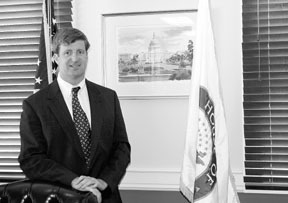
Patrick J. Kennedy
Position: U.S. Representative for the First District of Rhode Island
ISO 9001:2026: A Practical Opportunity to Build for What’s Next
For Rhode Island manufacturers, ISO 9001 has been much more than a certificate on the…
Learn More
Background: At the age of 21, Kennedy unseated a five-term incumbent
in the Rhode Island House of Representatives, where he served until 1994. In
November 1994 he won an open seat in the U.S. House of Representatives. Kennedy
was re-elected in November 2002 to serve a fifth term in Congress. He is a member
of the House Appropriations Committee, which has the authority over all of the
federal government’s discretionary spending.
Education: Bachelor degree in social science from Providence College
Age: 36
Residence: Portsmouth
Q. You’ve often referred to the need to help small businesses. Yet you
only voted in favor of pro-small-business bills 7 percent of the time last year,
according to the National Federation of Independent Business.
A. Irrespective of how I’m measured by a group whose method of measuring is
quite subjective, the fact is that when it comes to Rhode Island small businesses,
I am working as hard as I possibly can to fight for their cause. Not the least
of which, I am on the Appropriations Committee and on the subcommittee that
funds the Small Business Administration. Hence, you see projects like the Mason
Building downtown, which now encompasses a partnership between (Rhode Island
School of Design) and Bryant College, get $2 million each the last two years.
That’s tangible. That’s not casting one vote out of 435. While those votes make
a difference, the direct correlation between what you do on a vote for small
business and what you do directly, tangibly vis-à-vis the appropriations process,
is quite different. The (Rhode Island) Export Assistance Center I have fought
for money on behalf of, and that helps small businesses. I might vote overall
to enforce worker protections or uphold environmental law, which can be regarded
by some as anti-business. The bottom line is when it comes to Rhode Island business,
I am successfully fighting for dollars that help our economy.
Q. Last month the House passed a bill (called the Association of Health
Plans) that would allow small businesses to buy health insurance through national
trade groups. You voted against that bill. What’s wrong with allowing small
businesses to leverage their power to buy health insurance?
A. First let me say what I’m for, and that’s a health system, not a sick-care
system. We’re seeing premiums go up astronomically. Family plans are as high
as $14,000 a year for many businesses. The cost to business of providing health
insurance is astronomical. I believe a good percentage of that is a result of
a system that’s geared more toward taking care of the crisis than it is averting
the crisis. We’re never going to get to that system unless we insure everybody,
because you’re not going to reach everybody to work on prevention, rather than
just emergency care. Everybody is paying, whether they’re paying through the
state or through their own premium. So wouldn’t it make more sense to cover
everybody if we’re going to pay for everyone? That way it would help address
the effectiveness and efficiency of the system. That being my guiding principle,
the Association of Health Plans betrays real reform, because all it does is
try to cherry pick groups to be insured and thereby not change the dynamic that
is leading to these high premiums. No matter how effective you are at carving
out an insurance pool that looks more advantageous to business, the liability
is that you’re by design leaving out this group that’s still going to end up
costing the system. It doesn’t answer the problem. It’s trying to create a short-term
fix.
Q. You’ve made the mental-health parity bill – which would require employers
to extend the same level of benefits – your flagship issue. Business groups
are opposed, and the Congressional Budget Office estimated that the legislation
could add 1 percent to U.S. health care costs, or $23 billion. Do the benefits
really outweigh the costs?
A. Far outweigh. What absenteeism and ‘presenteeism’ – that is, being at work
but basically being absent – what that means to our economy has been calculated
to be devastating. When you look at substance abuse and alcoholism and chronic
diseases – hypertension, obesity, diabetes, cardiovascular disease – we need
to address the root causes of these stress-induced illnesses. It all comes back
to behavioral health, which is not covered by insurance. This all gets back
to that guiding principle in terms of the health care system, which is prevention
and early intervention. It also helps productivity because businesses pay for
all these illnesses through the back door. Quite frankly I expect that the business
community, like in most things, will end up leading the way, because they’re
about the bottom line and saving money and doing what it takes to make a profit.
And I think they’ll see that they’ll do more of those things if they address
these issues.
Q. A federal commission is studying potential military base closures for
2005. What can Rhode Island do to protect its defense industry?
A. Obviously we’ve been benefiting a great deal from the increased defense
spending, which I’ve supported, and obviously we’re very excited about not only
the direct defense spending but the spinoffs from that. I have worked very hard
to aggressively promote the research that’s done in our Naval Undersea Warfare
Center. I think the real crown jewel of our defense establishment here is NUWC,
because it’s the technical center, the seed for future product development.
The core technologies that we have mastered at NUWC in terms of communication
and computation is I think relevant and transferable to any future military
application. And I think the challenge for us is to make that case. Whatever
the criteria is that’s developed for this process, we’ve got to ensure that
it accurately values what we have. We want NUWC staying strong and vibrant here
in Rhode Island, with its associated industrial base intact. I’ve been very
active in this behind the scenes. Believe me, this is a singular priority for
me, in terms of protecting the economic base of my district.
Q. There’s been a lot of talk lately about the Democratic Party having
a real identity problem. What do you see as one or two key issues that could
turn things around for Democrats in 2004?
A. Well I think health care is No. 1, because we’re for bringing some coherence
back to this disjointed and destructive system. I’ve talked about proposals
that have been put forward that would take the Bush tax cuts – the dividend,
capital gains, estate and marginal-income tax cut on the top bracket. That’s
in excess of $3 trillion over the next 10 years. If we take those tax cuts and
… lump them into one tax proposal focused entirely on health care, where you
change the 60 percent employer-based tax deduction into a credit, and even expand
it ultimately to 100 percent. Essentially you’ll have 100 percent writing off
the cost of health care in this country. Basically what that means is the tax
code will pay for all employers’ health care costs. That will make the federal
government the single payer for health care. You take away one of the greatest
impediments to business and their new hiring, and at the same time you cover
everyone in this country. If the argument is not going to be over tax cuts,
but where those tax cuts can best be targeted, then target them to where they
will not only help businesses grow jobs, but they’ll also help workers and families
get the health care they need. I think that will be our touchstone issue.
Q. Earlier this summer you made some news in a speech in Washington when
you said something like, “I have never worked a day in my life.” Was there a
point you were trying to get across, or was it just a lighthearted discussion
with a group of young Democrats that was taken out of context?
A. Well, it was both. The serious nature of it was that I’ve never had to
live paycheck-to-paycheck. I have been given all kinds of advantages. And under
the dividend tax cut, the capital gains tax cut and the estate tax cut, that’s
a trifecta for me. My constituents who work hard paycheck-to-paycheck are not
the real winners under the Bush tax cut, and I think that’s unfair. I think
anyone looking at it objectively would agree with me that, ‘Do the Patrick Kennedys
of the world deserve the tax cuts? Or do the (average workers) at our (textile
mills) or a jewelry manufacturers?’ I think our country is stronger if we incent
meritocracy instead of aristocracy. Bush’s tax proposals … don’t help us fulfill
the American dream, that if you work hard and play by the rules, you win economically.
Rather, the Bush tax proposal, using myself as an example – and all of this
was using myself as an example, because I think it’s poignant – if you’ve inherited
your money and you live off unearned income, you benefit the most by the Bush
tax plan.
Q. Would you ever have any plans to run for Senate?
A. Right now as I said I have a very enviable position in the delegation as
a member of the Appropriations Committee, and I always ran on this notion that
I could do more for the state given my connections. And I feel like I followed
through on that promise by using the advantages I had politically and negotiating
my way onto this very coveted committee. For the last several years I’ve been
producing big dollars to the state, in terms of everything from health care
to education, job training to research and defense spending. If I was in the
minority and not accomplishing what I’m accomplishing now, I imagine it would
be very frustrating. But even though I’m in the minority, I’m still able to
do more than most. So I’m not squirming looking for a place to jump. I’m happy
where I am right now.