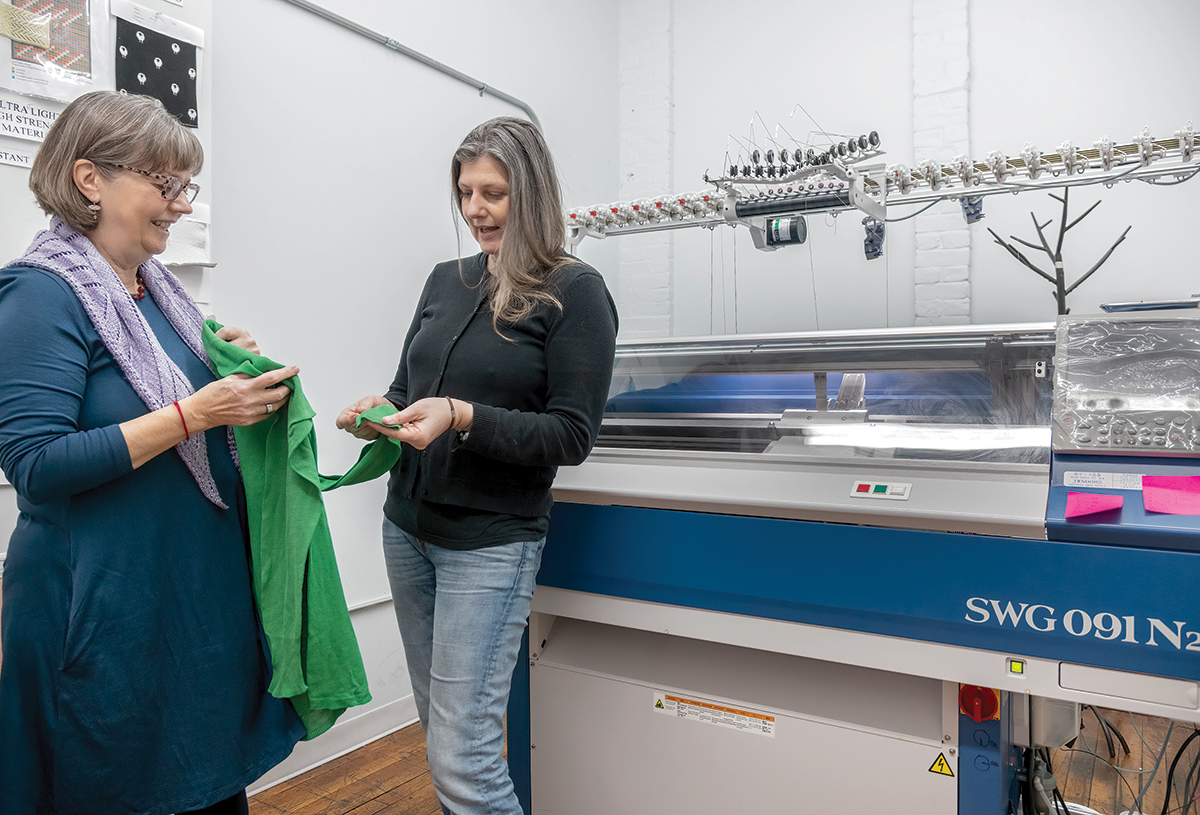
Clare King likes to mix things up.
She sees opportunity in combinations others may not. This might explain why her Pawtucket company, Propel LLC, solves problems by bridging two seemingly unrelated sectors – textile manufacturing and technology.
A London native, King’s undergraduate degree from Oxford University wasn’t in just one major but in a combination of subjects: philosophy, politics and economics. Her graduate degree, from Princeton University’s School of International Affairs in New Jersey, was in public affairs – equipping her for public policy work and economic analysis.
She started Propel – which works mainly with military clients – in 2006.
The company has four employees.
“I like to think I work in economic development in the innovation space. I always say that my Oxford education taught me how to ask questions and my Princeton education taught me how to answer them,” King said. “I use that knowledge to figure out how to attack a problem. There is never one solution.”
Mixing ideas is one thing. But King also knows how to apply those ideas where they will do the most good. When it comes to textiles, she has found a welcome market niche in the military and U.S. fire services.
King has long found opportunities in contract work with the military, such as from 1995 to 2000 when she served as director of sales and marketing for a North Smithfield manufacturer that specialized in films and laminates, and from 2000 to 2006 when she was a sales leader for a major manufacturer where she was responsible for developing opportunities within the military and fire services.
The military is the single largest customer of U.S. textiles, according to King. “If a soldier is wearing wool clothing, it has to not only be manufactured in the U.S. but made from fiber from sheep that were raised eating grass here in the U.S.,” she said, for national security reasons.
Both of these professional roles, paired with the analytical and research skills provided by her education, helped set King up for Propel’s formation. Starting her own company has allowed her freedom to explore and pursue work she deems as profitable or interesting, in a market where she sees great promise.
Propel’s team, skilled in textile materials, processes and technology, formulates solutions to problems from conceptualization to manufacturing.
Contracted work includes research for Smart Textiles, which sense and react to environmental conditions or stimuli from electrical, thermal or other sources, such as self-activated, heated footwear for the Department of Defense, as well as advanced cold-weather clothing.
Propel’s Damage Control Steam Suit – protective gear for emergency responders handling steam-line leaks aboard U.S. nuclear submarines – is significant in part for its design capability to fit anyone from 5-foot-2 to 6-foot-4. Propel designed an innovative, self-adjusting fit system that can adjust to a person of almost any size.
But while her economic training leads her, King says she also operates on instinct.
She is constantly referencing Propel’s profit-and-loss statement to see where the company spends its money and time. “Not a week goes by that I don’t look at it, and see where we are placing our efforts,” she said. “Everything is in the numbers.
“But I also run the business in an eccentric way and take on projects that might interest us, not the ones that result in the most dollars,” she said.
Case in point: Her purchase of a 3D knitting machine a few years ago – a $160,000 investment. “I hired a woman trained in coding” to operate it, King said. “It was a leap of faith.”
3D knitting creates seamless garments without the need for sewing or cutting. This eliminates wasted fabric and the need to keep inventory, and cuts carbon emissions and energy usage. King says 3D knitting is showing even more promise with pandemic supply chain issues and the war in Ukraine prompting more U.S. companies to consider purchasing domestic products.
Propel is now using the machine to make a U.S. Navy carrier flight deck jersey in a women’s fit for the first time. “We are looking at fibers for the first time, too, to see if we can make it more affordable. Can we change the manufacturing timeline with 3D knitting? That reduces the cost component and that’s where my economic training comes in,” King said.
King says 3D knitting could transform the industry, with electronic components previously knit into garments having a shorter lifespan than what 3D knitting offers.
She’s excited. She said many people are unaware of the difference between knit and woven fabrics, never mind the capabilities and complexities of textiles.
As for future Propel projects?
“They aren’t all just clothes. All are [under nondisclosure agreements], so I can’t tell you,” King said. “But some even blew my mind.”