The business model for acute care hospitals in Rhode Island is changing, moving from a model of inpatient care tied to geographic location to a more nimble system revolving around outpatient services, patient-centered medical homes and an online electronic resource network.
It’s a transition akin to neighborhood video rental stores being replaced by subscriber-based, online networks.
The pending sale of Landmark Medical Center in Woonsocket – four for-profit, out-of-state companies have submitted bids that will be reviewed April 14 and April 15 by Superior Court Judge Michael A. Silverstein – is symptomatic of larger structural changes now underway in the delivery of health care by Rhode Island’s hospitals.
There is general consensus among Rhode Island stakeholders – hospitals large and small, legislators, health insurers, public health officials and physicians – that the current system is unsustainable.
But, the fact remains that hospitals are big business in Rhode Island – accounting for $6.3 billion in annual economic activity, as well as 5 percent of the state’s private sector employment and 10 percent of the private sector payroll.
“To continue to attract jobs to and keep families in our state, we must have high-quality health care providers and services,” said Edward J. Quinlan, president of the Hospital Association of Rhode Island.
The findings and recommendations of the R.I. Special Senate Commission To Study Cost Containment, Efficiency, and Transparency in the Delivery of Quality Patient Care and Access to Hospitals, released March 23, offer a first step in how best to move forward.
Among the key trends and structural changes identified by the commission were:
• The business model for acute care hospitals in Rhode Island is moving away from inpatient to outpatient services; outpatient services today provide about 55 percent of hospital revenues, and that ratio is expected to increase.
• New payment methodologies are replacing the current fee-for-service business model of reimbursement in Rhode Island, spurred on in part by the new contract conditions imposed by the health insurance commissioner in July 2010 and by changes in Medicare and Medicaid.
The full transition away from fee-for-service payments in Rhode Island may soon be expedited by new legislation, based on the recommendations by the Senate commission. The proposal would, beginning in March 2012, require that “insurance contracts with hospitals and physicians include an optional, alternative payment structure beyond fee-for service, such as global payments or bundled payments.”
• The market leverage that Rhode Island’s largest hospital systems have in negotiating larger payments from commercial insurers, often at the expense of smaller, independent hospitals, is being challenged on a number of fronts.
“The commission was an effort to look at hospitals in Rhode Island as a system, rather than hospitals as separate entities,” said Sen. Joshua Miller, D-Cranston, chairman of the 17-member commission.
Health Insurance Commissioner Christopher F. Koller, one of 17 commission members, said one of the most important outcomes was the consensus that “the current system is unsustainable.” The solutions, Koller continued, “are going to get harder to achieve, because they’re going to require compromise and change.”
In the courts, Landmark Medical Center filed a lawsuit seeking injunctive relief and damages, charging that the inequity of payments by Blue Cross & Blue Shield of Rhode Island was responsible in part for its fiscal difficulties.
There is also talk about legislation to provide more capability for the R.I. health insurance commissioner to review, amend, approve or decline contracts between hospitals and insurers if they did not include fair and comparable rates.
“One of the unfair things that’s happening now,” Miller said, “is that negotiations are being done privately when there is a strong public interest and public dollars involved in how hospitals are reimbursed by insurance companies.”
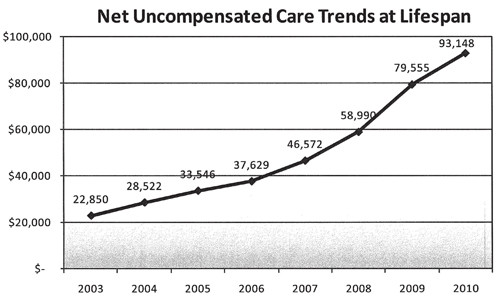
Not every commission member voiced agreement. Lifespan, represented by Mark Montella, senior vice president of external affairs, voiced concern about the ability of Lifespan to maintain its academic and research infrastructure that benefits the economic revitalization of the state.
Still, Montella praised the commission’s efforts. “The longer we continue to talk about the difficult issues that we have to face … the greater the opportunity to arrive at a consensus about [reaching] affordability, sustainability, and allowing for health insurance premiums to be stabilized,” Montella said. •
The Senate commission report is
available online at
www.rilin.state.ri.us/SpecialReports.
ISO 9001:2026: A Practical Opportunity to Build for What’s Next
For Rhode Island manufacturers, ISO 9001 has been much more than a certificate on the…
Learn More